Remember the good old days when “Shadow IT” was just about rogue Excel spreadsheets and unauthorized Dropbox accounts? But the times they are a-changing! Now we’re dealing with something far more insidious: Shadow AI. And no, it’s not just lurking in the corners of your or anyone’s organization anymore. Now, it’s driving productivity gains while simultaneously creating security nightmares that, hopefully, keep CISOs wide awake at night.

From private drives to GPT instances

Shadow IT has been the bane of enterprise administrators’ existence for decades. We’ve all seen it: marketing teams building up their own CRM systems, sales departments hoarding customer data in personal cloud drives, and finance teams creating elaborate Excel macros that, unnoticed, somehow have become mission-critical applications. But nowadays we have Shadow IT on AI steroids.

Because instead of innocent unauthorized OneDrive instances, we have unauthorized ChatGPT accounts, private Perplexity subscriptions, custom Copilots, and Excel automation scripts integrated with GPT APIs. And they ALL operate completely outside of IT oversight.

As many experts repeat: shadow IT hasn’t disappeared – it has evolved. And artificial intelligence has given it turbocharged engine.

The staggering scale of unauthorized AI adoption

IDC’s Global Employee Survey from April 2025 reveals that 39% of EMEA employees are using free AI tools at work, another 17% use AI tools they privately pay for. Only 23% of employees declare they use AI tools provided by their organization, and it still does not mean they are not using private tools simultaneously. Another survey I’ve come across shows that 52% of workers won’t admit to using AI in their jobs. And the percentage of sensitive corporate data being fed into AI tools has skyrocketed from a not insignificant 10% to over 25% in just one year.

Why are these numbers so high? The answer is frustratingly simple: on a basic level, AI can be ridiculously easy to use. You need a browser, a prompt, and you’re done. No coding, no server configuration, no IT tickets that sit in queues. Just pure, immediate productivity enhancement. Maybe with a bit of compliance catastrophe on the side, but who’s looking?

March or die

However, let’s be brutally honest about why else these numbers are so high. Employees aren’t just using AI tools to work smarter – they’re often using them to survive increasingly unreasonable workplace expectations. In an era where headlines scream about companies replacing entire departments with AI, workers are fighting hard to prove their relevance.

The pressure is palpable and justified. When employees read about firms cutting 30% of their workforce while boasting about AI-driven efficiency gains, the message is clear: march or die. Shadow AI adoption isn’t just about productivity enhancement, more than anything it can be about professional self-preservation.

This creates a weird dynamic where the very people organizations depend on feel compelled to hide the tools that make them valuable. Are they being rebellious or just rational? When your job security depends on meeting targets that seem designed for superhuman capabilities, you’ll probably use whatever tools necessary to achieve them, authorized or not.

Most AI tools don’t require dedicated client applications. They operate seamlessly through web browsers or as mobile apps, making them almost invisible to traditional IT monitoring systems. The vast majority of ChatGPT, Google Gemini or other tools usage at work happens through non-corporate accounts, meaning corporate data or IP is being processed by AI models that organizations have zero visibility into, zero control over, and zero ability to audit.

How pursuit of productivity kills strategic AI adoption

Many organizations, in their relentless pursuit of productivity metrics and efficiency gains, are creating an environment where employees feel compelled to hide their AI usage to meet impossible expectations. This creates a vicious circle where leadership demands productivity improvements while threatening job cuts, employees discover AI tools that help them meet unrealistic expectations, IT blocks access, so employees use unauthorized tools to avoid becoming the next layoff statistic.

The result? Organizations end up with lower overall AI adoption rates than they could achieve, precisely because they created a fear-based environment where survival instinct eats strategy for breakfast. Define irony: companies that publicly celebrate AI’s potential to replace human workers are simultaneously frustrated by their inability to achieve coordinated, strategic AI implementation.

The education paradox or one-time is here to fail you

And here’s where most organizations spectacularly miss the mark. They roll out a single “AI Awareness” training session, check the compliance box, and wonder why employees still go rogue.

Basic communication theory tells us that people need to hear a message seven times before it truly registers. Yet organizations treat AI education like a software update: deploy once, assume adoption. The learning curve for responsible AI usage isn’t a gentle slope. Or maybe gentle but the road will be long and winding. Employees need ongoing, contextual education that evolves with the changing AI landscape. They need to understand not just the “what” and “how,” but the “why” behind AI governance policies. (And you need AI governance, do we even need to say that?) When people understand the reasoning behind restrictions, compliance rates soar. When they don’t, Shadow Everything thrives.

Smart organizations recognize that AI literacy requires sustained and strategically planned education programs. They build comprehensive learning pathways that revisit core concepts with increasing depth over time, ensuring employees develop genuine understanding rather than superficial compliance. This investment isn’t just about risk mitigation – it’s about creating a workforce capable of strategic, responsible AI adoption.

Hope for the transparency solution? BYOAI!

The IEEE Computer Society proposes a solution that might make traditional IT nervous: BYOAI (Bring Your Own AI). This approach emphasizes transparency, risk assessment, and responsibility while allowing employees to work with their preferred AI tools.

The concept acknowledges a fundamental truth that many organizations refuse to face, although they should have learnt already: you can’t stop Shadow AI, or anything else for that matter, adoption through prohibition. Prohibition will only drive it deeper underground, where it becomes even more dangerous. Think about Chicago, Valentine’s Day, circa 1929, So if a ban is not the answer, then what? The easiest, yet most reliable, way to mitigate risk is good old, albeit boring, education…

Embrace reality, manage risk

Shadow AI isn’t going away. The productivity gains are too compelling, the tools are too accessible, and the competitive pressure too intense. Organizations have two choices: build frameworks for managing Shadow AI or watch it manage them.

What will smart companies do?

  • Invest heavily in ongoing employee AI education (not one-shot training)
  • Create transparent AI governance frameworks
  • Design security policies that enable rather than restrict innovation
  • Build trust through collaboration rather than control
  • Measure success by strategic AI adoption, not just productivity metrics

The question isn’t whether Shadow AI is a threat or an opportunity – it’s whether your organization will respond with wisdom or wishful thinking. Choose wisely!

Listen back to Ewa on the following webcast: AI in 2025: Deliver or Wither

To learn more about how International Data Corporation (IDC) can support your technology market data needs, please contact us.

Ewa Zborowska - Research Director, AI, Europe - IDC

Ewa Zborowska is an experienced technology professional with 25 years of expertise in the European IT industry. Since 2003, she has been a member of the IDC team, based in Warsaw, researching IT services markets. In 2018, she joined the European team with a specific emphasis on cloud and AI. Ewa is currently the lead analyst for IDC’s European Artificial Intelligence Innovations and Strategies CIS.

Tech leaders are under more pressure than ever – not just to make strategic decisions, but to prove they’re the right ones.

Across industries, organizations are rethinking every tool, every vendor, and every dollar spent. It’s not just about cutting costs. It’s about improving performance, aligning to evolving business needs, and unlocking long-term value. Boards want results. CFOs want savings. And teams want tools that support how they work today – not five years ago.

Renewals are approaching fast. But too often, platforms are re-signed without a meaningful evaluation of whether they still deliver. Legacy systems linger out of inertia. Duplicative solutions quietly drain budget. And leaders are left accountable for platforms that no longer fit.

But some CIOs are changing the narrative.

Instead of reacting to budget pressure, they’re using it as an opportunity to lead. They’re consolidating redundant vendors, replacing lagging platforms, and establishing a consistent way to evaluate what’s truly worth keeping and what’s not. Most importantly, they’re aligning these decisions across IT, procurement, finance, and business teams – so every move is backed by data, not just instinct.

They’re asking questions like:

  • “Which systems are actually earning their keep?”
  • “What could we consolidate to save time and money?”
  • “Where are we overpaying for tools that no longer align?

They’re replacing reactive renewals with strategic choices and it’s having real impact. When every dollar counts, tech leaders need more than instincts. They need insight.


Introducing the IDC Tech Leadership Transformation Series

To make this path easier, IDC created the Tech Leadership Transformation Series: two complimentary executive guides that work together as a practical, step-by-step playbook.

Part One helps you reassess and reprioritize your tech investments.
Part Two helps you optimize renewals, streamline decisions, and deliver measurable ROI from every platform in your stack.

Whether you download one or both, they’re designed to help tech leaders simplify renewals, cut waste, and align every decision to business impact.

This series is grounded in IDC’s decades-long commitment to helping technology leaders make data-driven decisions with clarity and confidence. Whether you download one or both, they’re designed to help tech leaders simplify renewals, cut waste, and align every decision to business impact.

Part 1: Prioritize to Lead

Start with a strategy. This guide gives you a structured framework to realign your tech investments with current business goals, identify friction points, and zero in on areas where legacy tools no longer serve your future.


Part 2: Do More With Every Tech Dollar

Now, execute. This second guide helps you turn strategy into action by providing practical ways to optimize renewals, reduce vendor sprawl, and prove ROI from every sourcing decision.

Together, these guides help tech leaders:

  • Evaluate platforms based on real outcomes, not assumptions
  • Cut costs without compromising business needs
  • Align IT, procurement, and finance around shared KPIs
  • Simplify vendor portfolios to increase agility and speed

Be the Tech Leader Who Sees the Whole Picture

Happy middle aged business man ceo wearing suit standing in office using digital tablet. Smiling mature businessman professional executive manager looking away thinking working on tech device.

2025 is shaping up to be a defining year for tech leadership. The margin for error is shrinking. Budgets are tighter. Expectations are higher. And the pressure to deliver ROI is real.

Yet many organizations still approach renewals and replacement decisions without a clear process – relying on legacy contracts, internal politics, or guesswork. The result? Wasted spend. Underperformance. Missed opportunities.

When tech leaders stop defaulting to renewals and start demanding results, everything shifts.

Spend becomes more strategic. Renewals become opportunities to optimize, not obligations to maintain the status quo. Platform decisions start reflecting where the business is going, not where it’s already been.

We’ve seen it firsthand:
• IT leaders consolidating overlapping tools and freeing up budget to invest in innovation
• Cross-functional teams making faster, smarter sourcing calls using shared benchmarks
• CIOs walking into board meetings with defensible ROI narratives and walking out with stronger support

The pressure hasn’t gone away. If anything, it’s growing. But leaders who embrace this approach are meeting that pressure with clarity and control.

The strongest tech leaders aren’t reacting to budget cuts, internal politics, or renewal dates. They’re driving the conversation. And they’re building tech portfolios that are leaner, stronger, and better aligned to the business.


The Best Leaders See and Seize the Bigger Opportunity

Presentation, training and workshop with a senior manager, leader or CEO coaching and teaching staff during a meeting in the boardroom. Boss talking to colleagues about the company vision and mission

The most effective tech leaders don’t just navigate change. They lead it with conviction. They don’t default to what’s familiar. They challenge it. And in a time defined by complexity, compression, and change, they know instinct isn’t enough. Clarity is what sets them apart.

But clarity takes the right tools.

AMAROK, a fast-scaling perimeter security provider, found themselves at a critical crossroads as they faced a high-stakes ERP replacement in the middle of business transformation. Like many IT teams, they were managing rising costs, mounting complexity, and pressure to act fast. We see this pattern across industries: smart teams stuck in slow, manual cycles, burdened by disconnected insights and consultant-heavy processes.

What changed the game for AMAROK was IDC TechMatch.

Instead of five weeks of spreadsheets and siloed interviews, AMAROK used IDC TechMatch to model scenarios in real time, reprioritize requirements as they aligned stakeholders, and take control of the evaluation process with trusted IDC data guiding every step. The result? A confident, defensible ERP decision and a 387% ROI from the evaluation process alone.

More importantly, they walked into leadership conversations equipped with answers. They could explain “why this, not that” with confidence, align their decision with business outcomes, and accelerate executive buy-in without guesswork or delays.

AMAROK’s story is one we’ve seen again and again. When you match strong leadership with the right platform, transformation gets faster, smarter, and easier to justify.

Because that’s what today demands. In the Tech Reset Era, it’s not just about managing renewals or reducing spend. It’s about building a stack that supports the future of your business, not the past.

The Tech Leadership Transformation Series is your starting point. These two executive guides walk you through how to assess, realign, and act with clarity, giving you a practical path to simplify renewals, replace what no longer fits, and do more with every tech dollar. Download both guides. Then see how IDC TechMatch helps you go further and faster, with the visibility and confidence to lead what’s next.

In today’s global economy, tariffs significantly shape various markets, including the used smartphone market. When governments impose tariffs on imported goods, they directly affect supply chains, pricing structures, and consumer behavior. IDC will examine tariffs, their impact on the secondary phone market, and what this means for consumers and sellers.

Price Increases and Market Dynamics:  

The most immediate and undeniable effect of tariffs on the used smartphone market is the potential for significant price increases. When tariffs are imposed on new smartphones, the cost of these devices rises. Consequently, consumers turn to the used smartphone market in search of more affordable alternatives. However, this shift results in increased demand for used devices, which in turn drives up prices in that market. Sellers take advantage of this heightened demand by raising their prices. As a result, tariffs intended to protect domestic industries often backfire, making used smartphones less affordable for consumers.

Supply Chain Complications

Tariffs disrupt the complex supply chains that are essential for distributing used smartphones. Most used devices come from networks that include trade-in programs, resellers, and refurbishment centers, all of which rely heavily on new devices for parts and support. As tariffs raise the cost of importing these vital components, bottlenecks occur, causing delays in repairs and refurbishments. This ultimately decreases the availability of quality used smartphones. Furthermore, the complexities introduced by tariffs may lead resellers to limit their inventory or focus solely on local markets. As a result, the variety of available used devices diminishes, frustrating consumers who are looking for specific models or brands.

Consumer Behavior Shifts

As prices continue to rise and availability declines, consumer behavior changes significantly. Buyers become more cautious, often opting to keep their devices longer instead of upgrading frequently. This trend can lengthen the lifespan of smartphones and negatively affect resale values, making it challenging for sellers to maintain their pricing. Additionally, the uncertainty surrounding tariffs leads consumers to delay purchases, hoping for better prices or availability in the future. This behavior results in fluctuating demand cycles, contributing to market volatility.

Environmental Impact

It is essential to recognize that tariff-induced changes can also impact the environment. Electronic waste may decrease when consumers keep their devices longer and turn to the used smartphone market. By extending the lifespan of these devices, we can adopt a more sustainable approach to technology consumption, which helps slow the ongoing cycle of new manufacturing and disposal.

Conclusion

The impact of tariffs on the used smartphone market underscores the complex relationship between government policy and consumer behavior. While tariffs aim to strengthen domestic industries, they often produce contrary results, pushing prices higher, disrupting supply chains, and altering consumer purchasing habits. Remaining informed about tariff policies is essential for buyers and sellers in the used smartphone market. Navigating this evolving landscape demands adaptability, awareness, and a solid perception of used and new markets. Understanding these complex dynamics prepares consumers to make informed decisions and promotes a more sustainable approach when buying a new device. Whether embracing the used market or extending refresh cycles, clear opportunities remain to lessen the adverse effects on current and new potential tariffs moving forward.

Anthony Scarsella - Data & Analytics Director - IDC

Anthony Scarsella is a Research Director with IDC'S Mobile Phone research team. Mr. Scarsella is responsible for researching, synthesizing, and analyzing data on the U.S. and worldwide mobile phone market for IDC's Worldwide Quarterly Mobile Phone Tracker and the Mobile Phone CIS subscription service. Mr. Scarsella incorporates his expertise and experience to establish a quantitative and qualitative view of the mobile phone market. He also leads IDC's research on the secondary smartphone market, including sizing and forecasting, used mobile phones worldwide.

(Editor’s note: This is the second of a two-part series on AI centers of excellence. Part 1 covers the benefits of an AI COE and how to measure its performance.)

Many organizations are racing to adopt artificial intelligence in the hope of creating new business efficiencies, gaining competitive advantages, and boosting the bottom line. But a recent survey finds that most organizations face a series of challenges before they can reap benefits from those investments.

For instance, IDC’s July 2024 Future Enterprise Resiliency and Spending Survey found that 26% of respondents had already introduced several GenAI-enhanced applications or services into production, up from 17% of respondents in a similar IDC study in April. Common challenges slowing down GenAI deployments include securing private information, preventing hallucinations, controlling costs, as well as how best to monitor and manage GenAI applications in production (GenAI Operations: A Guide to People, Process, and Tool Requirements, IDC #US52781824, December 2024).

“Using AI and, more specifically, GenAI has become an all-encompassing strategic initiative for business — but it’s not yet clearly defined,” says Jason Hardy, CTO of AI at Hitachi Vantara.

That fact is inspiring some organizations to develop AI centers of excellence (COEs). The goals are to better understand AI capabilities, to align AI initiatives with broader organizational strategy and ethics, to build internal trust and external credibility, and to put governance and guardrails in place early in the process, explains Richard Buractaon, head of artificial intelligence at Andesite AI, an AI architecture firm based in McLean, Virginia.

“An AI center of excellence helps cut through the noise. Its role is to educate, dispel myths, and ground AI initiatives in reality,” Buractaon says.

Using the COE to Spread AI Knowledge in the Organization

Because widespread interest in AI is still fairly recent, there is a supply-and-demand gap for experienced AI professionals. An AI COE can help bridge this gap by gathering top employees from throughout the organization to work together in a new team, share expertise, and then bring newly gained knowledge and culture back to their original units.

For this reason, it is important that the “right” employees are assigned to an AI COE, which is expected to provide a community of practitioners who can share knowledge, expertise, and best practices in AI and related technologies, says Rick Torzynski, senior data and AI engineer and product architect at ECS, a leading provider of cloud, cybersecurity, AI, machine learning, and IT modernization services in Fairfax, Virginia.

“The COE should generate excitement and interest in AI and related knowledge domains, encouraging employees to learn and explore new technologies,” Torzynski explains. “The COE should also provide training and development opportunities for employees, enabling them to acquire the skills and expertise needed to work with AI and related technologies.”

Experiences and Skills Wanted with Team Members

When HItachi Vantara builds out an AI COE team, it taps a mix of disciplines and backgrounds, Hardy says. “On the tech side, think data scientists, AI engineers, and machine learning gurus — the people who can wrangle the data, build the models, and actually get these AI algorithms up and running.”

But it’s not just technical expertise that is important when it comes to staffing the COE, Hardy says.

“We also need business leaders and execs from the different departments that’ll be using AI — bringing the real-world know-how and making sure our AI projects actually solve business problems. And of course, we can’t forget the IT and cybersecurity crew who are crucial to making sure everything integrates smoothly and stays secure.”

Across the board, everyone on a successful COE team needs to be a good communicator, a team player, a solid problem solver, and someone who’s always up for learning new things, he explains. That’s what really drives innovation and gets AI adopted across the organization.

Job Roles Commonly Found in an AI COE

There are several specific job roles typically assigned to an AI COE, Torzynski says. They include:

  • Data scientists, with a background in data science, machine learning, and statistics
  • Software engineers, with a background in software engineering, computer science, and programming languages
  • Business analysts, with a background in business analysis, operations research, and management science
  • Subject matter experts, with a strong understanding of the AI knowledge domain and its applications
  • Project managers, with a background in project management, agile methodologies, and scrum

Certain technology and business skills should also be included in the makeup of any AI COE, though not every member must possess them all, Torzynski explains.

Essential skills in the team include a strong understanding of the AI knowledge domain and its applications; a solid foundation in programming languages, data structures, and software development methodologies; the ability to analyze complex problems, identify patterns, and make data-driven decisions; the ability to communicate effectively with both technical and non-technical stakeholders; and the ability to work collaboratively with cross-functional teams and stakeholders.

“The COE’s team composition requires talent density in full-stack AI (machine learning, generative AI, deep learning and systems development life-cycle experts), domain fluency, and a flair for entrepreneurial mindset,” says Adnan Masood, chief AI architect at UST, a provider of digital technology and IT transformation services based in Aliso Viejo, California.

“We hire data strategists who appreciate how liquidity risk or M&A synergies intersect with quantitative modeling. We recruit engineers who can pivot to mission requirements at scale. We rely on AI-savvy project managers who spur iterative prototyping and keep strategic bet decisions on track.”

As to personal traits that will serve an AI COE well, Torzynski cites the following: a passion for learning and staying up-to-date with the latest AI trends and technologies; eagerness to work with cutting-edge technology and willingness to experiment and innovate; an ability to communicate effectively with both technical and non-technical stakeholders; adaptability to changing requirements and priorities; and the ability to think creatively and come up with innovative solutions to complex problems.

Qualities and Capabilities Wanted in AI OCE Team Leaders

Ideal leaders for AI COEs should have significant leadership capital and a vision-to-execution mindset, Masood explains. These individuals are often a chief AI officer or data-centric executive who practices radical candor and spurs creativity.

Leadership stamina is non-negotiable, since the COE’s arc extends from short-term projects to broad-stroke transformation blueprints, Masood says. They manage change while forging institutional legitimacy around data-driven decision-making.

Further, ideal leaders for an AI COE are visionary individuals with a strong understanding of both AI technologies and business strategy, Hardy says. They should typically have a proven track record of leading successful AI projects and building cross-functional teams. As such, they need to be influential and collaborative, capable of fostering a culture of innovation and knowledge sharing.

Also: “It goes without saying, but I’ll go ahead and say it anyway to be clear: Leaders should be adaptable and resilient, given the rapidly evolving nature of the AI field, and possess strong ethical considerations regarding AI implementation,” he explains.

By getting the team makeup and leadership right, one of the most significant benefits of an AI COE is that it can help create a company culture of creativity and innovation, Torzynski says.

“By bringing together experts from different departments and providing them with the resources and support they need, COEs can foster a culture of collaboration, experimentation, and risk-taking. This can lead to the development of new and innovative products, services, and processes that can help the company stay ahead of the competition.”

By following these lessons and adapting them to their own organization’s needs, companies can create a successful AI COE that drives innovation and growth, Torzynski says.

David Weldon - Research Adjunct - IDC

David Weldon is an adjunct research advisor with IDC's IT Executive programs, focusing on IT business, digital transformation, data management and artificial intelligence. He has extensive experience as a research analyst and as a business and technology journalist. His special concentrations are in the areas of technology, business and finance, education, healthcare, and workforce management. David started his national-level journalism career at IDG's Computerworld, a sister publication to IDC. He began as a features editor working on the Management section, covering topics of interest to chief information officers and other IT executives. He then took over Careers coverage and handled most of the editorial research projects for the publication. Computerworld's Careers section won several journalism awards and was the leading source of insights and advice on careers in information technology.

The technology landscape across Europe, Middle East, and Africa (EMEA) is changing rapidly in 2025, with innovations actively reshaping industries and creating new business opportunities.

The Emerging Tech Radar: Current Market Drivers 

The EMEA region’s technology environment encompasses a diverse range of emerging technologies at various maturity stages. Organizations demonstrate different levels of readiness and capability in adopting these technologies. Across EMEA, IDC observes technology gaps between industries and individual countries, highlighting variations in economic, financial and R&D power, and maturity.

These variations exist because countries and industries across EMEA differ in economic strength, investment levels, regulatory environments, and access to skilled talent, all of which impact their ability to adopt and develop new technologies. And as these technologies evolve, new trends are emerging.

Critical Topics Shaping EMEA’s Tech Conversation in 2025

1.     Quantum Computing’s Regional Applications

The state of quantum computing in EMEA reveals how this technology is moving from theoretical to practical applications across various sectors. Quantum computing in the region is rapidly advancing from theory to real-world use, with pilot quantum computers now integrated into supercomputing centers to tackle complex challenges in fields like drug design, supply chain management, and financial modeling.

2.     Tech Maturity Assessment

Organizations are evaluating adoption versus maturity, making critical assessments of emerging technologies and market readiness to guide implementation decisions. Structured maturity models and cross-functional assessments are essential to benchmark their current capabilities, identify gaps, and align technology adoption with business objectives and market readiness.

3.     Change Forecast: 2025–2030

The projected disruptions from emerging technologies over the next five years will reshape how businesses operate and compete in the EMEA region. From AI integration into virtual worlds, to European quantum computing centers, space initiatives, and next-generation batteries, the next five years are crucial for the region’s global competitiveness.

4.     GenAI as a Technology Catalyst 

GenAI is accelerating the development and adoption of other emerging technologies, creating and opening exciting new pathways to innovation for organizations. Its ability to rapidly generate code, simulate complex scenarios, and automate content creation is streamlining R&D processes and enabling faster prototyping across industries.

5.     Digital Natives Drive Innovation

Digital-first businesses, with their deep integration of technology and agile operating models, are often at the forefront of implementing emerging technologies and developing innovative use cases that set industry standards. Their ability to rapidly experiment, scale solutions, and leverage data-driven insights enables them to act as key partners and leaders in digital transformation initiatives across sectors.

6.     Investment Patterns Reveal Priorities

Current investment plans for 2025 and beyond highlight that emerging technologies are attracting capital and organizational focus across EMEA. Investments are supported by significant public and private funding initiatives, such as venture capital for deep tech and government-backed projects in clean energy, digital infrastructure, and advanced manufacturing, all aimed at boosting competitiveness and technological leadership across sectors.

7.     Beyond AI: Work Transformation by 2030

Five specific emerging technologies beyond AI are positioned to reshape how work happens by the end of the decade, enabling new forms of collaboration, automation, and real-time data exchange. The focus will be on streamlining secure transactions and digital identity management, creating immersive training and remote work environments, automating logistics and manufacturing, and supporting seamless connectivity for smart workplaces and IoT-driven operations.

Driving Adoption Through Measurable Results

Organizations across EMEA are adopting these technologies for specific business outcomes. Successful implementations connect directly to KPI improvements, with clear links between technology adoption and business performance metrics. Adoption barriers include challenges that limit EMEA organizations’ ability to implement emerging technologies effectively.

Technology Integration Benefits

Companies that combine multiple emerging technologies report stronger results than those implementing isolated solutions. The combination approach generates meaningful synergies across business processes.

The technical foundation is crucial. Organizations need the right technology backbone to exploit emerging technologies and generate maximum value.

What This Means for Your Business 

These emerging technological trends and their practical applications will influence your organization’s market position in 2025 and beyond. Understanding the key applications and use cases driving technology demand can help position your organization to capitalize on these developments as they mature.

The question isn’t whether these technologies will transform business — it’s how prepared your organization is to adapt to them. 

Did You Know?

IDC analysts are continuously monitoring and identifying emerging technologies through our Continuous Information Services. This resource empowers organizations to make informed decisions by providing comprehensive analyses, forecasts, and strategic guidance at the global, regional, and country levels.

To learn more about how our experts can assist you, feel free to reach out!

Lapo Fioretti - Senior Research Analyst - IDC

Lapo Fioretti is a Senior Research analyst in IDC Digital Business Research Group, leading the European Emerging Technologies Strategies research. In his role, he advises ICT players on how European organizations leverage new technologies to create business value and achieve growth and analyzes the development and impact of emerging trends on the markets. Fioretti also co-leads the IDC Worldwide MacroTech Research program, focused on the intertwined connection between the Economical and Digital worlds - analyzing the impact key MacroEconomic factors have on the digital landscape and viceversa, how technologies are impacting economies around the world.

With AI poised to reinvent how businesses operate, the stock market experiencing major swings, and geopolitical tensions growing, we can’t seem to shake “unprecedented times”.

Today, leaders are expected to move faster, while at the same time, making more informed decisions. They are juggling a delicate balance, embracing the best of technology with the best of humanity to transform their business for an AI world.

Earlier this year, IDC conducted our annual CEO Study including 419 CEOs and 15 in-depth CEO interviews. We explored business priorities, risks, approach to AI, technology priorities, and vendor perceptions.

Based on our research, there are 5 pillars of the 2025 CEO Tech Agenda.

1) Embrace the AI-Fueled Business

In our survey, we asked CEOs to select which word their company needs to focus on to thrive in 2025. The response acts as a pulse check for business sentiment. This year the word Innovation rose above the rest, underscoring the bold vision CEOs are carrying, anchored by the value proposition of AI technology. 

The AI-Fueled business is built on the shoulders of digital business transformation. Year- over-year comparison shows that CEOs continue to grow their expectation on the proportion of revenue to come from digital products, services, and experiences. AI can be an accelerator for this transformation. Data shows CEOs are keen to use AI for reinvention, with over half stating they think AI will offer their organization a chance to reinvent its business model in 3-5 years.

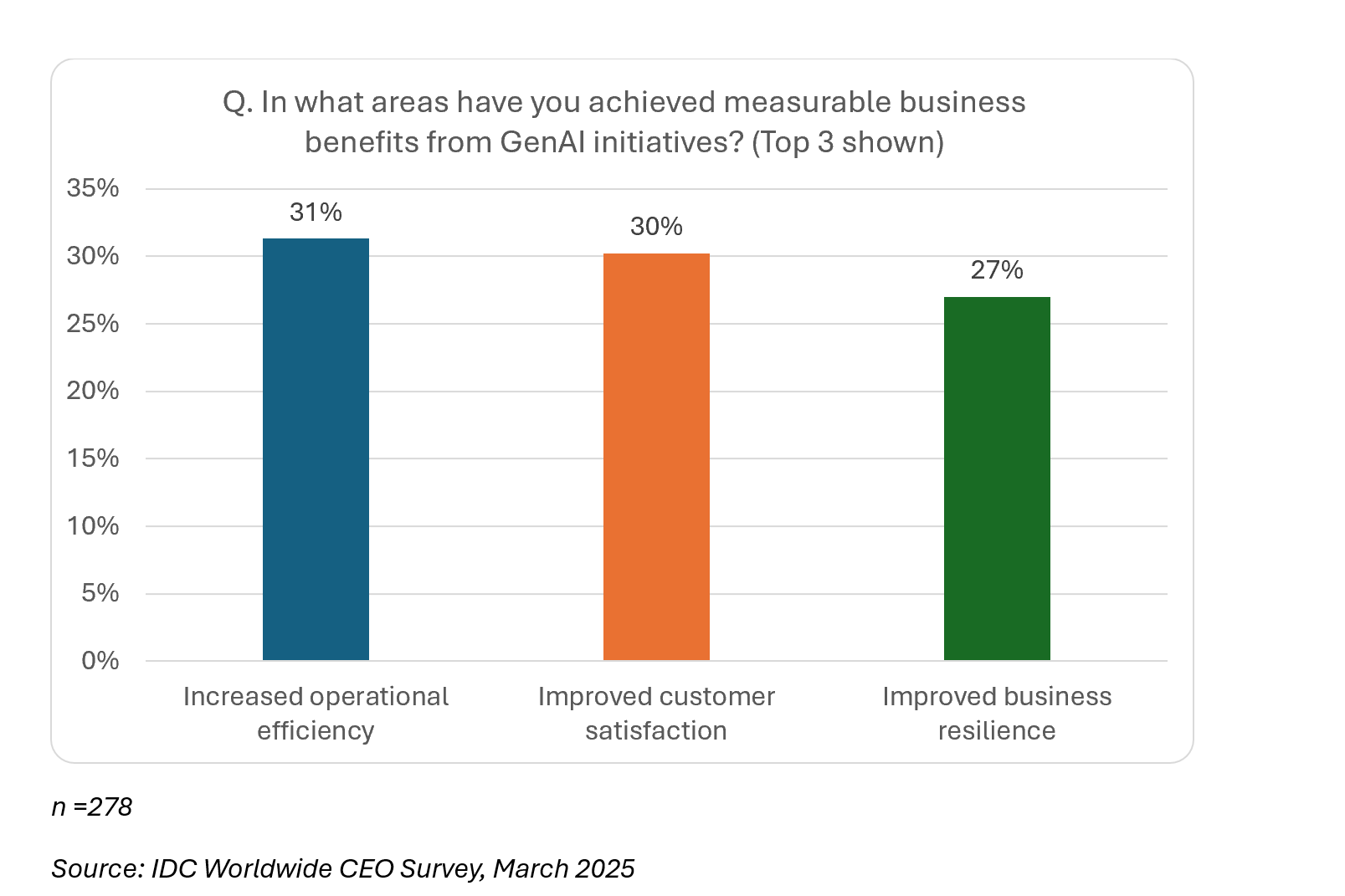
Why such optimism? Perhaps because majority of CEOs state they are seeing measurable business benefits from their generative AI initiatives. When asking what those benefits are, operational efficiency rose to the top of the list, followed by improved customer satisfaction, and improved business resilience.

As CEOs frame their view on technology through the lens of business strategy, it is important to note that CEOs articulate improving customer experience as their top business priority in 2025.

2) Find growth amid uncertainty

Year after year, business leaders are facing a tough economic landscape. Whether its supply chain issues, an inflation crisis, quantitative tightening, and now trade wars, CEOs have had to mitigate the risk of economic pressures on their business.

It is evident from the conversations that I’ve had with CEOs that they are up for the challenge – as it seems to not just be in the job description, but in the DNA of the best leaders.

While challenges by region vary, CEOs across the world are looking at how technology investments can help their organizations gain a competitive advantage or at the very least, not fall behind their counterparts.

This year, AI agents have been a hot topic in the tech industry, and front of mind for CEOs. However, this doesn’t mean that CEOs are handing the reins over to robots. In fact, about half say that all decisions must be approved by humans. It is evident that those forcing an extreme strategy may and, in some instances, already have seen that backfire. Hand in hand with investments in AI Agents is the emphasis to invest in cybersecurity. Trust is a cornerstone of the CEO agenda this year, and we will explore more on that later.

3) Enable a strong tech leader

With so much tech talk in the C-Suite, it is no surprise that the tech leadership function is evolving. While Chief Information Officer continues to be the most common role, we have also seen a rise in Chief Technology Officers and Chief Information Security Officers this year.

Reporting structures also trend towards a more direct relationship between the CIO and the CEO. This has likely prompted the CEO to envision the CIO role as more strategic. In fact, when asked about the desired state two years from now, less than 1 in 4 CEOs say they want their CIO’s primary focus to be on cost reduction and risk management. Rather, their focus should be to either modernize IT to drive better business outcomes, orchestrate digital transformation to improve business agility, use AI to transform and create new revenue streams, and/or promote collaboration on AI initiatives across functions.

4) Safeguard trust with employees, technology and partners

Earlier, we noted how trust is a cornerstone of the 2025 CEO Tech Agenda. Arguably, developing trust with employees is the lynchpin of getting value from AI investments. We know that many knowledge workers are concerned about the impact of AI on the workforce. Employees must be involved in reimaging workflows with AI, their expertise with the day-to-day must be valued, and leaders must be honest about where along the AI readiness journey their organization sits.

Secondly, CEOs must work with their tech leadership to ensure there is trust in technology. It is paramount that clarity exists on how outputs are determined, how data is shared, what biases may exist, and what is at risk moving forward with new technology versus maintaining the status quo.

Lastly, CEOs must work across their C-Suite to ensure the organization is developing trusted relationships with technology partners. This year, CEOs elevated data governance and security practices as the top characteristic they value in their technology partnerships.

5) Lead effectively in an AI world

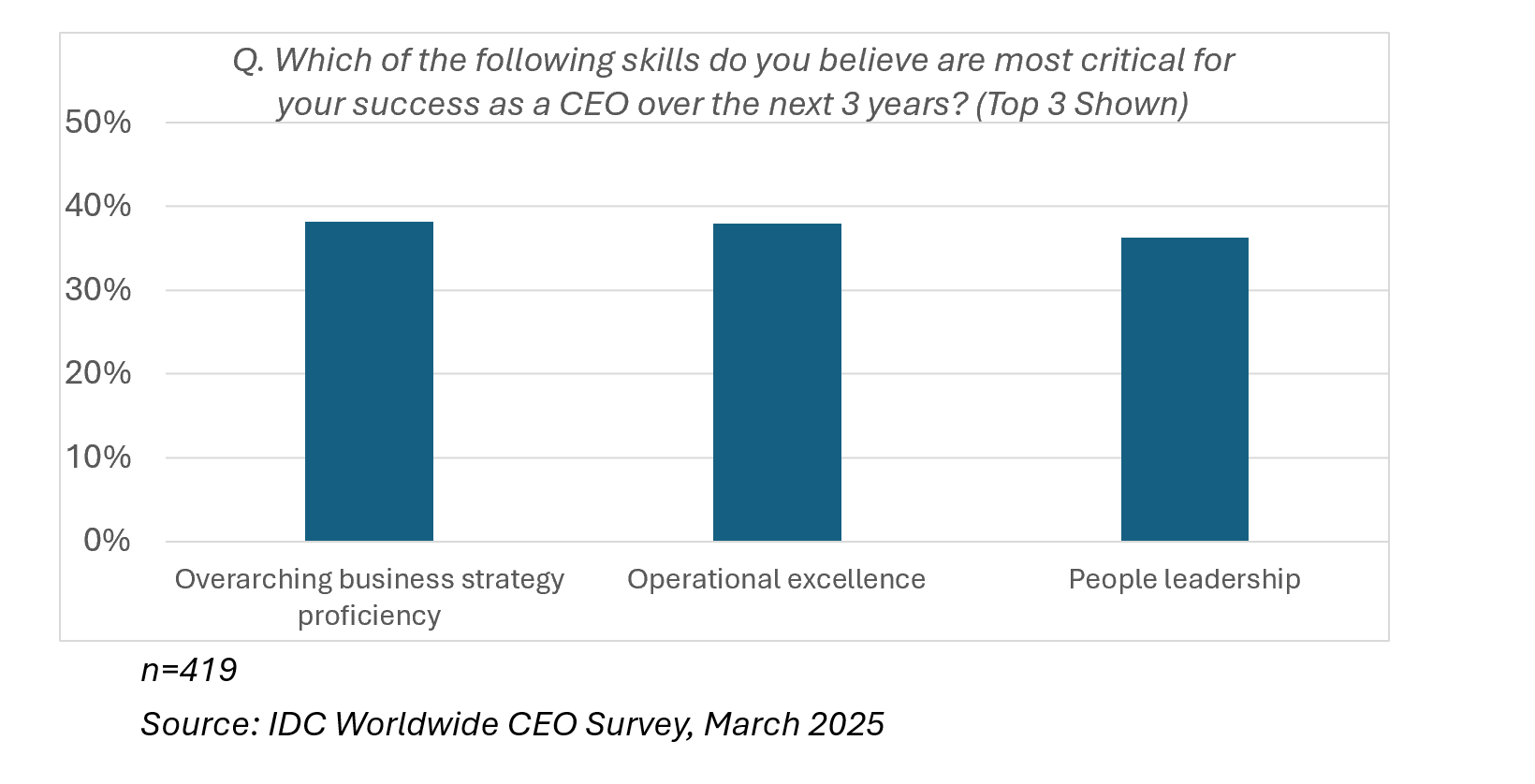
Beyond technology, CEOs express a critical need to hone skills around business strategy, operational excellence, and people leadership. As AI plays an increasingly larger role at work, leaders must show up with a human centered approach.

To land on the CEO agenda this year, it is critical to:

  • Find the connection between AI and CX: Determine how and where in the customer experience you can make an impact. This is not limited to customer service, rather it extends beyond this function to the sales and marketing lines of business, and is supported by efficiency in operational functions like finance, supply chain, etc.
  • Consider how you can build agility into your approach: With the economic stressors unrelenting, leaders will be looking for partners who move with agility and can provide guidance to find growth amid uncertainty.   
  • Secure the CIO as a champion: While the CIO may not always be the final decision maker, they are increasingly playing the role of strategic advisor on business transformation. Without them on board, it will be difficult to move forward.
  • Become a trusted partner: The message from CEOs is clear, they are looking for trust in their partnerships, valuing strong data governance and security practices.
  • Lead with humanity in the business relationship: While AI is great at a lot of things, building deep and trusted connections requires not just humans in the loop, but humans at the core.  

Teodora Siman - Research Manager, C-Suite Tech Agenda Program - IDC

Teodora is a Research Manager for the Worldwide C-Suite Tech Agenda program. Her responsibilities focus on creating research that assesses technology spending and buyer preferences across the C-Suite. This research covers the emerging trends around C-Suite technology objectives. Teodora’s analysis helps technology vendors, IT professionals, and business executives make informed and data-driven decisions on technology strategy.

Rethinking CRM and Embracing Agentic AI: Towards a New Era of Customer Experience

According to IDC research, 77% of consumers currently prefer to buy products and services through a mix of digital channels, and customer expectations relating to personalization, immediacy and cross-channel consistency are only becoming more demanding. Customer journeys are not linear, and consumer engagement is expected to become increasingly contextual, not just at the initial stages of the journey but also in terms of customer support — from sales and marketing to customer service.  To meet these demands, organizations are reimagining traditional customer relationship management (CRM) systems, which involves actively implementing AI in multiple ways. As part of this, exploration of agentic AI is ramping up.

The Evolution of CRM: from Systems of Record to Systems of Action

Customer relationship management has evolved beyond merely storing contact details and tracking interactions. CRM platforms need to be designed or re-designed following a omnichannel and cross-functional approach to customer data collection, enabling profile reconciliation through data integration from various sources such as online purchases, in-store transactions, social media interactions, and customer service incidents. This integration should ensure a comprehensive and unified view of customer data, allowing organizations to gain valuable insights and provide personalized experiences. By consistently providing personalized and meaningful interactions, companies can foster loyalty, resulting in increased customer retention and positive word-of-mouth referrals. Modern CRM systems must be dynamic, real-time, and deeply integrated across the entire customer journey, encompassing marketing, sales, service, and support. Key shifts in CRM thinking include:

  • Real-Time, Contextualized Data: Modern CRM platforms need to reflect customer data in real time, providing contextual and intent-driven insights that empower every function within the organization.
  • Cross-Functional Collaboration: Effective CRM now requires multiple departments to work together, breaking down data silos to ensure a comprehensive view of the customer.
  • Automation and AI Integration: AI-enhanced automation is foundational, enhancing customer service, streamlining operations, and ensuring consistency across channels.

IDC Insight: Organizations are rethinking CRM through collaborative, AI-enhanced approaches that connect data across functions and eliminate silos.

Agentic AI: Bringing Intelligence to Unstructured Work

Organizations are already gaining experience in leveraging AI in multiple ways to serve customers — from proposing next-best actions to making sense of documents and knowledge articles, analyzing customer sentiment and more. Agentic AI represents a new frontier here, and pulls AI capabilities towards task and workflow automation. Unlike traditional rule-based systems, where workflows and processes are designed statically up-front, the emergence of AI agents is starting to show how organizations can bring more nuanced automation capabilities to less structured, unpredictable environments. AI agents are therefore conceptually a great fit for complex service scenarios that can come into play at critical moments in the customer journey. At IDC, we see three waves of AI agents playing out:

  1. Knowledge Agents: Enhance decision-making by integrating relevant information into workflows
  2. Action Agents: Execute tasks (including taking actions in external systems) and assist in decision-making processes
  3. Orchestration Agents: Coordinate entire workflows, based on goals and insights into patterns of past behavior and positive outcomes

IDC Research: 41% of organizations say they are already investing in AI agents, recognizing their value in case management and service operations where flexibility and responsiveness are critical.

The Role of Platforms in Enabling AI and CRM Synergy

CRM systems are increasingly pivotal in the integration of customer data and AI across organizational value chains, serving as a foundational element for collaboration between IT and business units. Agentic AI, in this context, acts as a transformative accelerator, converting insights into actionable strategies and enhancing decision-making processes at scale. Organizations wanting to implement AI quickly, safely, and securely into CRM practices and capabilities will benefit from platforms that provide:

  • Managed Access to Enterprise Data: Secure, broad access to corporate knowledge, documents, and data is essential for AI systems to function effectively.
  • Integrated Automation Tools: A unified platform combining AI with existing automation capabilities reduces complexity and accelerates time to value.
  • Scalability and Agility: Platforms can help organizations quickly adapt to changing market conditions and customer needs without extensive customization.

Trend: In the context of modern CRM strategies, AI is most effective when integrated into a platform that spans front-, middle-, and back-office functions, enabling seamless customer experiences and operational efficiency.

Measurable Impact: What Organizations Are Achieving

Organizations embracing AI and modern CRM strategies are witnessing significant results:

  • Escalations reduced by approximately 90%
  • Case resolution time decreased from 7 hours to 2 hours
  • Customer satisfaction increased from 80% to 99%
  • 17% reduction in staff needed to handle more cases
  • 7% increase in billable utilization

These outcomes highlight the transformative potential of combining CRM modernization with AI and point towards an exciting future powered by agentic AI.

The Bottom Line

Organizations that rethink CRM as a real-time, AI-powered system of action — and embrace agentic AI to handle complex, unpredictable work — are better positioned to deliver exceptional customer experiences. This approach not only enhances satisfaction and loyalty but also drives operational efficiency and business agility.

Neil Ward-Dutton - VP AI, Automation, Data & Analytics Europe - IDC

Neil Ward-Dutton is vice president, AI, Automation, Data & Analytics at IDC Europe. In this role he guides IDC’s research agendas, and helps enterprise and technology vendor clients alike make sense of the opportunities and challenges across these very fast-moving and complicated technology markets. In a 28-year career as a technology industry analyst, Neil has researched a wide range of enterprise software technologies, authored hundreds of reports and regularly appeared on TV and in print media.

Ornella Urso - Research Director, IDC Retail Insights - IDC

Ornella Urso is Head of IDC's Retail Insights team and leads the Customer Experience research group in Europe. Urso conducts market research, industry analysis, and proactively contributes to the definition of thought-leadership at the intersection of businesses priorities and technology innovation in B2C and D2C strategy companies. In her role, she is responsible for the delivery of research reports, custom projects and offers strategic direction and advice to both technology providers and IT and business executives of global brands.

Today’s B2B tech buyers are digitally fluent, AI-assisted, and increasingly independent. They move easily between platforms, researching products and evaluating vendors, without ever needing to speak with a salesperson.

For marketing leaders, this changes everything. 

When buyers are making critical decisions before sales even enter the conversation, your role expands dramatically. It’s no longer about driving awareness or filling the funnel. You must own the entire buyer journey, from understanding what your buyers want to creating real demand.

That’s a tall order, but it’s the new starting line if you want your AI-powered product to stand out in a saturated, fast-moving market. Successfully marketing your AI solution requires orchestrating seamless omnichannel experiences that deliver relevance at every turn.

Where to Start: Understanding Digital-First Buyers

Most of the B2B tech buying journey happens digitally, but that doesn’t mean you should still be relying on gated PDFs and nurture campaigns. Modern buyers chart their own course, jumping between websites, apps, social platforms, videos, and interactive tools to explore, evaluate, and even purchase solutions.

And they’re confident doing it. Seventy-one percent of B2B tech buyers are comfortable using digital channels for large-ticket purchases, and 73% leverage digital tools for complex decisions. 

They’re also bringing AI into the process. Digital assistants are increasingly helping buyers compare vendors, configure solutions, and respond to requests for proposals (RFPs). This means AI is reshaping how your buyers make purchasing decisions.

The Rise of an Unpredictable Buying Committee

To complicate matters further, buying decisions aren’t centralized anymore. What once involved one or two senior decision-makers now requires consensus from a wide, and often unfamiliar, range of stakeholders. A single deal might include a VP of Customer Experience, a cybersecurity lead, an IT procurement manager, and a Head of AI Strategy.

Five years ago, many of these roles weren’t even part of the conversation. Today, they have the power to make or break your deal. 

What does this mean for marketing leaders? GTM strategies based on traditional buyer personas and outdated messaging will fail to resonate. To reach this modern buying committee, marketing teams need to orchestrate connected, omnichannel experiences that speak to each stakeholder’s priorities and position your AI solution as the one that solves their specific challenge.

If you don’t, your competitors will gain influence with the very stakeholders you overlooked.

The New Marketing Playbook is Built on Omnichannel Moments

In this environment of self-guided buyers, shifting stakeholder dynamics, and AI-mediated decisions, marketing must prove value earlier and more deliberately than ever. Add to that the challenge of standing out in a saturated market of AI-powered products, plus pressure from a performance-focused C-suite, and the stakes only climb higher.

Buyers are accustomed to personalized experiences from the B2C brands they engage with every day, and now they expect the same from B2B. In fact, nearly 70% say their decision on whether to read something is influenced by whether it’s personalized. Omnichannel marketing is the new marketing playbook.

Still, personalized content only works if it’s delivered in the right format, on the right channel, at just the right time. And that’s tougher than it sounds. A VP of Customer Experience scrolling LinkedIn has a different set of concerns than a Head of AI Strategy downloading a technical white paper. A short explainer video might catch one stakeholder’s attention, while a peer case study builds credibility with another.

The key is creating moments where something clicks for the buyer: “This solves my problem.”

But that’s just the spark. To be effective, each moment needs to connect, creating a continuous experience. Ask yourself:

  • What happens after a buyer engages with your content? How are they guided to the next step?
  • Is each interaction building momentum, or starting from scratch?
  • Do our digital and human touchpoints hand off smoothly?

True omnichannel excellence isn’t just about being everywhere; it’s about designing deliberate transitions between content, people, and stages of the journey.

To lead with that kind of intention, marketing leaders must leave the old playbook behind and navigate this new reality. Here’s how the shift looks in practice.

Old Marketing PlaybookNew Marketing Playbook
Marketing owns the top of the funnel, then hands off to sales.Marketing guides the entire buyer journey, including how and when sales steps in.
Buyers discover your products through search engines or industry events.Content means connected moments: interactive tools, live demos, short-form video, and real-time prompts.
Personalization happens in the sales conversation.Personalization starts with marketing across channels and at scale.
Content means white papers and static assets.Content means connected moments: interactive tools, live demos, short-form video, real-time prompts.
Trust is built through human interaction.Trust is earned digitally and strengthened through strategic human touchpoints.

What Successful Marketers Are Doing Differently

It’s no surprise that 37% of CMOs say creating a unified, omnichannel customer experience will have the greatest influence on their marketing strategy over the next 12 to 18 months, according to IDC’s 2024 Worldwide CMO Priorities Study. But how are they actually making it happen?

They’re designing journeys where every touchpoint, whether self-service, automated, or human, works in harmony. 

Consider this scenario: a potential buyer discovers your product comparison guide on a third-party site. That guide links to a chatbot that provides real-time answers to technical questions. The chatbot offers a live Q&A session with a product expert. After the session, the buyer receives a personalized recap that highlights the exact features they asked about.

Every interaction builds momentum, and each step feels relevant, timely, and connected. That’s what omnichannel excellence looks like, and it’s what successful marketers are putting into practice.

Rather than focusing on how many campaigns they can launch this quarter, top teams are focused on how well each moment contributes to the bigger picture. That shift shows up in how they:

  • Map the buyer journey to uncover pain points and find new opportunities.
  • Pinpoint where human interaction adds the most value.
  • Use real-time buyer behavior signals to fine-tune nurture paths.
  • Ensure every asset and handoff supports a unified story.

However, none of this works without a clear understanding of who your buyers are, what they want, and how they’re making decisions.

To Lead the New Buyer Journey, You Need Trusted Tech Intelligence

Successfully guiding today’s buyer, one who is self-directed, AI-assisted, and surrounded by a growing cast of decision-makers, requires more than instinct. It requires intelligence.

Research and analysis grounded in real-world insight help you:

  • Identify and understand your buying committee.
  • Craft messaging that resonates with each stakeholder.
  • Orchestrate omnichannel experiences with confidence.
  • Make evidence-based decisions with speed and confidence
  • Differentiate your AI product in a market full of similar-sounding solutions.

It’s time to lead the new buyer journey and make your AI product the obvious choice. Discover how IDC can help you think bigger and move faster.

Inspire Buyers Every Step of the Way

Buyers don’t think in terms of funnels, functions, or handoffs. They think in terms of outcomes: Does this solve my problem? Can I trust it? 

That clarity is earned one intentional, relevant, and personalized moment at a time.

The companies that succeed are those where marketing and sales aren’t working in silos, but rather building unified experiences that inspire modern tech buyers at every step. Is yours one of them?

Ryan Smith - Content Marketing Director - IDC

Ryan Smith is the Director of Content Marketing at IDC, where he leads brand-level content and social media strategy, aligning research insights with compelling storytelling to engage technology decision-makers. With a background in both IT and marketing, Ryan brings a unique blend of technical understanding and creative strategy to his work. He’s also a seasoned storyteller, speaker, and podcast host who believes the right message, told the right way, can drive both trust and transformation.

As organizations attempt to keep pace with the rapidly evolving landscapes of artificial intelligence and data analytics, many are developing AI centers of excellence (COEs). The goals are to harness the power of AI to create business value, to drive innovation, and to stay ahead of the competition.

AI COEs follow the traditional COE model, though obviously focused on the role of AI in business strategies and in corporate culture. They draw the top talent from throughout an organization that can champion how AI can be interwoven into existing processes to create new efficiencies.

Consider the example of ECS, a leading provider of cloud, cybersecurity, AI, machine learning, and IT modernization services in Fairfax, Virginia.

“Our data and AI center of excellence was established to advance our company’s data and AI culture, practice, products, partnerships, and social eminence,” explains Rick Torzynski, senior data and AI engineer and product architect for Atlas Graph at the company. “With a vision to scope, prioritize, induct, govern, and integrate data and AI opportunities, our COE aims to align our capabilities with the strategic vision and operational needs of our customers.”

By creating a dedicated COE for AI and data analytics, Torzynski says the company can leverage the expertise of over 200 data professionals — 50% of whom hold PhD or master’s degrees — to drive innovation and solve complex problems.

“Our COE serves as a community of practitioners, providing a platform for knowledge sharing, expertise exchange, and best practice development,” Torzynski says.

Investments for the Future

As an AI leader, practitioner, and researcher, Adnan Masood has long maintained that an AI COE defines a strategic inflection point in how organizations can future-proof their core competencies.

The chief AI architect at UST, Masood says his organization established its COE to address a classic demand: “We needed adaptive leadership and a single source of truth for data-driven strategy, from dynamic risk management to value chain optimization,” Masood explains. “That has been our springboard to scalable solutions and sustained momentum. Since then, I have worked with various client organizations, helping them establish and run their respective COEs.”

UST, formerly known as UST Global, is a provider of digital technology and IT transformation services based in Aliso Viejo, California. But AI COEs are hardly limited to technology companies. Among non-tech organizations, Masood says he has watched COEs generate quick wins — such as reducing fraud loss by double digits or serving as a catalyst for deeper initiatives such as advanced customer lifetime value analytics.

When an AI COE is designed and staffed effectively, executives can hope to witness strategic cohesion when AI-driven insights support critical-path decisions, aligning people, platforms, and cultural capital, Masood says.

“AI COEs help build cross-functional synergy by merging data scientists, domain experts, and finance leaders,” Masood explains. “That cross-pollination strengthens institutional memory while mitigating the strategic ambiguity that so often stymies new tech deployments.”

Potential Benefits from an AI COE

The benefits of an AI COE can be many and go far beyond technology advancements, Torzynski says. At ECS, they include:

  • Talent development: “Our COE provides opportunities for employees to grow professionally, even in areas outside of their primary job responsibilities. Regular town hall meetings encourage employees to explore various COEs, fostering a culture of continuous learning and development,” Torzynski says.
  • Knowledge sharing: “Our COE serves as a community of practitioners, holding regular meetings and events to share knowledge, expertise, and best practices. This collaborative environment promotes innovation and drives business value.”
  • Strategic partnerships: “Our COE manages and develops strategic, technical partnerships, enabling us to stay at the forefront of AI and data analytics trends.”
  • Certification and training: “Our COE provides flexible and rigorous training, supporting project delivery and ensuring that our teams are equipped with the necessary skills to succeed.”
  • Proposals and solutions: “Our COE supports proposals by providing technical solution strategies, enabling us to deliver innovative solutions to our customers.”
  • Culture of innovation and creativity: “Our COE has been instrumental in fostering a culture of innovation and creativity, empowering employees to pursue their passions and drive business value.”

What Organizations Can Expect from an AI COE

The expectation of any COE is that it will help drive innovation and improve efficiency first and foremost, says Jason Hardy, CTO of AI at Hitachi Vantara. It is also important that a COE enhances the decision-making process and facilitates a healthy collaboration between business units and external partners.

At Hitachi Vantara, “The COE is ultimately designed to move AI from theoretical exploration to practical implementation, delivering tangible business value by optimizing the many processes, enhancing efficiency, and unlocking data-driven insights,” Hardy explains.

It should also be noted that by developing and implementing AI-driven solutions, the COE contributes to the creation of new revenue streams and business opportunities, he says.

An ideal COE should serve each business unit with both operational transparency and agile governance, Masood explains. At UST, the company places data engineers side by side with financial analysts to ensure swift translation from concept to execution excellence.

“Boards want tangible ROI — like the significant improvement in operational efficiency we saw once advanced ML was integrated into supply chain optimization,” Masood explains. “By embracing this purposeful approach, the COE stands at the center of a broader innovation ecosystem.”

Gaining Resilience and Competitive Edge

Any organization aiming for market and competitive resilience should consider developing an AI COE, Masood says.

“I’ve seen it become a vital change agent that champions iterative prototyping, fosters collaborative innovation, and sustains a high-performance culture,” Masood explains. “Companies with strong AI governance can boost [significant] returns on invested capital. C-suites increasingly view these [gains] as the hallmark of mission alignment, especially when shareholders demand better liquidity analysis and more reliable revenue management.”

An AI COE helps accelerate AI adoption by providing a dedicated hub for a more practical application, Hardy says. It achieves this by piloting innovative AI solutions tailored to specific industry needs, as evidenced by successful advanced prototypes in energy, industrial, and mobility industries, among others. This hands-on approach enables clients to see impactful results and understand the real-world implications of AI.

“The COE fosters collaboration with key technology partners, ensuring access to cutting-edge AI capabilities and facilitating the development of robust and impactful AI solutions that directly address client business challenges and unlock new value streams,” Hardy explains. “This collaborative approach allows us to develop and deliver impactful prototypes, as we’ve already demonstrated in the energy, industrial, and mobility sectors, ultimately accelerating AI adoption and delivering tangible business value for our clients.”

Defining and Measuring Success

To determine if an organization has benefited from establishing an AI COE, it must first define what it means by success, Torzynski says. He recommends these steps:

  • Establish clear goals and objectives: Define the purpose of the AI COE, such as improving operational efficiency, enhancing customer experience, or driving revenue growth.
  • Develop key performance indicators (KPIs): Measure gains from the AI COE, such as with project completion rates, customer satisfaction, or revenue growth.
  • Establish a framework for success: Outline the key elements that enhance the business, such as with innovation, impact, and efficiency.

To measure actual success, Torzynski says organizations should:

  • Track project completion rates: Monitor the progress of each project and measure the impact on business outcomes.
  • Monitor customer satisfaction: If customers of the COE have been identified, evaluate customer satisfaction and measure the impact of AI on customer experience.
  • Measure revenue growth: Determine what portion of revenue growth can be attributed to the AI COE.
  • Track innovation and impact: Assess the innovation and impact that AI projects have had and measure the value created.
  • Conduct regular evaluations: Routinely assess the performance of team members and identify areas for improvement.

Finally, Masood stresses that a robust AI COE is more than just a discrete function; it becomes a cornerstone of enterprise architecture, shaping tomorrow’s go-to-market strategy and fueling future-proofing.

“The ability to harness frontier AI, such as generative models or agentic automation, hinges on forging an environment of continuous learning,” Masood explains. “The strategic imperative is clear. Organizations should establish their AI COE now to lead, rather than follow.”

(This is the first of a two-part series on AI COEs. In part 2, we explore how an AI COE impacts individual units in an organization, who should be selected to the COE team, and who the ideal leaders for the effort are.)

David Weldon - Research Adjunct - IDC

David Weldon is an adjunct research advisor with IDC's IT Executive programs, focusing on IT business, digital transformation, data management and artificial intelligence. He has extensive experience as a research analyst and as a business and technology journalist. His special concentrations are in the areas of technology, business and finance, education, healthcare, and workforce management. David started his national-level journalism career at IDG's Computerworld, a sister publication to IDC. He began as a features editor working on the Management section, covering topics of interest to chief information officers and other IT executives. He then took over Careers coverage and handled most of the editorial research projects for the publication. Computerworld's Careers section won several journalism awards and was the leading source of insights and advice on careers in information technology.

The current global tariff situation and resulting supply chain volatility and price increases send a clear signal: The era of seemingly limitless availability of materials and products is over. Companies that rely on global supply chains are increasingly having to deal with geopolitical uncertainty and price turbulence. Risk and resilience are becoming primary aspects to future proof the organization.

The challenge, however, also presents a significant opportunity: The transition to a circular economy offers a way forward. Circularity offers independence, innovative strength, and sustainability. In the current macroeconomic climate, the business case for circularity is increasingly attractive.

In Europe, circularity is additionally driven by the EU’s EcoDesign for Sustainable Products Regulation (ESPR). It obliges companies to make products more sustainable, repairable, and resource-efficient — thus specifically promoting those who rethink and act at an early stage.

ESPR, which entered into force in July 2024, forms the cornerstone of the European Commission’s approach to more environmentally sustainable and circular products by improving their circularity, energy performance, recyclability, and durability.

It considerably extends the scope of application in comparison to Directive 2009/125/EC, shifting the focus from energy efficiency to broader sustainability across the entire product life cycle. It is intended to play a central role in developing a strong, well-functioning single market for sustainable products in the EU.

The EU’s EcoDesign Regulation

 The ESPR enables the setting of performance and information rules — known as ecodesign requirements — for almost all categories of physical goods. It aims to:

  • Improve product durability, reusability, upgradability, and reparability
  • Enhance the possibility of product maintenance and refurbishment
  • Make products more energy- and resource-efficient
  • Address the presence of substances that inhibit circularity
  • Increase recycled content
  • Make products easier to remanufacture and recycle
  • Set rules on carbon and environmental footprints
  • Limit the generation of waste
  • Improve the availability of information on product sustainability

For groups of products that share enough common characteristics, the framework allows horizontal rules to be set.

The ESPR also contains these new measures:

  • Digital Product Passport: A digital identity card for products, components, and materials, it will store relevant information to support product sustainability, promote their circularity, and strengthen legal compliance.
  • Destruction of Unsold Consumer Products: Introducing a ban on the destruction of unsold textiles and footwear opens the way for similar bans in other sectors if evidence shows they are needed. It will require large and, eventually, medium-sized companies across all product sectors to disclose annual information on unsold consumer products on their websites, such as the number and weight of products they discard and their reasons for doing so.
  • Green Public Procurement: Public authorities in the EU spend around €1.8 trillion purchasing works, goods, and services. The ESPR will help steer these funds in a more sustainable direction by enabling mandatory Green Public Procurement rules to be set for specific products. Under those rules, public authorities that purchase the products concerned will be required to purchase products that meet the highest levels of performance in terms of sustainability and circularity. This has the potential to significantly boost demand for sustainable products and, in turn, further incentivise companies to invest in this area.

In the first work plan, adopted on April 16, 2025, the European Commission gives priority (over the next three years) to certain product groups, notably final products (textiles and apparel, tires, furniture, and mattresses) and intermediate products (iron, steel, and aluminium). ICT and energy-related products will continue to be addressed under existing directives or upcoming reviews.

Opportunity for Transformation

Compliance with the ESPR is a legal obligation but also an opportunity for companies to systematically rethink their products, processes, and business models. The required change is profound: It requires technical audits, data collection along the supply chain, document transparency, and external audits.

The entire business ecosystem will be involved in this transition. Internally, it will involve organizations’ technical departments, marketing, sales, procurement, and GRC. Externally, it will involve supply chain partners. Forward-thinking companies will be able to use the ESPR as a lever to strengthen their competitiveness, differentiate themselves in the market, and credibly meet the expectations of customers, investors, and regulators.

ESPR Applies Globally

The ESPR’s reach extends far beyond EU borders. Any company wishing to place a product on the European market must comply with the requirements of the regulation, regardless of where it is manufactured. For manufacturers from non-EU countries, this means they must fundamentally revise their product designs, their traceability systems, and their information transparency.

Looking to the future, the ESPR could become a reference standard at the international level, helping to redefine the rules of global trade and promote a circular and sustainable economy on a global scale.

Technology as an Enabler

IT for circularity describes how IT products and services can support the circular economy (e.g., by enabling efficient resource management or reducing waste). The use of advanced data management and analytics and the IoT enables organizations to track, trace, and optimize the life cycle of products, ensuring they are reused, refurbished, or recycled rather than discarded.

Many tech vendors are offering advisory, advanced technologies, and even AI-enabled solutions to support their customers in improving both their environmental impact and contribution to a more sustainable, circular economy as well as generating efficiencies, advancing supply chain resilience, and reducing risk. Increasingly, aspects around the latter are becoming key drivers for circularity initiatives.

IDC is launching a research project to examine the current status of tech vendors’ strategies, solution offerings, customer projects, and benefits achieved from supporting their customers’ initiatives towards circularity. If you’d like to know more or would like to participate, please get in touch.

Katharina Grimme - Associate VP, Research and Practice Lead, EMEA Sustainable Strategies and Technologies - IDC

Katharina Grimme has more than 20 years' experience as an industry analyst and strategy consultant in the tech industry and is leading is leading IDC's Sustainability research in EMEA. With her expertise and passion for sustainable concepts for business, society, and digitization, she drives thought leadership at the intersection of sustainability and digital transformation.