In a world where tech decisions move markets, the analyst voice carries more weight than ever. But for many organizations, analyst engagement remains a missed opportunity; seen as a checkbox instead of a strategic lever. If you’re still treating analysts as one-way validators, it’s time to rethink your approach. 

Welcome to the new era of analyst relations: where influence is earned, insight is mutual, and every interaction can shape the market. 

Analysts don’t just observe the market, they help shape it

Analysts aren’t just keeping score. They inform buyer decisions, guide vendor roadmaps, and influence how innovation gets adopted. They hold the power to elevate your story or challenge it at critical moments in the buyer journey. 

Yet too many organizations treat analyst engagement as reactive—a scramble before a report, a briefing once a quarter, a missed chance to shape perception. 

Here’s the truth: Proactive analysts engagement shapes the market.

The risk of misalignment: When narratives don’t match

When your public story says one thing, but analysts say another, the disconnect stalls deals, confuses customers, and erodes trust. 

Why it matters: IDC research shows that C-suite buyers increasingly rely on analyst validation to guide high-stakes decisions. If analyst commentary doesn’t reinforce your core message, you’re not just invisible, you’re at risk of disqualification.

From engagement to influence: 3 rules for analyst relations that work

1. Lead with evidence, not ego

Skip the hyperbole. Analysts are data-driven thinkers. Give them what they need to validate your claims: proof points, customer results, trend alignment, and most importantly, the “so what.” 

2. Treat analysts as strategic allies

Briefings shouldn’t just be broadcasts. The best relationships are built on transparency and dialogue. Let analysts challenge your thinking; they’ll help sharpen your go-to-market message. 

💡 Use IDC’s Tracker® and Black Book data to anticipate market shifts before your competitors do, and invite analysts into the conversation early. 

3. Align internally first

Mixed signals across sales, marketing, and product derail analyst relationships. Build a unified, evidence-backed narrative that connects the dots between your product roadmap, market opportunity, and customer value. 

💡 IDC helps companies create that shared view, grounded in trusted tech intelligence and aligned across GTM functions. 

Why it pays off: Analysts influence in action

Organizations that invest in strategic analyst relations aren’t just better positioned in reports, they’re better aligned with buyer expectations, more credible in competitive cycles, and more confident in their decisions. 

And confidence is contagious. 

Get started: Make every analyst interaction count

You can’t control what the market says. But you can shape who says it—and how they say it. Engage analysts not as observers, but as partners in market influence. 

Let’s build your analyst strategy to win in 2026; on purpose, with purpose. 

As AI reshapes Martech and Adtech, pricing is shifting from technical inputs and usage metrics to measurable business outcomes. This isn’t just about covering AI’s costs, it’s a strategic opportunity to stand out in a crowded, commoditized market.

Legacy pricing models, flat-rate, usage-based, tiered, per-user, can’t keep up with AI’s compounding, often invisible value. AI automates, optimizes, and delivers insights in ways these models were never built to capture. In this environment, pricing itself becomes a competitive weapon.

For both buyers and vendors, this is more than a tactical adjustment. It’s a chance to redefine expectations, relationships, and what ROI really means in AI-powered marketing and advertising. This article breaks down why the old playbook fails, what’s replacing it, and how smart vendors can turn pricing into a market differentiator.

Why Traditional SaaS Pricing Breaks in an AI World

The familiar pricing playbook wasn’t built for AI:

  • Flat-rate models treat a static software package the same as one that’s constantly learning and optimizing, leaving both value and revenue on the table.
  • Usage-based models miss the mark because AI’s value isn’t about how many queries you run or emails you send. It’s in the decisions made, outcomes improved, and time saved.
  • Tiered pricing quickly becomes outdated as AI capabilities advance, creating misalignment between what customers need and what they’re paying for.
  • Per-user models overlook AI’s ability to amplify small teams. AI does much of its best work invisibly, unlinked to logins or headcount.
  • Feature-based and credit-based models struggle with AI’s unpredictability and variability. Locking customers into fixed credits or feature bundles risks alienating them when AI’s true value lies in flexibility and continuous improvement.

The bottom line: AI fundamentally changes how value is created, and old pricing models can’t capture it.

The Case for AI-Driven, Value-Based Pricing

AI fundamentally changes the economics of Martech and Adtech platforms, and pricing needs to reflect that shift. Traditional models charge by seats, queries, or feature bundles, but AI delivers value in compounding, often invisible ways: automating decisions, uncovering insights, accelerating campaigns, and improving business outcomes. Vendors that fail to align pricing with these benefits risk undervaluing their products and alienating customers.

Value-based pricing ties costs to clear, measurable business outcomes. Instead of billing by usage or features, vendors price based on metrics like:

  • Conversion rates and revenue growth
  • Customer engagement and retention improvements
  • Operational efficiencies and cost reductions
  • Faster time-to-market for campaigns
  • Risk mitigation and data accuracy gains

For example, a predictive AI personalization tool might charge based on uplift in campaign ROI or increase in customer lifetime value rather than by audience size or impressions served.

To support this, vendors should move beyond flat subscriptions and introduce AI-specific pricing tiers. Basic levels might cover standard automation, while premium options unlock advanced capabilities like real-time personalization, media mix modeling, or predictive lead scoring. This allows customers to scale investment in line with the value AI delivers.

Additionally, vendors should leverage dynamic pricing models that evolve alongside the customer relationship. AI-powered solutions improve over time, pricing should, too. Regularly reviewing customer outcomes, benchmarking against performance targets, and adjusting pricing accordingly ensures long-term alignment and value capture.

New pricing levers also come into play. Vendors can quantify AI’s contributions by measuring:

  • Net-new revenue opportunities unlocked by AI features
  • Productivity gains through automated workflows
  • Competitive advantages like faster insights or superior targeting
  • Customer loyalty improvements from AI-driven personalization

These are tangible, defensible metrics that buyers care about and that vendors can tie directly to pricing structures.

Ultimately, AI-driven, value-based pricing is a strategic weapon. It deepens customer relationships, differentiates vendors from commoditized competitors, and ensures that pricing keeps pace with AI’s accelerating impact.

What It Takes to Make Value-Based Pricing Work

Implementing value-based pricing requires more than clever packaging; it demands organizational change. Pricing strategy can’t live in finance alone. It belongs in customer success and strategy teams, focused on long-term outcomes, not one-off sales.

Continuous feedback loops are crucial. AI-powered solutions evolve fast and pricing must adapt just as quickly. Vendors need to regularly evaluate performance, update pricing as capabilities grow, and maintain open, outcome-focused customer conversations.

To support this, vendors should expand pricing levers beyond the usual suspects. AI’s ability to unlock new revenue streams, increase market share, and boost differentiation should factor into pricing. Vendors must account for AI’s impact on productivity, risk reduction, and loyalty areas traditional models often ignore.

Technology End User (Buyer) Considerations. 

For Martech and Adtech buyers, this shift means focusing on outcome alignment and vendor accountability. Buyers should prioritize:

  • Vendors offering outcome-driven pricing models — like Experience Level Agreements (XLAs) — that emphasize ongoing performance, not static commitments.
  • Vendors who demonstrate clear, measurable business value — whether through native features or integrated ecosystems.
  • Flexibility and transparency — no one wants to decode AI credits or compute hours. Vendors win by stripping away jargon and clearly stating what outcomes they deliver, and what it’ll cost.

Conclusion

AI is forcing both vendors and buyers to rethink value and pricing. Traditional models can’t keep up with AI’s dynamic, invisible, and compounding business impact. Outcome-based and value-driven pricing approaches are quickly becoming essential for anyone hoping to compete.

Vendors that treat pricing as a strategic lever not a back-office task will outpace competitors and lock in long-term advantage. The real winners in AI-powered Martech and Adtech will be those bold enough to rethink what customers pay for, why it matters, and how to turn pricing into a lasting market differentiator.

Roger Beharry Lall - Research Director, Marketing Applications for Growth Companies - IDC

With over 25 years' experience leading technology driven marketing programs, Mr. Beharry Lall is now a Research Director with IDC covering Advertising Technologies and SMB Marketing Applications. He brings a unique multidisciplinary perspective, evangelizing the innovative and pragmatic use of both martech and adtech solutions for companies of all sizes. Early in his career Rog worked with an IBM subsidiary expanding into the Asian Market and subsequently, he spent over a decade at RIM (BlackBerry) building marketing leadership across new industry segments, geographies, and product categories. This background fuels his perspective as he researches enterprise customers engagement tools and tactics across the unified omnichannel.

AI is no longer just a feature in your product. It’s part of how your buyers behave and interact with your brand.

While your team has been working hard to build AI into services and solutions, buyers have been sharpening their own AI skills too. AI is now embedded in how they research, evaluate, and validate decisions.

In this new landscape, it’s not the companies that simply offer AI that stand out. It’s the ones that know how to market it and use AI to their advantage.

So if your product is changing, and your buyers are changing, it is time for your go-to-market (GTM) strategy to change too.  

Why marketing feels the squeeze

This can cause a lot of pressure on marketing teams who are already battling against competing demands from executives:

  • CEOs expect bolder innovation and faster growth.
  • CFOs want clear ROI from AI investments.
  • CIO/CTOs demand secure integration aligned with technology roadmaps.

As a result, marketings role is expanding dramatically. Teams must now own buyer intelligence, ensure they stand out in a saturated market, and orchestrate a connected journey across digital and human interaction.

Without recalibration, these demands can overwhelm marketing. But with the right insights, the pressure cascade becomes a launchpad for momentum and leadership.

Your product changed. So did your buyer.

Once AI was built into solutions, buyers not only began to accept it, they started to expect it with competitors following suit. Now, with buyers leveraging AI on their side, the rules of engagement have shifted.

Sixty-nine percent of buyers will only engage with content that feels personalized. That means messaging and approach needs to change. It’s about creating the right messaging that reaches the right buyer, at the right time, in the right channel, and in the right format.

And it’s not only one buyer anymore. Modern buying committees can include VPs of customer experience, VPs of cybersecurity, heads of data and AI strategy, and IT procurement managers.

Each of these stakeholders approaches the journey differently and enters at a different stage. If your strategy doesn’t account for each one, it can derail the deal. Marketings job is to anticipate, tailor, and orchestrate messaging for all.

Understanding who is in the buying committee is only half the challenge. The other half is keeping pace with how they buy. AI has made the journey more fluid, more self-directed, and spread across countless touchpoints—all of which buyers expect to feel connected.

The AI-assisted buyer journey

Understanding who is in the buying committee is only half the challenge. The other half is keeping pace with how they buy. AI has made the journey more fluid, more self-directed, and spread across countless touchpoints—all of which buyers expect to feel connected.

Today’s buyer journey is fluid, AI-assisted, and omnichannel. IDC research shows that buyers seamlessly move between digital and human touchpoints: reading analyst reports, attending webinars, engaging with ads, visiting websites, and testing self-service tools.

At the same time, they use AI to weigh trade-offs, simulate outcomes, and filter vendors before sales ever enter the picture.

Success isn’t about being everywhere. It’s about making each interaction intentional. A diagnostic tool can help uncover a blind spot. A webinar can reframe strategy. And a sales conversation can build directly off of what buyers have already explored.

When every step feels orchestrated, you remove friction and create momentum in the journey.

Recalibrate your GTM journey

So what does that recalibration look like?

  • Build a buyer-first intelligence engine
    Move beyond assumptions. Use real-time signals and verified insights to guide your strategy.
  • Differentiate with outcomes, not features
    Everyone has AI. The winners will frame their solutions around measurable customer impact.
  • Orchestrate across personas and channels
    Ensure handoffs don’t become gaps. Design transitions that feel intentional, not accidental.
  • Align across the business
    Sales, product, CX, and marketing must share the same buyer narrative. Without alignment, execution fractures. With alignment, you unlock momentum.

Those who start recalibrating today won’t just keep pace with change, they will define it.

Download the IDC eBook Leading Through Change to learn how to recalibrate your GTM with real buyer intelligence, omnichannel excellence, and outcome-driven differentiation.

Christina Cardoza - Content Marketing Manager - IDC

Christina Cardoza is a Content Marketing Manager at IDC, where she specializes in brand content and social media strategy. With a background in journalism and editorial leadership, she has a proven ability to transform complex technology topics into clear, actionable insights.

AI isn’t just transforming businesses, it’s quietly reshaping the consumer experience in ways that are more personal, emotional, and surprising. For B2C brands, this evolution brings both new opportunities to engage customers and new expectations to meet. For technology vendors, it opens up a fast-growing market to empower brands with the tools, platforms, and infrastructure they’ll need to compete.

At IDC FutureScape Technology and AI Predictions 2026 on November 14, 2025, in Singapore, I’ll be sharing our latest outlook on how AI is evolving in the consumer space. While enterprise AI, China’s AI landscape, and service providers will be covered by my fellow speakers, I’ll focus on how AI is changing the way people live, create, and connect, as well as, what this means for the businesses serving them.

Here’s a preview of the themes and their implications:

1. AI as the new creative partner

From social media posts to full-blown entertainment, AI is becoming the go-to tool for content creation. Consumers are using it to produce videos, music, and writing that rival professional output, and in some cases, they’re starting to prefer AI-generated content over human-made. The implications for media, marketing, and creative industries are massive.

For B2C brands: Marketing, media, and customer engagement strategies must evolve as audiences consume and even co-create with AI. The line between brand-generated and consumer-generated content will blur.

For tech vendors: Demand will rise for platforms that enable safe, brand-aligned, and scalable content creation, as well as tools to detect, curate, and amplify AI-made content.

2. Emotional Intelligence meets artificial intelligence

AI companions are moving beyond productivity and into mental wellness and emotional connection. Whether it’s helping users manage stress or forming meaningful bonds, these agents are becoming trusted confidants. It’s a shift that could redefine how we think about relationships with technology and with ourselves. Consumer GenAI adoption is projected to approach 4 billion users in 2028 according to IDC’s Consumer Market Model.

For B2C brands: Opportunities emerge to build products and services that prioritize emotional well-being and create deeper, more authentic customer relationships.

For tech vendors: Expect a growing need for AI solutions that combine personalization with ethical safeguards, data sensitivity, and cultural nuance.

3. AI as your personal life manager

Imagine outsourcing your daily decisions to an AI assistant. From managing your calendar to handling your shopping and finances, AI is stepping into the role of life manager. And yes, people are willing to pay for it. This isn’t just convenience; it’s a new category of consumer service.

For B2C brands: New service categories will emerge, where customer loyalty hinges on how seamlessly brands integrate into AI-managed lifestyles.

For tech vendors: This opens demand for APIs, integrations, and platforms that allow AI assistants to securely transact, recommend, and automate across ecosystems.

4. Hybrid AI agents on consumer devices

The next generation of consumer devices will feature hybrid AI agents, working both on-device and in the cloud. This model balances privacy, performance, and personalization, enabling smarter, more responsive experiences without always needing to phone home. It’s a major leap forward in how AI integrates into daily life. More than half of PCs shipping next year (and more than two thirds of smartphones) will have NPUs to enable on-device AI.

For B2C brands: Devices will become more intelligent touchpoints, reshaping customer engagement models. Privacy-conscious consumers will expect “smart but safe” experiences.

For tech vendors: There’s a race to power these hybrid environments with optimized chips, edge models, and management tools for scale.

5. With power comes risk

As AI becomes more embedded in consumer hardware, model integrity becomes a real concern. We’re already seeing enterprises grapple with corrupted or misaligned on-device AI models and similar risks could soon affect consumers. Expect a growing need for oversight tools and safeguards, even in the devices we carry every day.

For B2C brands: Trust will become a competitive differentiator. Brands must anticipate and proactively manage AI-related risks that impact customer safety.

For tech vendors: This creates a market for monitoring, auditing, and security solutions tailored to consumer AI applications.

These trends point to a future where AI isn’t just something consumers use; it’s something they live with. For B2C brands, that means building more human, responsive, and resilient connections with customers. For technology vendors, it’s an unprecedented chance to help those brands deliver on the promise of AI at scale.

Seats are limited, register today for IDC FutureScapes Technology and AI Predictions 2026.

Bryan Ma - Vice President - IDC

Bryan Ma is Vice President of Client Devices research, covering mobile phones, tablets, PCs, AR/VR headsets, wearables, thin clients, and monitors across Asia as well as worldwide. Based in Singapore, Bryan provides insights and advisory services for both vendors and users, and coordinates his team of analysts in building IDC's core market data, analysis, and forecasts in these sectors. Bryan has been quoted in a number of publications, including The Wall Street Journal, The Economist, The Financial Times, BusinessWeek, The South China Morning Post, and The New York Times. He has been a featured speaker at numerous industry conferences and appears frequently as a guest commentator on television networks such as CNBC, Bloomberg, and the BBC.

Qualcomm invited analysts to its annual Snapdragon Summit again this year, where the spotlight was shone on the company’s latest processors for both phones and PCs, as well as the role of NPUs (neural processing units) in enabling new on-device AI experiences. My colleagues and I wrote extensively about these announcements here. However, on the final day, a surprise announcement brought forth a totally new narrative: the unveiling of a Snapdragon X Elite-powered PC from an unexpected player, Humain.

For those unfamiliar, Humain is not a traditional PC vendor. It’s a Saudi Arabian AI datacenter company focused on full-stack AI solutions, including its Allam foundation model tailored for Arabic-speaking markets. Earlier this year, Humain made headlines by bringing Qualcomm back into the datacenter space with its Cloud AI 100 Ultra chips. Now, with the Horizon Pro, it’s entering the PC market—but not in the way most would expect.

The PC as a trojan horse for enterprise AI

Humain’s Horizon Pro isn’t about competing with HP, Dell, or Lenovo in the commercial PC space. Instead, it’s a strategic enabler for a broader vision: simplifying enterprise software stacks through a conversational interface called Humain One, layered on top of Windows. This interface leverages the NPU for secure, on-device orchestration of enterprise workflows, with the goal of abstracting away the complexity of legacy applications.

At its core, Humain One seeks to replace HR, finance & legal apps. For example, an employee requests a vacation via the text interface, and the app handles payroll and approvals end-to-end. The company claims that internally, it cut HR from 11 staff members to one plus the AI agent.

CEO Tareq Amin, known for disrupting telecom norms with OpenRAN at Rakuten, made it clear during the Summit: “I really don’t care about making money on the PC itself. The value add is on top of it.” While the Horizon Pro boasts premium hardware features like an OLED display and a high-quality touchpad, the real innovation lies in the software and services model.

A subscription model for enterprise transformation

Humain’s business model centers on enterprise subscriptions, not hardware margins. The Horizon Pro is a gateway to a secure, AI-driven orchestration layer that could reshape how businesses interact with their digital infrastructure. The ultimate goal: To replace some or all of the hundreds or even thousands of apps that enterprises rely on, including many SaaS apps, with agents at a fraction of the cost. It’s a challenging concept to wrap your brain around: replacing Salesforce, Workday, and SAP isn’t straightforward. But if Humain can run its entire company on AI agents, without any legacy ERP, it points to a fascinating shakeup in how enterprises think about computing.

Amin mentioned offerings for students and an Ultra 5G variant, but the core focus remains enterprise transformation and leveraging the unique strengths of access to capital and energy, and agentic local language agents that will create operational workflows and personalize them for an organization and user.

This approach aligns with broader industry trends where NPUs can enable a shift in how we think about PCs—not just as endpoints, but as intelligent, secure nodes in a larger AI-driven ecosystem. The NPU helps this shift, enabling real-time inference, privacy-preserving AI, and new user experiences.

Challenges ahead – and strategic advantages

To be sure, Humain faces an uphill battle. Enterprises are notoriously resistant to overhauling their software stacks, and entrenched players with mature sales channels dominate the commercial PC market. But Humain has a few strategic advantages:

  • Regional relevance: Its Arabic-language LLM positions it uniquely for Middle Eastern enterprises, although its ambitions are surely global too given the English language demonstrations provided.
  • Government backing: With ties to the Saudi Public Investment Fund, there’s potential for deeper regional partnerships, although Amin said that this model hasn’t been accepted by large PC vendors yet.
  • Visionary leadership: Amin’s track record suggests he’s not afraid to challenge incumbents and rethink industry norms.

What to watch next

Humain plans to reveal more at the 9th Edition of the Future Investment Initiative conference in Riyadh in late October. Amin emphasized that partnerships—especially open-source collaborations—will be key to scaling the Humain One platform. While a licensing model for the Horizon Pro hardware isn’t on the table yet, it’s clear that Humain is thinking beyond the box.

This is a horizontal business model approach by a hyperscaler that is looking to disrupt the current marketplace by trying to redefine the user experience. It could be appealing to enable a premium set of devices without having to charge consumers premium prices. It provides hardware and AI as a service for a new set of users who are not bound by legacy workflows and applications. And If the PC is adopted, it could open room for smartphones, kiosks, cameras, drones, and wearables connected to each other and AI infrastructure that Humain is building in the region.

In many ways, this is a small blip on the radar for now. But it’s one worth watching. Like OpenRAN, Humain’s approach forces the industry to rethink assumptions. Even if its hardware market share remains modest, the impact could be significant—especially if it inspires others to reimagine the role of the PC in enterprise AI.

Bryan Ma - Vice President - IDC

Bryan Ma is Vice President of Client Devices research, covering mobile phones, tablets, PCs, AR/VR headsets, wearables, thin clients, and monitors across Asia as well as worldwide. Based in Singapore, Bryan provides insights and advisory services for both vendors and users, and coordinates his team of analysts in building IDC's core market data, analysis, and forecasts in these sectors. Bryan has been quoted in a number of publications, including The Wall Street Journal, The Economist, The Financial Times, BusinessWeek, The South China Morning Post, and The New York Times. He has been a featured speaker at numerous industry conferences and appears frequently as a guest commentator on television networks such as CNBC, Bloomberg, and the BBC.

ROI Is the New Mandate: Events Are Back at the Center

B2B tech marketers are navigating tighter budgets and higher expectations in 2026. With ROI under the microscope, one strategy is emerging as both high-impact and measurable: events. IDC’s latest Sponsor Survey surfaces the data behind this shift, equipping marketing leaders with clarity on how and where to focus.

Events Deliver Real Value at Critical Stages

This isn’t a return to events as usual. It’s a reimagining based on measurable business outcomes.

According to IDC’s 2026 Sponsor Survey of 150 senior marketers across the US, UK, Germany, and Singapore:

  • 67% rank brand awareness as a top priority
  • 53% are focused on generating qualified leads
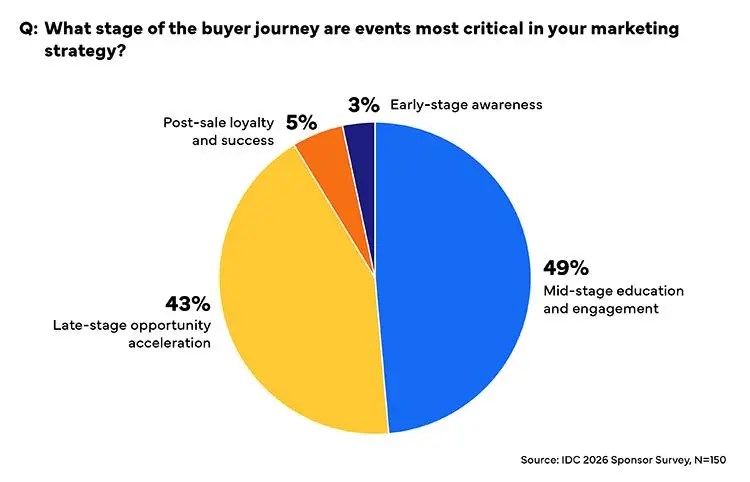
  • 90%+ say events deliver the most value in mid-to-late funnel stages

Hybrid Takes the Lead and the Budget

The format matters, and hybrid is winning.

When asked which formats they’ll prioritize in 2026:

  • 57% of marketers chose hybrid events as their top format
  • 58% expect their event budgets to increase next year

This reflects a push for flexible, scalable, and inclusive experiences that can drive personalized engagement at scale.

What Performance Looks Like in 2026

To prove impact, marketers are aligning event ROI with funnel-specific metrics:

Top success metrics:

  • Cost per opportunity (67%)
  • Lead quality and conversion (60%)
  • Deal influence in key accounts (43%)

Top challenges:

  • Complex execution (52%)
  • Delivering personalized experiences (42%)

Marketers aren’t just seeking impact,they need proof they can show upstream.

What Marketers Value Most in Event Partnerships

Marketers aren’t just choosing events; they’re choosing strategic ecosystems. The IDC survey reveals a strong alignment between what drives investment and what defines a valuable partner.

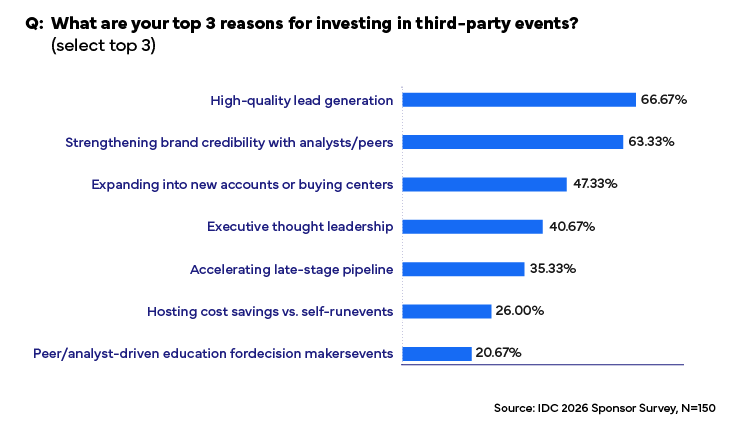
What drives investment in third-party events:

  • High-quality lead generation (67%)
  • Credibility through association with analysts or peers (63%)
  • Expansion into new accounts or buying centers (47%)

These motivators point to one thing: marketers want more than visibility; they want validation and velocity. Events must open doors, fast-track trust, and spark meaningful conversations.

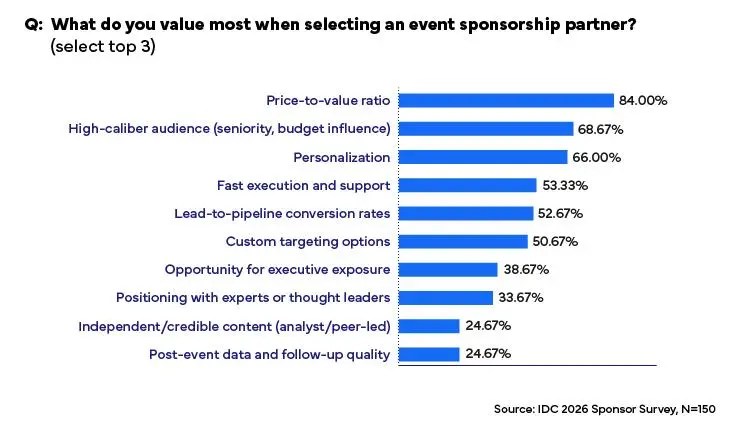
What defines the right partner:

  • Price-to-value ratio (84%)
  • High-caliber audience (seniority, budget influence) (69%)
  • Personalization (66%)
  • Fast execution and support (54%)
  • Lead-to-pipeline conversion performance (53%)
  • Custom targeting options (51%)

It’s not just about format or reach. Marketers are choosing partners that combine content credibility with precision targeting. In a complex buying environment, relevance, not just scale, wins.

Together, these findings reflect a clear mandate: outcomes matter. From tailored audience experiences to measurable lead progression, marketers are investing where value is both visible and verifiable.

Insight-Led Content Is the Difference-Maker

The success of an event hinges on relevance. That’s why marketers are doubling down on partners who bring audience precision and analyst-backed content.

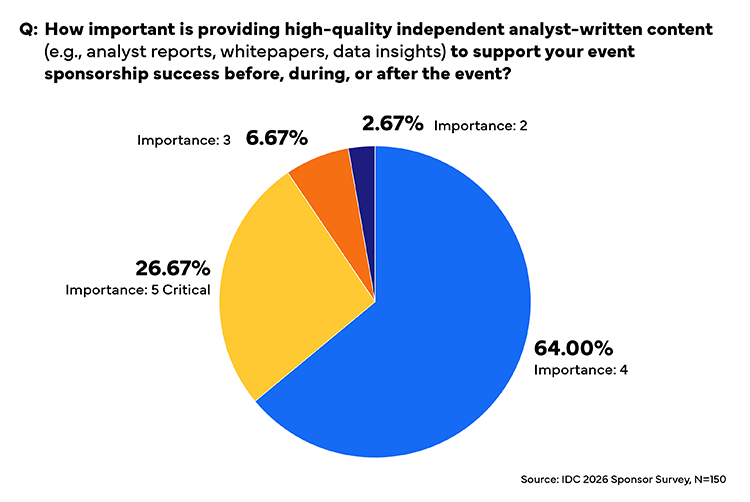
  • 91% say independent, analyst-led content is critical to event success
  • Trusted insight builds trust across every stage of engagement before, during, and after the event

Key takeaway: Price-to-value, audience quality, and credible content are top criteria when selecting event partners.

Navigate Your 2026 Strategy With Confidence

Events are no longer standalone experiences, they’re central pillars in a broader B2B growth strategy. When backed by trusted tech intelligence, the right formats, and analyst-led content, events can help your team hit every metric that matters.

Whether you’re optimizing your event calendar or rethinking your demand strategy, IDC’s insights are here to guide your next move.

🗓️ Explore the IDC 2026 Events Calendar
Discover the best opportunities to connect with your audience with data, formats, and partnerships that work.

The acronym CMO has traditionally stood for “Chief Marketing Officer,” but that role is evolving. The need for today’s midmarket CMOs to lead with clarity and vision is more important than ever.

A third of midmarket CMOs expect to take on the new title of Chief Market Officer, according to IDC’s 2025 Global Midmarket Tech CMO Priorities Survey. This shift signals broader leadership responsibilities, a deeper understanding of the market, and a central role in driving business growth.

But as the expectations placed on CMOs continue to rise, many are facing critical disconnects between what is expected of them and what they’re currently equipped to deliver.

The misalignment between exekutive expectations and marketing realities

The Pressure Cascade CMO’s are facing highlights a growing challenge: rising executive demands for innovation, AI-driven strategies, and customer acquisition are colliding with limited resources and skills gaps within marketing teams.

CMOs must act decisively to address these issues and secure their role as essential growth drivers within their organizations. Failure to do so risks diminishing marketing’s strategic relevance – and potential for transformation.

IDC has identified four critical disconnects holding back midmarket CMOs. Addressing these gaps is not only necessary, it’s urgent.

Many midmarket organizations believe they’ve adopted AI, but in reality efforts are fragmented and lack the necessary infrastructure and talent to scale. According to IDC’s MaturityScape Benchmark AI Survey, most companies remain in the “AI Pivot” stage, despite their beliefs that they’re further along in the AI journey.

While individual AI tools or pilots may be in place, they often lack a cohesive, strategic approach that aligns with broader business objectives. This gap between perceived and actual AI maturity leaves marketing teams underprepared to capitalize on AI’s full potential.

Why this can’t wait

CMOs who fail to address these challenges risk falling behind competitors who are fully integrating and leveraging AI to drive innovation and growth. Without a unified AI strategy, marketing can’t deliver on its transformative potential, leaving the organization at a competitive disadvantage.

How you can lead

By lifting the AI illusion and closing the gaps in AI adoption, you establish marketing as a central driver of innovation and growth. This is your chance to step into a leadership role and show that marketing isn’t just a function but a catalyst for long-term success.

As you fully integrate AI into your marketing strategy, you position your team to lead the charge in personalizing customer experiences, optimizing processes, and making data-driven decisions that directly contribute to business growth.

While the C-suite expects marketing to drive customer acquisition and fuel business growth, many CMOs continue to focus on retention and efficiency, according to the IDC Midmarket Survey.

Marketing leaders are prioritizing existing customer relationships and cutting costs, rather than aggressive executive growth strategies. This disconnect between corporate objectives and marketing’s internal goals limits CMOs’ ability to lead strategically.

Why this can’t wait

The pressure to drive growth is intensifying. CMOs who fail to align marketing’s efforts with executive expectations risk losing the confidence of the C-suite. When marketing remains focused on maintenance, it misses out on new market opportunities and limits its impact on the organization’s growth trajectory.

Without a strategic shift toward customer acquisition and new business development, CMOs risk being viewed as supporting players rather than transformation leaders, diminishing their organizational authority.

How you can lead

Position your department as a leader in expansion by shifting your focus toward growth, aligning marketing strategies with the C-suite’s expectations. This shift enables you to actively contribute to new revenue streams and enhance your organization’s competitive position.

With strategic rebalancing, marketing becomes a key player in achieving measurable business growth, firmly establishing your leadership role and delivering on your department’s potential for transformation.

Disconnect 3: The budget deadlock

As marketing teams are tasked with delivering high-impact results across the board, many CMOs face the reality of flat or insufficient budgets. More than half of CMOs expect no increase to their budget, found the IDC Midmarket survey.

This disconnect occurs when marketing is expected to drive tomorrow’s growth with yesterday’s financial resources, hindering the ability to invest in the necessary tools, technology, and talent. The added challenge of quantifying marketing’s value can frame it as a cost center rather than a revenue generator.

Why this can’t wait

Without the financial flexibility to execute growth strategies, marketing will struggle to meet rising executive demands. The inability to allocate resources to high-ROI initiatives such as AI, customer acquisition, and digital transformation will lead to missed opportunities. This disconnect can quickly erode marketing’s credibility and relevance within the company – and the market.

How you can lead

You can prove marketing’s worth as a driver of organizational growth by addressing the budget disconnect and securing the resources you need to act, not react.

With the right resources to execute your strategic vision, you’ll be empowered to develop initiatives to drive proactive AI integration, customer acquisition, and improved customer experiences – becoming an essential partner in business growth and demonstrating critical leadership value.

Disconnect 4: The execution crisis

Midmarket CMOs recognize the importance of orchestrating complex, AI-powered customer journeys and delivering personalized experiences, but many struggle with the execution. In fact, upskilling and hiring were found to be low priorities for marketing leaders who responded to the Midmarket survey.

Without the right infrastructure and talent, even the most well-conceived strategies will fall short, limiting marketing’s ability to execute at the scale required to meet organizational objectives.

Why this can’t wait

As expectations for marketing continue to grow, failure to close the execution gap poses a serious risk. Ineffectively executed strategies lead to missed opportunities, fragmented customer experiences, and eroded executive trust.

In an increasingly competitive market where speed and agility are crucial, organizations that cannot execute swiftly and effectively will be outpaced by competitors. The execution crisis jeopardizes marketing’s ability to deliver measurable, timely results, weakening its strategic position.

How you can lead

By overcoming the execution crisis, you establish marketing as a results-driven function that consistently achieves wins. Building clear operational frameworks, defining roles, and empowering skilled teams ensure your marketing initiatives can be executed effectively and at scale.

This transformation enables marketing to lead with precision, translating strategic visions into impactful business outcomes and solidifying your role as a critical driver of organizational success.

Reconnect the disconnects and become a leader

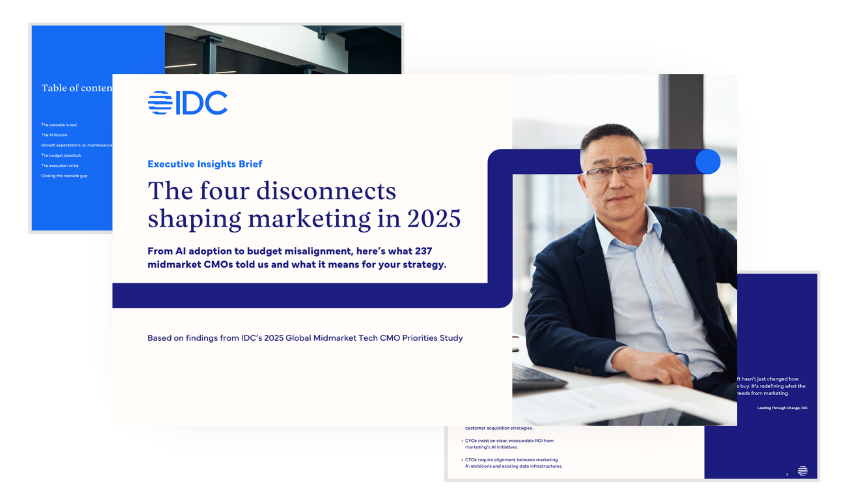
screenshot of ebook

The four disconnects aren’t just operational challenges: They’re strategic barriers preventing marketing from reaching its full potential. As a CMO, now is the time to step up and lead.

By addressing these disconnects head-on, you can transform marketing from a perceived support function to a recognized driver of growth and innovation.

The ability to successfully overcome these gaps will help you make the leap from Chief Marketing Officer to Chief Market Officer: an authority who not only meets the rising expectations of the C-suite but shapes broader market trajectories.

The urgency to resolve these disconnects is more than just about staying competitive. It’s about asserting marketing’s place at the heart of business transformation. The time to act is now.

Are you ready to fully align your marketing strategy with executive demands? Learn more about the four disconnects shaping marketing and unlock 13 proven strategies for bridging these critical marketing disconnects and lead with confidence.

As 2026 planning accelerates, high-performing GTM teams are doing more than building campaigns. They’re stress-testing their positioning. Not just for alignment with internal priorities, but for resonance with evolving buyer expectations, stakeholder dynamics, and budget scrutiny. 

It’s not about tearing everything down. It’s about refining what’s already strong and spotting the subtle misalignments that weaken performance over time. 

Here’s what we’re seeing from top-performing marketing and strategy teams as they get ready for 2026: 

1. They’re building from buyer economics, not brand preference

The strongest value narratives in 2026 are rooted in how buyers think—not just what they want. That means anchoring messaging in: 

  • Business outcomes that map to line-of-business KPIs
  • Time-to-impact metrics relevant to finance, RevOps, and procurement
  • Proof points that connect product value to real spend categories and budget decisions

2. They’re aligning to who the buyer really is now

Your champion might still be in product or IT, but the buying committee has expanded. In many 2026 deals, procurement, RevOps, and CFOs are shaping final evaluations. And they’re asking different questions: 

  • “Where does this fit in the broader vendor stack?”
  • “What are the operational metrics tied to this investment?”
  • “How does this align with compliance and risk management goals?”

Messaging that focuses only on user value misses the table where decisions are made. 

3. They’re checking internal alignment before buyers do

Too often, what strategy wants to say, what sales is saying, and what analysts are saying don’t line up. And when those narratives diverge, the buyer journey slows or stalls. 

Leading teams are investing in shared narratives built on external signals, not just internal direction. Because when analyst commentary doesn’t match your positioning, buyers notice. And they move on. 

Want a deeper checkpoint?

This guide outlines the most common (and often hidden) signs of misalignment we’re seeing in enterprise GTM efforts right now, along with steps you can take to course-correct using IDC data. 

Because in this market, the risk isn’t messaging that’s “wrong.” It’s messaging that’s “just a little off”. 

Tech marketers are no strangers to low conversion rates, tight budgets, and the ongoing quest to create content that both informs and influences. Foundational assets like white papers and infographics still play a critical role in that journey, but even the most informative content often struggles to gain traction. 

It’s not that the content isn’t valuable. It’s that it’s not being seen in the right way, by the right people, at the right moment. 

The hidden cost of content that sits still

You invest in building authoritative, data-rich content. But if the only people who see it are those who download the full asset, you’re limiting its reach, and its return. 

Today’s marketing leaders are rethinking how they activate content. They aren’t replacing white papers, InfoBriefs, or foundational research assets, but amplifying them with visual formats that scale attention, spark engagement, and lead audiences back to the deeper story. 

That might mean turning key insights into short-form video narratives or extracting the most compelling stats into modular social tiles that spark curiosity and direct traffic back to the full story. 

The goal isn’t simplification. It’s strategic amplification with visual storytelling. 

Today’s buyer journey is social, visual, and fast

IDC’s global buyer research confirms what many B2B marketers already feel: decision-makers are consuming more content across more formats, and they expect relevance within seconds. 

That means:

  • Visual-first content that leads with a bold and clear message
  • Formats optimized for feeds, not files
  • Thought leadership that feels human, timely, and on-message
  • A content ecosystem where each asset earns its next audience

Think of it as a launchpad, not a shortcut

A well-crafted white paper still delivers depth. A research spotlight still builds credibility. What’s changed is how those assets drive pipeline activation. 

It’s not about doing more. It’s about making what you already do work harder to drive the engagement you need. 

Get more from every message

At IDC, we help marketing teams elevate their core content with formats built for the channels where attention lives. Our Video Portfolio and Infographic Social Tiles are designed to extend the reach, resonance, and ROI of foundational thought leadership assets. 

When your content is backed by data, delivered by experts, and formatted for how buyers actually consume, it doesn’t just inform. It moves. 

AI is quickly transforming what marketing teams are capable of: automating routine tasks, delivering instant insights, and powering deeply personalized customer experiences. But for all its promise, AI is only as effective as the people and processes guiding it.

And that’s where many organizations are hitting a wall.

As marketing strategies grow more complex and technology becomes more advanced, the internal capabilities needed to execute at scale haven’t kept pace. The result? A widening execution gap: the disconnect between what marketing promises and what teams are equipped to deliver.

Thirty-seven percent of CMOs say creating a unified omnichannel experience will have the greatest influence on their marketing strategy over the next 12-18 months, according to IDC’s 2025 Global Midmarket Tech CMO Priorities Survey.

Yet in practice, most teams lack the operational infrastructure to make that experience a reality. Defined roadmaps, repeatable processes, and specialized talent remain in short supply. Only 15% of CMOs say upskilling or hiring for new roles such as AI prompters, data scientists, or digital experience designers is a top priority.

That percentage is strikingly low given what lies ahead. Over the next two years, more than a quarter of digital marketing, journey orchestration, and campaign optimization tasks are expected to shift to AI.

This is the execution gap in action, and it is one of the four critical disconnects IDC has identified for marketing today.

screenshot of ebook

Skills gaps puts CMOs out of step with the C-suite

So where is the focus instead?

Currently, many teams are prioritizing customer retention and cost reduction — another of IDC’s identified disconnects. Looking ahead, priorities are expected to shift toward customer acquisition. But even then, areas like MarTech modernization, AI implementation, and upskilling continue to rank lower than expected, despite mounting pressure from the top.

Thirty-four percent of midmarket CMOs say their executive team expects modernization of MarTech, including AI integration, in the next 12 to 18 months.

The expectation is clear: marketing must lead with speed, precision, and scalable results.

CMOs acknowledge the need for bold. But without internal talent to support execution, strategies stall before they scale.

Meeting buyer expectations requires the right talent

This pressure isn’t just coming from the C-suite. Buyers are raising the bar, too.

Real-time personalization, seamless channel transitions, and responsive engagement are now baseline expectations. Meeting those expectations increasingly depends on AI. From automating workflows to dynamically tailoring content, AI enables marketing to deliver consistent, context-aware experiences at scale.

But without the right talent in place, AI’s promise remains unfulfilled. Personalization remains superficial. Campaigns stall. And performance suffers. Not because the strategy is wrong, but because the team isn’t equipped to deliver on it.

Technology alone won’t drive results

It’s tempting to think that new technology can make up for talent gaps. Just over 35% of midmarket CMOs believe AI-enabled marketing technologies have the greatest potential to help their organization achieve its marketing goals over the next 12-18 months, according to the Midmarket survey. However, AI doesn’t eliminate the need for skilled marketers. It magnifies it.

Automation can handle repetitive processes, but people are needed to:

  • Identify where AI adds value.
  • Interpret outputs and make context-driven decisions.
  • Integrate insights into broader strategies that reflect brand, buyer, and business needs.

That’s why it’s so concerning that skills development continues to lag. Without the internal capabilities to orchestrate and govern AI, even well-resourced marketing organizations risk underutilizing their investments. Execution doesn’t hinge on the tools in place; it hinges on the people who know how to use them well.

Redefining the skills that power modern marketing

Closing the execution gap means redefining what modern marketing excellence looks like. Roles in strategy, journey orchestration, campaign optimization, advertising, and creative will all have the most tasks delegated to AI/GenAI in the next two years. However, delegation doesn’t equal replacement. Instead, deeper fluency in the systems, data, and experiences that AI supports will be necessary.

In order to compete, teams must build capability in three key areas:

  1. AI and automation fluency: Knowing when to trust automation, how to fine-tune outputs, and when to step in and redirect AI-driven decisions.
  2. Data literacy and analytics: Understanding how to translate performance signals into actionable insights and aligning those insights with strategic business outcomes.
  3. Digital experience design: Creating cohesive, cross-channel journeys requires fluency in UX, content strategy, and personalization technologies.

CMOs who invest in developing these skills position their teams to execute at scale and lead in a rapidly transforming marketplace.

The execution gap widens every quarter you wait

The execution gap only compounds with time. The longer it goes unaddressed, the more it begins to show up in tangible ways: slower campaign activation, fragmented customer journeys, and a growing reliance on external vendors that reduce agility and inflate costs. Measurement and optimization also suffer, as internal teams struggle to connect AI-driven activity to business outcomes.

Meanwhile, AI isn’t going anywhere. In fact, the AI economy is predicted to reach $22.3 trillion globally by 2030, accounting for 3.7% of global GDP, according to IDC’s Macroeconomic Center of Excellence. That scale of transformation will require deliberate, enterprise-wide investment in people, process, and capability.

In a competitive environment where speed, efficiency, and relevance are already defining market leaders, the cost of inaction grows with every quarter. Organizations investing in execution readiness now are positioning themselves to lead.

And perhaps most importantly, the execution gap threatens marketing’s strategic credibility. As C-suite expectations continue to rise, leadership won’t be looking for plans. They’ll be looking for proof.

Solve your execution crisis today

Today, the marketing teams best positioned to deliver will be those with the skills to move quickly, adapt intelligently, and orchestrate AI-enabled experiences with precision. To do that, CMOs must act now to assess, address, and develop the capabilities their teams need to keep pace with evolving expectations.

Explore the four disconnects shaping marketing in 2025. Uncover the gaps holding back growth—and the strategies to close them. Visit our landing page to access insights, frameworks, and next steps for aligning with executive priorities and leading with confidence in an AI-driven market.