In two earlier posts I argued that SaaS is being disrupted rather than killed, and that the per-seat revenue model is on its way out. The dramatic decline in market capitalization of SaaS vendors over the past 9 months, sometimes referred to as the SaaS-pocalypse, is partly about investors pricing in the fear that SaaS applications will recede behind an AI agent layer. This would make the SaaS applications become invisible “featureware,” with the agent capturing the user relationship, the workflow, and, eventually, the budget. 

This post will show that enterprise buyers now expect their software vendors to supply the agents, and to serve as the trusted source of data and context for custom-built and third-party agents. This is the natural next progression for SaaS vendors and represents an attractive market opportunity. 

To avoid confusion, here are IDC’s AI-related definitions. An AI assistant is conversational and works as a tool for a human. An AI agent is autonomous, uses other tools, and carries memory and context across tasks. An agentic workflow is a business process that an agent executes end-to-end with limited human intervention. 

SaaS vendors are faced with a dual threat, hence SaaS-pocalypse 

The first threat is that organizations will simply write their own applications instead of buying standard SaaS applications. This threat triggered the dramatic devaluation of SaaS stock in February as Anthropic released its Code capabilities. Conversations with CIOs in enterprises partly validate this fear. While they are not contemplating creating core accounting, HRIS or workforce management applications, they might build rather than buy auxiliary applications in areas such as planning, performance management, compensation management, logistics planning, etc. Application areas where customer requirements vary widely and where legal complexity is low are moving gradually from buy to build. 

The second threat is that agentic overlays will increasingly handle the user interaction while AI agents access SaaS applications via API interfaces to carry out transactions on behalf of the human user. The implication is key price justifiers of SaaS applications, such as the interface, the feature breadth, and the brand gradually disappears from the users. This also implies that the per-seat user pricing stop making sense, when humans are no longer the primary users of SaaS applications. 

AI agent adoption is already past the tipping point 

In IDC’s April 2026 Future Enterprise Resiliency and Spending survey of organizations with 500 or more employees, 74% had already deployed at least one agent, 15% were piloting, and only 1% reported no use and no plans. The same respondents expect the number of agent types in production to roughly triple, from 24 in March 2026 to 62 by 2027. Buyers are not evaluating whether to enter the agentic era. They are deciding which parts of their operation to hand over first, and operational and core business data are their top target. 

The big question is who will deliver these AI agents. Most organizations have deployed standard AI tools and run pilots, but few have redesigned core processes to use AI at scale. The survey results shows that most organizations deploy ready-made agents wherever they can, rather than build their own. 

Where vendor-supplied agents win 

IDC distinguishes four kinds of agent by who builds them and how the buyer obtains them. In-application agents come packaged inside the application and the buyer simply adopts them. Low-code / no-code agents are configured by the buyer in a visual builder the vendor provides. Standalone agents are third-party products the buyer implements alongside existing applications. Custom-built agents are assembled by internal teams using full-stack orchestration frameworks. 

The survey data, which focuses on AI agent quantities as opposed to spend, points in one direction. The two types that vendors supply directly, in-application agents and low-code or no-code builders, are growing fastest in numbers and from the largest installed base. Custom-built agents show the slowest growth, because the orchestration they require is more difficult and require more inhouse skills to build. Buyers prefer to adopt or configure an agent that already understands their data and respects their permissions over building one from scratch. 

SaaS applications as trusted data and context for custom-built agents 

IDC also sees massive demand for custom-built AI agents, especially for core business processes unique to an industry or organization. Standalone products and custom-built agents will operate inside the same enterprise, and they will need data and context that lives inside your application. 

A custom-built or third-party agent that accesses data “from anywhere” still needs a place where the data is correct, the process is compliant, the permissions are enforced, and the transaction is guaranteed to execute. A SaaS vendor can offer vetted business processes, governed data, and audit trails for custom AI agent consumption. This is, in IDC’s view, a key future role for today’s SaaS applications. 

What the AI-pivoted SaaS application looks like 

The interface stops being a single screen and becomes several modes serving the same processes: the traditional UI, a conversational UI, a flow-of-work UI embedded where the user already operates, and machine interfaces so external agents can call the application directly and safely. 

The AI-pivot requires SaaS vendors to rethink the workflow from the ground up, which touches the full stack: foundation models, an embedding layer, a vector database, retrieval-augmented generation, an orchestration layer, guardrails, monitoring, and version management. The vendor also has to give buyers an agent toolkit of their own, so that the low-code and no-code configuration buyers increasingly demand happens inside the vendor’s governed environment rather than outside it. 

European vendors carry an additional set of requirements that, handled well, become a selling advantage. Compliance with GDPR, NIS2, and the EU AI Act (still there despite the recent delay), data residency and sovereign cloud guarantees, genuine multi-language model performance, and transparency in how the AI reaches a decision are all conditions of sale to compliance-sensitive European buyers. 

SaaS is not dead, and the incumbents are not doomed. But the asset that justifies a vendor’s existence is shifting from the screen the user looks at to the agents the vendor supplies and the governed data those and other agents rely on. Your customers already expect you to be their agent supplier. The only question is whether you are ahead of that shift or reacting to it. 

So, what do you actually do with this? There are three concrete moves software vendors need to make in the near term. They are specific, they are sequenced, and the window to move first is closing. I will walk through all three in a focused 25-minute webcast, grounded in IDC survey data from more than 1,000 enterprise organisations: where your customers sit on the AI maturity curve, why vendor-supplied agents will dominate enterprise deployments through 2030, and which ERP and SaaS processes are attracting the most AI investment right now. Secure your spot here. 
Bo Lykkegaard

Bo Lykkegaard - Associate VP for Software Research Europe

Bo Lykkegaard is associate vice president for the enterprise-software-related expertise centers in Europe. His team focuses on the $172 billion European software market, specifically on business applications, customer experience, business analytics, and artificial intelligence. Specific research areas include market analysis,…

これまで、国内のビジネスコンサルティング市場の成長は、個別テーマへの需要と、それを担うコンサルタントの人員拡大によって説明されてきました。「需要が増えれば人を増やし、売上が伸びる」これが長く前提とされてきた成長の方程式です。

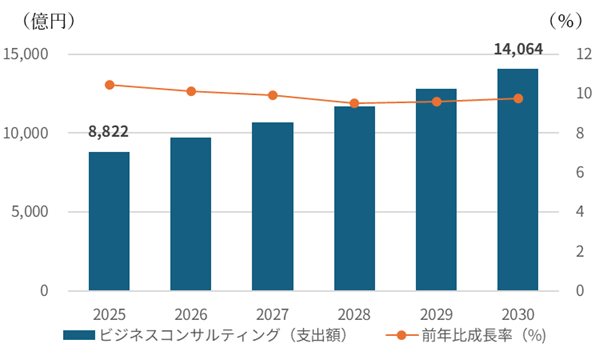
しかし、その前提は変わりつつあります。IDCは、国内ビジネスコンサルティング市場の支出額が、2025年の約8,822億円から2030年には約14,064億円へと、年間平均成長率(CAGRCompound Annual Growth Rate9.8%で拡大を続けると予測しています。

注目すべきは規模だけではありません。AIを核とした企業変革が市場を牽引する中で、案件の規模や収益化、そして成長と人員数の関係そのものが構造的に変化し始めています。本稿では、IDCの最新予測から読み解ける3つの構造変化を解説します。

構造変化(1)AIを核とした「全社変革」が市場を牽引し、案件が大型化する

成長の最大のドライバーは、企業のAI活用と変革需要です。生成AIやエージェンティックAIが「試す」段階から「変革する」段階へ移行し、局所的なAI導入ではなく、業務プロセス・データ基盤・組織体制を一体的に変革する全社変革型の案件が増え、ディールサイズの大型化と複数年にわたる長期プログラム化が進んでいます。

この動きはセグメント別の成長率にも表れています。業務改善コンサルティングは、AIエージェントの業務実装支援やERPのサポート終了(EOS)対応、レガシーモダナイゼーションに伴う上流支援を背景に、全セグメントで最も高い成長を示す見通しです。組織/変革コンサルティングも、後述する「人と組織」の変革需要を背景に堅調な成長が見込まれます。

構造変化(2):「人員増を上回る成長」への転換

より本質的な変化は、売上成長と人員数の関係が切り離され始めていることです。従来の労働集約的な人月モデルに対し、人員数の伸びを上回るペースで売上を拡大するファームが増えています。背景には、複数の要因が同時に作用しています。

  • フィー単価の上昇:人材の供給不足を背景に、案件単価が人員数の伸びを上回って上昇し、1人当たり売上を押し上げています。
  • ソリューション化・アセット化:再利用可能なフレームワークやAIツール、業界別テンプレートを提供物に組み込み、人員を比例的に増やさずに価値を拡大しています。
  • グローバルデリバリーの活用:海外デリバリーセンターやニアショア/オフショアを活用し、国内人員コストを抑えながら供給能力を拡張しています。
  • AIによるデリバリー生産性の向上:現時点で「劇的」ではないものの、1人当たり売上額の着実な向上として表れ始めており、2030年に向けて効果は累積していきます。

さらに中長期では、提供モデルそのものの変容も萌芽的に進んでいます。

  • 成果報酬型(アウトカムベース)契約:顧客の成果指標に連動した報酬設計。
  • プラットフォーム/マネージドサービス型:継続的な収益(リカーリング)を生む提供形態。
  • BOT型・内製化支援:顧客の自走を支えるBOT(Build-Operate-Transfer)型の関与モデル。
  • GCCの活用支援:GCC(グローバルケイパビリティセンター)の構築・活用支援。

これらはまだ一部にとどまりますが、顧客の価値可視化ニーズの高まりとともに採用事例は増えており、人月依存型モデルからの構造転換がファーム各社の戦略課題として明確になりつつあります。

構造変化(3):「人と組織」の変革支援が成長の中核テーマに

企業変革の主軸は、戦略と業務、人と組織、テクノロジー(AI)を横断する形へと拡張しており、中でも「人と組織」の変革支援の重要性が高まっています。全社的なAI変革においてチェンジマネジメントとタレント支援は不可分であり、その需要は単独の案件としてだけでなく、大型変革案件の不可欠な構成要素として組み込まれる傾向を強めています。具体的には、以下のような領域で需要が拡大しています。

  • リスキリング/アップスキリング:AIを前提とした働き方に向けた人材育成。
  • 人的資本経営(HCM):戦略立案から実践までの支援。
  • ワークフォース変革:AIケイパビリティを軸とした役割・組織・チームの再設計。
  • チェンジマネジメント:大型変革プログラムに組み込まれる変革推進支援。

これらは経営戦略や財務・経理など他機能と統合され、複合的な「経営課題」として扱われるようになっています。組織変革の実績を持たないファームは、最も価値の高い変革案件を獲得・維持することが難しくなりつつあります。

ビジネスコンサルティングはITコンサルティングを上回る成長を続ける

国内コンサルティング市場全体(ビジネス+IT)は、2025年の約1兆4,554億円から2030年には約2兆2,897億円へと拡大します。このうちビジネスコンサルティングはCAGR 9.8%でITコンサルティング(同9.0%)をわずかに上回り、全体に占める構成比は2025年の60.6%から2030年には61.4%へと緩やかに上昇する見通しです。背景には、AIを核とした変革の入り口が「経営アジェンダ」からトップダウンで設定されるようになり、戦略立案や業務変革設計といったビジネスコンサルティング領域から案件が起動するケースが増えています。主要事業者の多くが上流のビジネス領域とIT実装を一体化したデリバリーへ移行しており、ビジネスコンサルティング比率の高い案件が収益成長を牽引しています。

コンサルティング事業者のリーダーへの示唆:2030年に向けた5つの戦略的優先事項

以上の構造変化を踏まえると、市場の拡大に乗るだけのファームは、構造転換を進めた競合に成長率で劣後するおそれがあります。次の成長フェーズを取り込むために、各社が優先すべき打ち手は明確になりつつあります。

  • AIを核とした全社変革案件の獲得:個別ソリューションではなく、複数年にわたる大型プログラムにポジショニングする。
  • AIによるデリバリー生産性への投資:競争要件になる前に、今から体制と仕組みを構築する。
  • スケーラブルなソリューション・アセットの整備:人員数に比例しない収益構造へ転換する。
  • 「人と組織」の変革ケイパビリティの確立:最大級の案件を勝ち取る鍵として、組織変革の実績を積む。
  • 成果報酬型・プラットフォーム型モデルの探索:価値の可視化を求める顧客の増加に備える。

国内ビジネスコンサルティング市場は、これからも堅調に拡大します。しかし、その成長の「中身」は、AIを前提とした提供モデルへの転換と、「人と組織」を中核に据えた全社変革支援へと確実にシフトしていきます。この構造変化を早期に捉え、自社のオファリング・人材・デリバリー体制を適応させたファームこそが、2030年に向けた次の成長フェーズを取り込むことができるでしょう。

関連する調査やご相談について 本稿は『国内ビジネスコンサルティング市場予測、2026年~2030年』(IDC #JPJ53501026、2026年5月発行)[MD1][TU2]に基づいています。市場規模・予測の詳細、セグメント別・産業分野別のデータ、主要事業者の動向については、当社アナリストへお気軽にご相談ください[MD3][TU4] 。

植村 卓弥 (Takuya Uemura) - Senior Research Manager, AI and Automation, IDC Japan - IDC Japan

IDC Japanにおいて、年間情報提供プログラムであるJapan AI and Data Platformsのリードアナリストとして、国内AI市場について、サービス/ソフトウェア/インフラストラクチャといったテクノロジースタック全般の予測やシェアの調査/分析を担当する。 IDCでは、15年以上に渡り、ビジネスコンサルティングやITサービス市場などサービス市場全般の予測や競合分析、企業ユーザーニーズなどの調査を担当し、国内市場におけるデジタルトランスフォーメーション/デジタルビジネスの動向と、これらを実現するサービス市場(デジタルビジネスプロフェッショナルサービス市場)についての専門性を持つ。 IDC Japan入社前は、主に国内大手IT ベンダー/通信事業者/電機メーカーなどに向けて、上位レイヤーサービスや各種製品の事業性評価などの調査・コンサルティングに従事。IT関連市場においてSMBを含む法人、消費者の各市場分野についての定量、定性両面の調査経験を有する。 【専門の分野/テーマ】 国内AI市場 国内企業のAI駆動型(AI Fueled)ビジネス動向

これまで、国内のビジネスコンサルティング市場の成長は、個別テーマへの需要と、それを担うコンサルタントの人員拡大によって説明されてきました。「需要が増えれば人を増やし、売上が伸びる」これが長く前提とされてきた成長の方程式です。

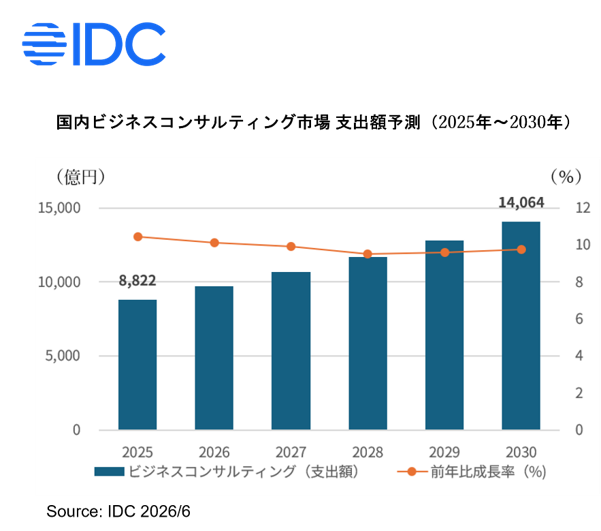
しかし、その前提は変わりつつあります。IDCは、国内ビジネスコンサルティング市場の支出額が、2025年の約8,822億円から2030年には約1兆4,064億円へと、年間平均成長率(CAGR:Compound Annual Growth Rate)9.8%で拡大を続けると予測しています。

2025の市場規模(支出額)

8,822億円

2030年までのCAGR

9.8%

注目すべきは規模だけではありません。AIを核とした企業変革が市場を牽引する中で、案件の規模や収益化、そして成長と人員数の関係そのものが構造的に変化し始めています。本稿では、IDCの最新予測から読み解ける3つの構造変化を解説します。

図表1:国内ビジネスコンサルティング市場 支出額予測(2025年~2030年)

Source: IDC 2026/6

構造変化(1)AIを核とした「全社変革」が市場を牽引し、案件が大型化する

成長の最大のドライバーは、企業のAI活用と変革需要です。生成AIやエージェンティックAIが「試す」段階から「変革する」段階へ移行し、局所的なAI導入ではなく、業務プロセス・データ基盤・組織体制を一体的に変革する全社変革型の案件が増え、ディールサイズの大型化と複数年にわたる長期プログラム化が進んでいます。

この動きはセグメント別の成長率にも表れています。業務改善コンサルティングは、AIエージェントの業務実装支援やERPのサポート終了(EOS)対応、レガシーモダナイゼーションに伴う上流支援を背景に、全セグメントで最も高い成長を示す見通しです。組織/変革コンサルティングも、後述する「人と組織」の変革需要を背景に堅調な成長が見込まれます。

構造変化(2):「人員増を上回る成長」への転換

より本質的な変化は、売上成長と人員数の関係が切り離され始めていることです。従来の労働集約的な人月モデルに対し、人員数の伸びを上回るペースで売上を拡大するファームが増えています。背景には、複数の要因が同時に作用しています。

  • フィー単価の上昇:人材の供給不足を背景に、案件単価が人員数の伸びを上回って上昇し、1人当たり売上を押し上げています。
  • ソリューション化・アセット化:再利用可能なフレームワークやAIツール、業界別テンプレートを提供物に組み込み、人員を比例的に増やさずに価値を拡大しています。
  • グローバルデリバリーの活用:海外デリバリーセンターやニアショア/オフショアを活用し、国内人員コストを抑えながら供給能力を拡張しています。
  • AIによるデリバリー生産性の向上:現時点で「劇的」ではないものの、1人当たり売上額の着実な向上として表れ始めており、2030年に向けて効果は累積していきます。

さらに中長期では、提供モデルそのものの変容も萌芽的に進んでいます。

  • 成果報酬型(アウトカムベース)契約:顧客の成果指標に連動した報酬設計。
  • プラットフォーム/マネージドサービス型:継続的な収益(リカーリング)を生む提供形態。
  • BOT型・内製化支援:顧客の自走を支えるBOT(Build-Operate-Transfer)型の関与モデル。
  • GCCの活用支援:GCC(グローバルケイパビリティセンター)の構築・活用支援。

これらはまだ一部にとどまりますが、顧客の価値可視化ニーズの高まりとともに採用事例は増えており、人月依存型モデルからの構造転換がファーム各社の戦略課題として明確になりつつあります。

構造変化(3):「人と組織」の変革支援が成長の中核テーマに

企業変革の主軸は、戦略と業務、人と組織、テクノロジー(AI)を横断する形へと拡張しており、中でも「人と組織」の変革支援の重要性が高まっています。全社的なAI変革においてチェンジマネジメントとタレント支援は不可分であり、その需要は単独の案件としてだけでなく、大型変革案件の不可欠な構成要素として組み込まれる傾向を強めています。具体的には、以下のような領域で需要が拡大しています。

  • リスキリング/アップスキリング:AIを前提とした働き方に向けた人材育成。
  • 人的資本経営(HCM):戦略立案から実践までの支援。
  • ワークフォース変革:AIケイパビリティを軸とした役割・組織・チームの再設計。
  • チェンジマネジメント:大型変革プログラムに組み込まれる変革推進支援。

これらは経営戦略や財務・経理など他機能と統合され、複合的な「経営課題」として扱われるようになっています。組織変革の実績を持たないファームは、最も価値の高い変革案件を獲得・維持することが難しくなりつつあります。

ビジネスコンサルティングはITコンサルティングを上回る成長を続ける

国内コンサルティング市場全体(ビジネス+IT)は、2025年の約1兆4,554億円から2030年には約2兆2,897億円へと拡大します。このうちビジネスコンサルティングはCAGR 9.8%でITコンサルティング(同9.0%)をわずかに上回り、全体に占める構成比は2025年の60.6%から2030年には61.4%へと緩やかに上昇する見通しです。背景には、AIを核とした変革の入り口が「経営アジェンダ」からトップダウンで設定されるようになり、戦略立案や業務変革設計といったビジネスコンサルティング領域から案件が起動するケースが増えています。主要事業者の多くが上流のビジネス領域とIT実装を一体化したデリバリーへ移行しており、ビジネスコンサルティング比率の高い案件が収益成長を牽引しています。

コンサルティング事業者のリーダーへの示唆:2030年に向けた5つの戦略的優先事項

以上の構造変化を踏まえると、市場の拡大に乗るだけのファームは、構造転換を進めた競合に成長率で劣後するおそれがあります。次の成長フェーズを取り込むために、各社が優先すべき打ち手は明確になりつつあります。

  • AIを核とした全社変革案件の獲得:個別ソリューションではなく、複数年にわたる大型プログラムにポジショニングする。
  • AIによるデリバリー生産性への投資:競争要件になる前に、今から体制と仕組みを構築する。
  • スケーラブルなソリューション・アセットの整備:人員数に比例しない収益構造へ転換する。
  • 「人と組織」の変革ケイパビリティの確立:最大級の案件を勝ち取る鍵として、組織変革の実績を積む。
  • 成果報酬型・プラットフォーム型モデルの探索:価値の可視化を求める顧客の増加に備える。

国内ビジネスコンサルティング市場は、これからも堅調に拡大します。しかし、その成長の「中身」は、AIを前提とした提供モデルへの転換と、「人と組織」を中核に据えた全社変革支援へと確実にシフトしていきます。この構造変化を早期に捉え、自社のオファリング・人材・デリバリー体制を適応させたファームこそが、2030年に向けた次の成長フェーズを取り込むことができるでしょう。

関連する調査やご相談について

本稿は『国内ビジネスコンサルティング市場予測、2026年~2030年』(IDC #JPJ53501026、2026年5月発行)に基づいています。市場規模・予測の詳細、セグメント別・産業分野別のデータ、主要事業者の動向については、当社アナリストへお気軽にご相談ください。

植村 卓弥 (Takuya Uemura) - Senior Research Manager, AI and Automation, IDC Japan - IDC Japan

IDC Japanにおいて、年間情報提供プログラムであるJapan AI and Data Platformsのリードアナリストとして、国内AI市場について、サービス/ソフトウェア/インフラストラクチャといったテクノロジースタック全般の予測やシェアの調査/分析を担当する。 IDCでは、15年以上に渡り、ビジネスコンサルティングやITサービス市場などサービス市場全般の予測や競合分析、企業ユーザーニーズなどの調査を担当し、国内市場におけるデジタルトランスフォーメーション/デジタルビジネスの動向と、これらを実現するサービス市場(デジタルビジネスプロフェッショナルサービス市場)についての専門性を持つ。 IDC Japan入社前は、主に国内大手IT ベンダー/通信事業者/電機メーカーなどに向けて、上位レイヤーサービスや各種製品の事業性評価などの調査・コンサルティングに従事。IT関連市場においてSMBを含む法人、消費者の各市場分野についての定量、定性両面の調査経験を有する。 【専門の分野/テーマ】 国内AI市場 国内企業のAI駆動型(AI Fueled)ビジネス動向

国际数据公司(IDC)最新发布的2026年第一季度全球耳戴市场数据显示,开放式耳机出货量同比增长39.9%,在整体耳戴市场仅增长3.9%的背景下表现突出。但IDC认为,比增速更值得关注的是品类结构,竞争格局与市场需求的多重转变。品类结构上,耳夹式占比首次过半,稳固其主流产品形态的地位。当前全球开放式耳机市场由中国厂商主导,海外品牌加速入局,行业竞争持续升温。与此同时,AI技术为市场注入全新动能,智能化将成为下一阶段竞争核心。

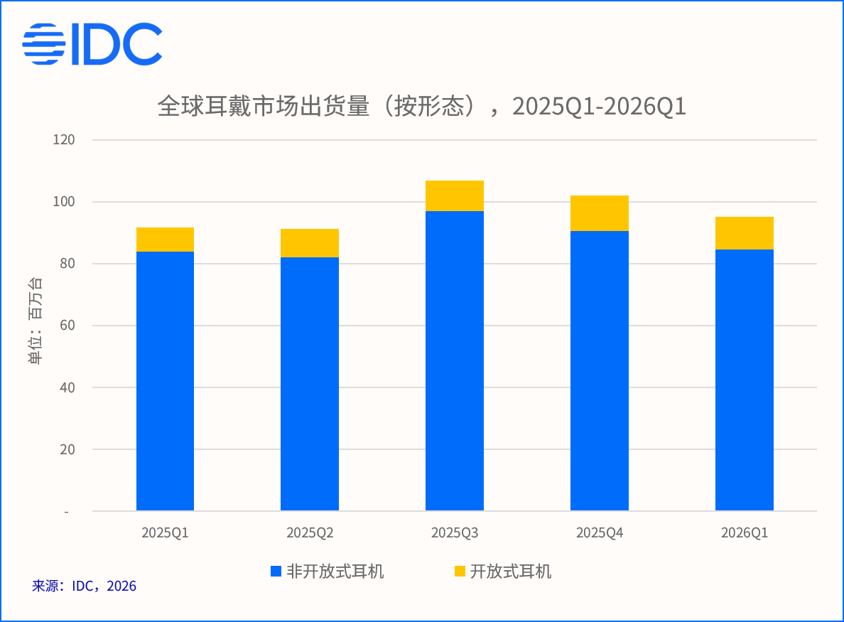
根据IDC最新发布的《全球可穿戴设备市场季度跟踪报告,2026年第一季度》显示,2026年一季度全球耳戴市场出货9,520万台,其中开放式出货1,067万台,同比增长39.9%,占比达到11.2%。凭借差异化的佩戴体验,开放式耳机在蓝牙耳机品类中的出货占比正持续攀升。

IDC三大核心洞察

结合开放式整体市场走势与市场竞争态势,2026年一季度全球开放式市场耳机三大核心洞察如下:

洞察一:细分品类格局重塑,耳夹式领跑市场增长

开放式耳机细分形态迎来明显更迭,品类内部竞争格局持续重构。2026年一季度,耳夹式在开放式产品中占比54.3%,同比份额增幅超10个百分点,已成为全球开放式耳机的主流形态。该品类凭借精巧的外观与多场景适配的能力受到市场认可,叠加时尚属性带来的溢价能力,部分采取机海战术的厂商逐步调整布局重心,从耳挂式赛道转向加码耳夹式产品。耳挂式同比增长11.8%,市场份额有所回落,凭借佩戴稳定性,现阶段头部品牌主要聚焦于运动细分场景。作为开放式领域成熟度最高的品类,颈挂式产品凭借骨传导技术深耕运动赛道,并依托游泳等专属场景稳固市场定位,同比增长11.9%,增速保持稳健。

洞察二:中国厂商主导市场,差异化竞争格局深化

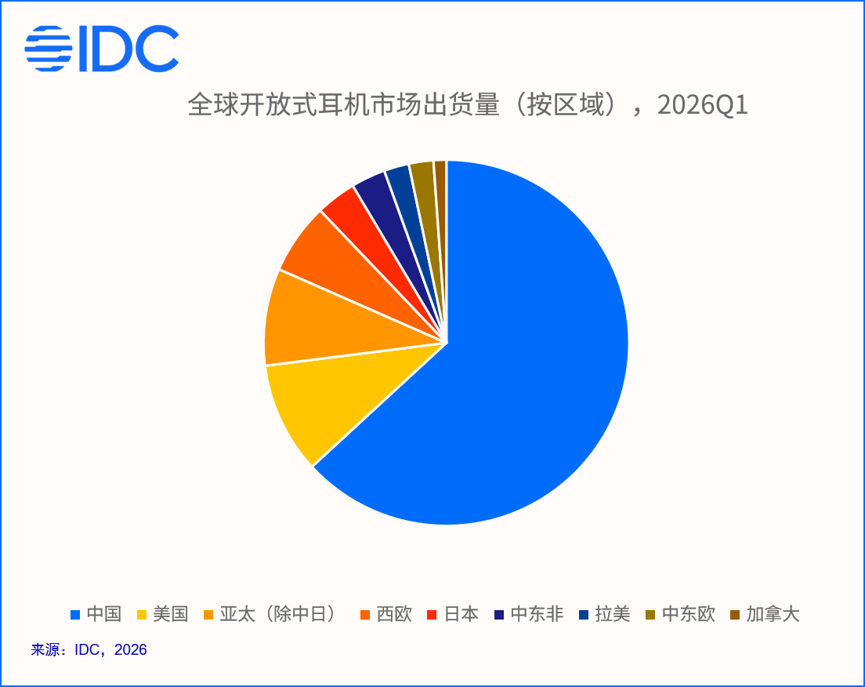
中国是开放式耳机起步最早,规模最大的核心市场,2026年一季度中国市场出货量占比超过六成。美国,亚太(不含中国和日本)及西欧市场紧随其后,增长态势亮眼。中国厂商利用先发优势全球布局,凭借完善的供应链与多元化产品矩阵持续抢占全球市场份额。市场主流集中在50美元以下及100美元以上两大价格区间,分层竞争特征显著。100美元以上高端市场中,核心技术,音质表现,品牌力与智能化成为竞争关键。韶音,华为凭借综合实力稳居领先位置。Bose,JBL等海外传统音频厂商也加码布局,依靠声学技术优势夯实产品实力,丰富自身产品线。50美元以下入门市场主打性价比,厂商凭借多样外观,新颖形态及丰富机型吸引消费者,中国与印度厂商为该市场主力。

洞察三:AI赋能硬件升级,智能化渗透空间广阔

随着蓝牙耳机硬件日趋同质化,AI技术已成为行业破局的重要方向。智能服务的迭代优化,离不开长期佩戴所沉淀的用户数据,而开放式耳机适配长时间佩戴的特性,为AI功能落地提供了天然优势。部分中国厂商已将产品搭载AI功能作为营销亮点,入门级产品主要对接第三方云端大模型,落地场景以实时翻译,会议纪要等办公需求为主,相关功能主要依托手机APP运行,并不具备端侧实时运算能力。优质的智能化体验目前仍集中于中高端产品线。定位商务场景的厂商,搭配自研大模型与端侧处理芯片,将AI打造为核心竞争壁垒,而非常规附加功能。手机品牌则凭借自有操作系统优势,整合自研大模型与终端硬件,构建“系统+模型+硬件”一体化生态闭环。该模式深度绑定用户使用习惯,有效强化用户粘性与品牌忠诚度。目前全球市场中的AI功能整体渗透率有待提升,品类智能化升级仍拥有广阔发展空间。

IDC建议

面对开放式耳机品类格局重构,中国厂商领跑全球,AI技术驱动产品升级的行业新态势,IDC为行业参与者提出以下三点切实可行的战略建议:

建议一:找准市场定位,优化产品结构与资源布局

开放式耳机品类加速分化,市场格局不断演变。厂商需明确自身赛道定位,避免盲目跟风内卷。耳夹式增长势头强劲,而耳挂式凭借更大的机身空间,更利于搭载元器件,落地 AI相关功能。厂商需结合自身核心优势搭建产品矩阵,平衡流量型与技术型产品布局,合理分配研发与产能资源,打造符合行业长期发展趋势的产品体系。

建议二:依托产业优势,深耕差异化竞争与品牌力建设

依托成熟的供应链与规模化制造能力,中国厂商可充分发挥产业优势。作为市场的先发参与者,应把握发展窗口期,聚焦品牌建设,规避同质化低价竞争。同步推进本土化运营,结合各地消费特征,文化偏好制定市场策略,以差异化产品与本地化服务提升用户认同,持续夯实全球品牌价值与综合竞争力。

建议三:着眼长远发展,强化AI核心能力建设

随着蓝牙耳机产品同质化问题日益凸显,厂商应将AI智能化升级确立为长期核心战略。依托开放式耳机可长时间佩戴、持续沉淀用户数据的特性,在现有的语音助手,AI降噪等应用基础上,拓展个性化服务,智能自适应调节等高阶体验。推动AI从单纯的营销亮点转变为核心产品实力,把握行业智能化转型机遇,充分释放市场增长潜力。

IDC中国研究经理戴翘楚认为,当前全球开放式耳机品类结构加速调整,中国厂商依托产业积淀与先发优势领跑市场,AI智能化则将成为行业下一阶段竞争焦点。厂商需明确发展方向,打造差异化产品,推进全球化布局,同时坚持长期投入,深耕AI核心技术,夯实可持续发展根基。

综合来看,IDC认为2026年第一季度全球开放式耳机市场的核心变化在于:耳夹式正在重塑品类格局,中国厂商持续主导全球市场,而AI技术的实际落地仍处于早期阶段。对于行业参与者而言,单纯依靠形态创新或价格策略的增长空间正在收窄,下一阶段的竞争将更多取决于厂商在技术深耕和智能化能力上的长期投入。市场仍在高速增长,但赛道逻辑正在变化,唯有做出清晰战略选择的厂商才能在竞争中占据主动。

如对本次报告内容感兴趣,或咨询其他相关内容,欢迎与IDC联系,以获取更多信息或探讨合作机会。

请点击此处与我们联系

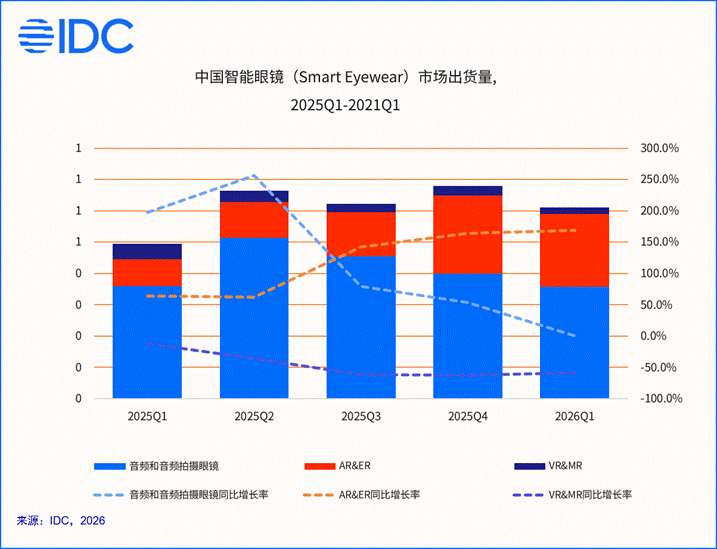
2026年第一季度,全球智能眼镜市场以130.1%的同比增速交出亮眼答卷,中国市场以23.5%的增长位列全球第三。然而,增速背后的结构性剧变更值得关注。国际数据公司(IDC)最新数据显示,中国音频和音频拍摄眼镜市场整体出货量同比下滑0.1%,其中不具备拍摄功能的纯音频眼镜产品需求开始疲软;,而轻量级显示眼镜逐步进入消费视野,带动AR&ER市场同比增长168.6%,成为一季度市场结构变化的重要变量。与此同时,国家补贴首次纳入智能眼镜,叠加AI大模型落地和密集新品发布,正在加速行业从“功能叠加”向“场景增值”演进。

全球市场

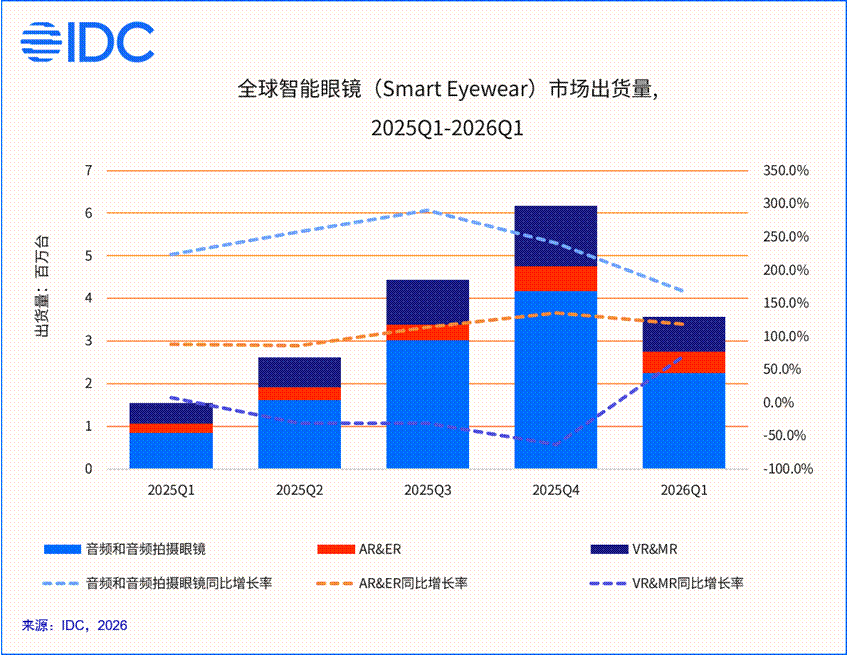
IDC最新数据显示,2026年第一季度全球智能眼镜(Smart Eyewear)市场出货量356.6万台,同比增长130.1%。其中全球音频和音频拍摄眼镜市场出货量224.8万台,同比增长167.4%;AR/VR市场出货131.8万台,同比增长85.9%。

全球市场产品动态

1. 国际巨头动向持续定义赛道方向

巨头在智能眼镜领域的布局预期持续发酵,赛道本身的战略价值已获得产业链和资本端的双重验证。

苹果:智能眼镜项目或于2026–2027年进入量产窗口。首代可能采用无屏轻量化设计,分阶段落地规划可为供应链预留爬坡周期,同时通过持续释放预期信号占据市场声量,为后续产品迭代积累用户认知基础。苹果的入局会倒逼供应链成熟、拉升用户认知,但也会在高端市场形成新的竞争压力。

谷歌:谷歌以Android XR平台授权加合作方硬件为主,与XREAL合作的Project Aura、与三星及Gentle Monster等联合开发的音频及显示眼镜均为确认项目。平台方身份规避了自有硬件的库存与品控风险,同时为国产硬件出海提供适配入口。

2. 跨界新玩家入局拓宽行业边界

非传统XR厂商的进入,说明智能眼镜的竞争已从专业赛道扩展至更广泛的消费电子领域。不同背景厂商带来的差异化场景定义有助于激活多元用户群体。

科大讯飞:语音技术切入办公场景,避开定位和手机生态的正面竞争。以垂直场景建立差异化认知,为中小厂商提供单点突破路径参考,其场景深度与商业闭环的验证值得期待。

极米:将自身技术优势进行迁移,探索新形态,品牌认知为产品溢价提供支撑,也为行业注入创新变量,将拓展智能眼镜在影音娱乐场景的价值边界。

3. AI厂商加速布局,推动竞争逻辑升级

未来的竞争将更多依赖软件生态和用户数据积累,而非单纯的产品迭代速度。对行业而言,头部AI厂商的介入将提升终端用户的认知水位,加速市场教育进程。

阿里:千问眼镜上市后份额提升迅速,核心在于打通了千问大模型与电商、支付生态,将硬件作为生态入口。有屏S1与无屏G1双线并行,覆盖不同用户需求,生态闭环的完整性是其区别于竞品的核心优势。

字节:字节产品发布时间尚未明确,但其在内容生态和算法推荐上的积累,使其具备从内容分发端切入市场的潜力。有望激活更多年轻用户群体,为市场带来新的增长变量。

中国市场:

2026年一季度中国智能眼镜市场在全球市场中份额排名第三,一季度出货量61万台,同比增长23.5%。本季度,智能眼镜首次被纳入国家补贴目录,带动渠道备货和终端需求释放,成为市场增量的核心动力。拍摄眼镜、具备AI大模型的眼镜、显示眼镜等细分品类均实现三位数同比增长,行业竞争加速分化,创新节奏明显加快。主流产品在轻量化、AI能力和佩戴体验等方面持续优化,叠加新品密集发布和渠道深度拓展。

中国细分市场概况及市场格局

音频和音频拍摄眼镜市场

2026年一季度,中国音频和音频拍摄眼镜市场结构出现明显升级,总出货量35.8万台,同比下滑0.1%,但其中音频拍摄眼镜占比达到43.4%,同比增长513.1%。

支持AI大模型语音助手的新品上市节奏加快,推动产品创新活跃。市场份额进一步向具备差异化功能和创新能力的品牌集中,TOP5品牌合计市场份额超过50%。小米、阿里、华为、雷鸟等头部厂商持续储备新品,带动行业竞争格局加速分化。从应用角度来看,厂商需要在高频场景中验证产品能否真正降低用户操作成本,这将直接影响用户留存和品牌口碑。

AR/VR市场

2026年一季度,中国AR/VR市场出货量25.2万台,同比增长86.2%。

AR&ER品类保持高速增长,季度市场份额已超过90%,同比增长168.6%。从市场表现来看,显示型眼镜新品的关注度相对高于音频眼镜,尽管轻量级显示眼镜的价格普遍集中在2000-3500元区间,仍处于较高水平,但其核心优势在于用户价值感知的提升。音频眼镜的功能与手机高度重叠,用户较难形成刚性使用习惯,而显示型眼镜能够覆盖手机难以触达的应用场景,带来更直观的体验,因此用户的尝鲜意愿和溢价接受度更高。从产品结构来看,轻量级显示眼镜已成为用户入门显示类产品的首选,为后续向更高端产品的转化奠定基础。

VR&MR市场一季度出货量同比下滑58.8%。整体表现依然低迷,缺乏新的增长动力。苹果Vision Pro M5版本虽然在产品层面有所更新,但产品定价仍处高位,内容生态和佩戴舒适度尚未达到用户预期,导致市场热度与实际转化之间存在明显落差。此外,VR&MR市场企业级采购有一定机会,但体量有限,尚不足以对冲消费端的疲软表现。

未来展望与新机会

IDC中国市场分析师叶青清认为,当前智能眼镜产品普遍面临的问题在于,虽然用户愿意为新鲜感买单,但不会为体验短板持续付费,若无法在体验上形成持续价值,用户留存就会成为瓶颈。因此厂商在产品定义和资源投入上需要做出更务实和偏向性的取舍。

在此基础上,未来还有以下几个方向值得追踪:

第一,新型方案已开始受到行业关注。独立通信、固态电池、体征监测集成等方向已经处于技术验证或小规模试产阶段,为产品定义和场景创新提供了新的可能性,值得持续跟踪。但现阶段真正影响用户留存的仍是连接稳定性、佩戴舒适度等基础体验,厂商在跟进新技术的同时,需要优先把现有成熟方案做到位。

第二,外观设计正成为用户决策的关键变量。轻量化已从加分项变为必选项,时尚性和个性化设计将在下半年成为头部厂商建立品牌辨识度的重要手段。在技术参数趋同的背景下,佩戴体验直接影响购买转化和日常使用频率,设计的差异化正在从产品层面升级为品牌资产。

第三,国内隐私安全标准正在加速落地。随着可穿戴设备采集敏感数据的场景增多,国内相关标准化工作已在推进。厂商需将隐私保护前置到概念设计阶段,合规能力将加速行业洗牌,提前建立技术储备和认证体系的厂商,有望在下一阶段竞争中占据主动。

IDC持续关注全球智能眼镜及可穿戴设备市场的发展动态。我们诚邀行业同仁、投资机构及媒体朋友与IDC中国分析师团队保持沟通,共同探讨市场趋势、技术创新与商业机遇。无论您是希望深入了解数据细节,还是寻求定制化市场洞察,欢迎随时与我们联系。

请点击此处与我们联系

企业AI落地正在从“试点优先”走向“价值优先”,服务商的竞争焦点也从交付项目转向交付持续业务结果。中国AI专业服务市场正在进入由应用落地和运营能力驱动的新阶段。

中国企业级AI服务市场正在经历一次重要转向。过去,企业更关注模型能力、算力资源和试点项目;现在,越来越多客户开始关注AI能否真正嵌入业务流程,能否连接企业数据与核心系统,能否在安全合规的前提下持续产生业务价值。

国际数据公司(IDC)最新发布的《2025H2中国AI专业服务市场跟踪报告》显示,2025年下半年,中国AI专业服务市场继续提速,市场规模近 20亿美元;2025全年市场规模超过 30亿美元。但比规模增长更值得关注的是,市场驱动力正在发生变化:基础设施集成仍是重要基本盘,平台与应用服务、管理与支持服务正在成为新的增长引擎。这意味着,AI专业服务市场的竞争逻辑正在从“谁能建项目”,转向“谁能帮助客户把AI长期用好”

一、市场增长的核心信号:从“建设”走向“建设+应用+运营”

报告显示,2025H2中国AI专业服务市场规模达到近两年来的高点。其中,基础设施集成服务仍是最大板块,云、算力、网络、安全、数据中心、国产化和混合架构建设仍是企业AI服务投入的重要基本盘。

但更值得关注的是结构变化。平台与应用服务在2025H2快速增长,反映企业正在从底层环境建设转向应用现代化、数据平台建设、AI应用开发、RAG/Agent落地和业务系统改造。与此同时,管理与支持服务也呈现高增长态势,说明客户对AI应用上线后的持续运营、应用支持、安全保障和效果监控需求正在提升。

中国AI专业服务市场正在从过去以“项目建设”为中心,逐步进入“建设、应用、运营”并重的新阶段。AI正在推动专业服务从一次性项目交付,走向更长期、更持续的能力运营。

二、AI正在改变专业服务需求结构

过去,专业服务项目更多围绕基础设施部署、系统集成和应用上线展开。但AI应用进入企业场景后,客户需求变得更加复杂。企业不再只要求服务商完成系统交付,而是更关注AI能否接入真实业务数据,能否与现有业务系统和数据平台集成,能否满足权限控制、数据安全和合规要求,能否持续优化模型效果并产生业务价值。这也是平台与应用服务增长的重要原因。

同时,AI应用上线并不意味着项目结束。知识库需要持续更新,Prompt需要管理,模型调用成本需要优化,输出质量需要评估,安全风险需要监控,业务部门使用效果也需要持续跟踪。因此,AI正在推动专业服务从“一次性交付”走向“持续运营”。

三、竞争格局正在重塑:头部厂商稳固基本盘,AI与平台能力成为分化关键

从2025H2市场表现看,中国AI专业服务市场的头部厂商仍主要集中在具备云、算力、基础设施、AI平台和大型政企服务能力的企业之中。华为在基础设施集成服务中保持优势;百度在平台与应用服务中表现活跃,体现出AI平台和大模型应用落地带来的增长机会;联想、新华三、浪潮等企业依托基础设施和全栈服务能力参与市场竞争;软通动力等服务商则在系统集成、本地交付和行业客户服务中保持增长;运营商也依托云网资源、政企客户基础和本地服务能力参与相关项目。

总体来看,2025H2中国AI专业服务市场的竞争不再只是“谁能交付项目”,而是“谁能把基础设施、平台应用和持续运营连接起来”。未来市场分化的关键,将取决于服务商能否从单一项目交付,转向行业化方案、平台化工具和管理化运营。

IDC建议:服务商如何抓住转型窗口?

第一,把AI能力嵌入现有IT服务组合。

服务商不应把AI作为单独的创新实验,而应将AI能力嵌入基础设施集成、平台应用建设和管理支持服务中,形成从环境建设、应用开发到持续运营的完整服务链。

第二,从项目交付转向行业资产沉淀。

平台与应用服务的快速增长说明,客户需求正在行业化和场景化。服务商应沉淀行业知识库、RAG模板、Agent流程、数据连接器、测试集、评估指标和部署蓝图,将项目经验转化为可复制的解决方案,提高交付效率和利润率。

第三,提前布局AI管理运营服务。

管理与支持服务增长显示,客户正在为持续运营能力付费。服务商应强化AI应用监控、模型成本管理、Prompt管理、知识库更新、安全审计和业务效果评估等能力,从一次性项目收入转向持续性服务收入。

IDC认为,2025年下半年,中国AI专业服务市场规模已近20亿美元,全年市场规模超过30亿美元,按人民币口径测算已成为明确的百亿级市场赛道。这一增长不仅是短期项目回暖,更标志着企业AI建设进入新的扩张周期,市场正从传统基础设施建设,向AI驱动的平台应用建设和持续运营服务加速延伸。展望2026年,OpenClaw等智能体平台的规模化落地将进一步深刻重塑AI专业服务市场的发展路径,推动服务内容、交付模式和商业价值的全面升级,成为企业数智化转型的重要引擎。

IDC中国企业级服务研究经理张舒认为,中国AI专业服务市场正在进入从“技术验证”到“业务规模化”的关键转换期。过去企业采购AI服务,更多关注模型能力、应用演示和短期试点;未来企业将更关注服务商是否具备端到端落地能力,包括业务场景识别、数据治理、系统集成、安全合规、AI治理和持续运营。

为了更好地帮助用户了解企业与软件AI的发展动态和未来趋势,IDC正式发布《2025H2中国AI专业服务市场跟踪报告》,并即将启动《2026H1 中国AI专业服务市场跟踪》报告研究,欢迎大家与我们保持沟通交流,与IDC共同开展更多前瞻性与实践性研究。

请点击此处与我们联系

Emily Zhang

Emily Zhang - Research Manager

Emily Zhang is Research Manager for IDC’s Services technology data in China and leads IDC’s PRC IT Services research. Her coverage spans IT consulting, cloud managed services, and AI-related service offerings. Emily delivers data and insights from both tech provider…

腕戴设备市场正在发生静默而深刻的结构性转折。智能手表与手环的走势分化、各价位段需求的冷热不均、区域市场之间的增长落差——这些表象背后,同一个问题是所有参与者必须回答的:当普及红利消退,增量从何而来?本文基于IDC最新发布的《全球可穿戴设备市场季度跟踪报告》,梳理2026年第一季度全球腕戴市场的三大结构性特征、头部厂商的应对策略,以及中国市场的独特发展路径。


根据国际数据公司(IDC)最新发布的《全球可穿戴设备市场季度跟踪报告》,2026年第一季度全球腕戴设备市场出货量为4,705万台,同比增长2.2%。腕戴设备市场包含智能手表和手环产品。其中,全球智能手表市场出货量3,703万台,同比增长4.8%。手环市场出货量1,002万台,同比下滑6.1%。腕戴产品发展背后,全球市场呈现出哪些特点?头部厂商表现如何?中国市场又将呈现哪些异同?本文将为您一一解读。

2026一季度全球腕戴市场发展的三大特点

根据IDC跟踪报告,2026年一季度全球腕戴市场发展呈现以下三个显著特点:

特点一:手表走强,手环疲软

智能手表凭借功能升级稳步增长,部分分流手环用户。手环受去年需求提前透支、存储成本抬升影响,再加入门手表价格下探抢占市场,需求持续承压,整体走势偏弱。

特点二:价位结构升级,入门稳、高端旺

大环境承压下,百元美金以内入门产品依靠刚需稳住出货量;300 美元以上高端机型依托软硬件迭代、健康医疗及AI功能升级,消费升级需求逐渐释放,高端价位段增速突出。

特点三:区域发展分化

中国凭借新品发布与电商促销,成为全球增长主力;美国、拉美受益换新与渗透率提升小幅增长,其他地区受经济影响需求表现平淡。

2026一季度全球腕戴市场Top 5厂商表现

华为

2026 年一季度华为腕戴产品全球出货量登顶。华为时隔5年推出 WATCH GT Runner 2,深耕专业跑步赛道;Ultimate 2 高尔夫版满足进阶人群的专业需求;手环 11 系列补齐入门价位空档。全品类阶梯矩阵落地,完善价格与功能布局,稳固华为穿戴出货领先优势。

Apple

2026年一季度中国市场成为苹果智能手表全球增长核心驱动力。品牌提前落地多轮促销活动有效拉动终端销量;产品高端定价优势明显,可更大程度消化上游元器件涨价带来的成本压力,对冲供应链紧缺负面影响,支撑中国市场业绩稳步上行。

小米

2026年一季度小米智能手表表现优于手环品类。品牌落地 S5 系列新品,持续加大中高端 Watch 5 铺货力度,稳步向上优化产品结构。中高端机型逐渐放量,小米加速优化产品结构,逐步向中高端市场纵深布局。

三星

三星全球主推 Galaxy Watch8 及 8 Classic,但整体出货受内部战略调整小幅收缩。欧美成熟市场需求承压,中东、非洲等新兴市场依托品牌口碑与渗透率提升实现小幅增长,成为品牌现阶段为数不多的增量市场。

佳明

佳明坚守专业户外、运动细分赛道,深耕垂直用户巩固专业产品壁垒;同时加速产品迭代、拓宽大众消费产品线。配合各地阶段性营销与促销落地,品牌兼顾专业与大众市场,在多个区域实现出货同比增长。

2026一季度中国市场发展的三大特点

IDC报告指出,2026年第一季度中国腕戴市场出货量1814万台,同比增长3.5%;其中成人智能手表出货量888万台,同比增长15.3%,儿童手表出货量442万台,同比增长22.4%,手环市场出货量483万台,同比下滑22.2%。

特点一:入门价位补位扩容,五百元档市场回暖

500 元以下成人智能手表一季度出货量回暖。头部品牌产品迭代逐步撤出该价格带,中小品牌顺势优化产品配置填补空白。上游存储成本抬升环境下,该档位机型性价比凸显,精准承接入门刚需,拉动该价位稳步回暖。

特点二:渠道分化凸显,线上增速领跑线下

产品成熟带动消费者选购趋于理性,用户习惯线上比价筛选机型。叠加直播、多平台大促等多元电商业态持续扩容,线上渠道出货增速显著跑赢线下。线下侧重体验成交,增长相对稳健,线上已成为拉动大盘增量的核心载体。

特点三:产品精细化发展,功能人群多元细分

市场开始逐渐尝试跳出同质化堆砌,逐步走向场景与用户分层。更具有针对性的女性向和青少年设计的产品更多出现,在全智能、专业健康、专业运动、日常健康和轻运动等维度打造差异化卖点,围绕细分需求定制产品,精细化细分成为行业明确发展趋势。

针对技术供应商和采购方的建议

建议一:产品分层精细化布局,打造差异化竞争壁垒

厂商应搭建阶梯化、差异化产品矩阵,规避同质化与低价内卷。面对存储成本上涨压力,各价位段需优化配置与定价策略。中小厂商依托优质体验稳固入门市场,头部品牌深耕高端健康、AI、运动功能迭代。通过场景、功能、外观多元差异化设计,覆盖多人群需求,筑牢产品竞争壁垒。

建议二:双线渠道协同布局,高效盘活存量增量市场

厂商需优化线上线下双线渠道协同布局,加大电商、直播等线上资源投入,依托平台优势快速走量、盘活存量。线下门店重点聚焦高端机型体验、售后服务与高价值用户转化,打造线上引流、线下提质增收的良性渠道体系。

建议三:区域市场差异化深耕,分散经营风险挖掘增量

厂商应实施差异化区域运营策略,平衡市场规模与盈利水平。欧美成熟市场避开低价内卷,深耕专业运动、健康垂直圈层守住利润;积极开拓拉美、中东非等新兴市场,凭借性价比快速提升渗透率。同时深耕中国本土市场,依托新品迭代与电商促销持续激活换新增量。

分析师观点与行业建议

IDC认为,全球腕戴行业已告别普及放量期,正式迈入存量精细化竞争阶段。增量不再依靠全民新机普及,转而由产品升级、细分人群、区域下沉三大逻辑驱动。成本波动加速行业洗牌,倒逼品牌放弃低价同质化内卷,依托价位分层与场景细分挖掘新增量,未来品牌综合产品架构、渠道与区域布局的能力将成为拉开份额差距的关键。

延伸阅读与沟通:

如需了解更多IDC相关研究或进一步与我们沟通,请点击此处与我们联系。我们将安排专人与您对接,为您提供定制化的市场洞察与咨询服务。

Sophie Pan

Sophie Pan - Research Director, Client System Research

Sophie Pan is a research director for the Client Systems Research team at IDC China. She is responsible for emerging technology device research, including wearable devices and smart home devices. Sophie has a deep understanding of the landscape and ecosystem…

Although WWDC is a developers’ conference, this year’s keynote was primarily a statement of intent about Apple’s future and demonstration of its AI credibility.

The most important announcement this year was the new Siri AI. Apple rebuilt it from the ground up, trying to make AI feel native, useful and invisible across devices people already own. The winning AI experience for consumers will not be the loudest or most technically complex. It will be the one that understands context, respects privacy, works reliably across apps, and reduces friction without forcing users to change behavior.

Apple has rarely been about being first to a trend. It has been about waiting for the ability to embed technology far enough into hardware and silicon to change how people actually behave. Much has been made about Apple being behind on AI, and the company certainly had failed to deliver on promises made back in 2024. But consumers are wary of AI, and what the company demonstrated at WWDC this year seems ready to meet them where they are today.

What is the new Siri AI?

The center piece is a rebuilt Siri, dubbed Siri AI, and the detail that matters most is what sits underneath it. Apple was emphatic on one point: this third generation of foundation models is its own work, trained on its own data. Yes, the company worked with Google to develop the model family, and Apple refined four of the five models using outputs from Gemini’s frontier models. But the models, the training data, and the privacy architecture all belong to Apple. And while some of the broader Apple Intelligence capabilities, such as image generation, will run on Google’s Cloud Platform on NVIDIA chips, none of the new Siri AI runs on Gemini’s chat infrastructure.

The new Siri AI also arrives as a standalone app across iPhone, iPad, Mac, and Vision Pro with an iMessage-style interface, persistent conversation bubbles and a full chat history synced through iCloud. Users can attach images and documents and switch between quick voice commands and a deeper chatbot mode. The visual signature has changed too. Instead of the edge glow that has signaled Siri for years, the assistant now lives inside the Dynamic Island, expanding the pill to show prompts and a glowing search state. The “All Systems Glow” tagline was a tease of exactly this. The effect is that Siri AI feels part of the hardware rather than something that hijacks the screen.

What can Siri AI do?

One of the stronger Siri AI demos is write with Siri AI. Startups like WisprFlow have built entire businesses around helping people dictate clean text on an iPhone instead of thumbing out long passages. Siri AI goes further, picking up on your writing style, proofreading on its own, and producing complete drafts. Assuming it performs the way Apple showed it, the company has pulled off a familiar trick: baking in for free the kind of capability users have been paying outside vendors to get.

Siri AI appears to finally do what Apple suggested it would be capable of doing back in 2024. It reads personal context across emails, photos, messages and files, understands what is on screen, and executes multi-step tasks across apps. That personal context is a unique advantage that Apple has over competing AI services. While services such as OpenAI’s ChatGPT and Anthropic’s Claude are collecting contextual data on their users now, Apple has that data going back many years. It’s a true advantage, but one that Apple must leverage carefully as it continues to hammer on its privacy and security promises.

Understandably, then, Apple is being cautious with this Siri AI rollout. It is shipping the new feature as a preview, gated behind a waitlist even among those receiving the live developer betas. We expect many of the advanced parts of the stack to arrive across later 27.x updates rather than at launch.

What other OS improvements did Apple announce?

Beneath Siri AI, the various OS updates are where most users will experience benefits. Across each device Apple has worked to enhance app launches, speed up performance, and smooth animations. It added a slider so users can change the opacity of the Liquid Glass interface. And on macOS 27, specifically, it addressed a wide range of complaints around last year’s additions, from fixing the corner radius of windows to removing extraneous menu icons.

Safari gains Organize Tabs, which sorts open tabs into topics such as shopping, travel and work. Shortcuts have been rebuilt so you can describe a multi-step automation in plain language, and have it assembled for you, which finally makes the feature accessible to people who were never going to script it.

The camera and photo upgrades in iOS 27 are where Apple Intelligence becomes very tangible and will likely get the fastest recognition from consumers outside of Siri. Photos adds two generative tools: Extend, which fills in scenery beyond the original frame, and Reframe, which shifts the perspective of spatial photos after capture. The Camera app gains a Siri AI-powered Visual Intelligence mode that reads a nutrition label and logs calories and macronutrients straight into Health or pulls a phone number and address off a business card into Contacts. Wallet can now scan a physical ticket or membership and generate a digital version, and a new bill-splitting feature tied to Apple Cash lets you photograph a receipt, assign items to people, and send payment requests with tax and tip handled automatically, approved from your wrist if you like. The bill-splitter launches in the United States first because of the Apple Cash dependency.

What is Apple’s AI Strategy?

Apple’s strength has never been to ship new technologies for the sake of shipping. It has been to package complex technology into experiences that feel polished and trusted. This year’s Apple Intelligence announcements follow that logic. The new Siri AI, with a richer understanding of the user, smarter Shortcuts, visual intelligence in the camera, improved writing and image tools, and more capable on-device intelligence all point to the same strategic direction: Apple wants AI to become part of the operating system, not a separate destination only available through an app.

Siri AI is central to that ambition. For years, voice assistants were useful but limited. They answered basic questions, controlled simple settings and handled routine commands. What Apple is now proposing is genuinely different: an assistant that can understand what is on screen, read what is actually happening across apps, and execute multi-step actions on behalf of the user. If Apple delivers this well, Siri AI stops being a feature and becomes a new interaction layer for all of Apple’s current devices and eventually future categories of hardware.

Will Siri AI improve Apple’s long term growth or upgrade cycle?

The iPhone remains the center of Apple’s ecosystem, but growth increasingly depends on making the installed base more valuable, more loyal and more difficult to leave. A better Siri AI and a more capable Apple Intelligence layer make Apple devices harder to leave by making them work together in more personal and contextual ways. A Siri AI experience that works the same way across every device is an advantage other vendors will find difficult to replicate and gives Apple the upper hand. 

It also gives Apple a stronger upgrade argument, especially as the best AI experiences will depend on newer hardware. The argument is even more pronounced for iPhone 15 and older users, who lack all access to Apple Intelligence.  Any users that may have resisted upgrading due to inflationary pressures and economic uncertainty have a compelling argument to upgrade.  For Apple this means continued upgrade momentum in 2026, despite a very strong upgrade cycle last year.

The announcements around Apple platforms reinforce this point. The operating systems are not being reinvented visually this year. They are being refined around performance, usability and embedded intelligence. That is the right move. After a major design transition, Apple needed to show maturity. The company is signalling that AI will improve everyday tasks: managing information, searching, automating workflows, editing photos, understanding documents, using the camera, and moving between apps with less effort.

Why is 2026 a pivotal year for Apple?

The bigger strategic question is execution. The AI features Apple showed this week weren’t groundbreaking. And the word “agentic” was rarely uttered. Apple isn’t chasing the hype around AI; it’s focused on delivering a polished AI experience rather than an experimental one. Consumers will not judge Apple Intelligence by model sizes, partnerships or technical architecture. They will judge it by whether Siri AI understands them, whether actions work, whether personal context feels useful rather than intrusive, and whether the experience is consistent across devices.

This is therefore a high-stakes year for Apple. If the new Siri AI works as shown, Apple Intelligence could become one of the most important ecosystem upgrades since the App Store matured into a services platform. It would deepen loyalty, increase the value of newer devices and reposition Apple’s operating systems around personal intelligence.

But the margin for disappointment is narrow. Apple has chosen a user-first AI narrative. Now it must deliver against it. The keynote created confidence; the real test will come when these features reach millions of users. Delivering on what was shown on stage is critical, because for Apple the risk is not that users misunderstand the strategy. The risk is that they understand it perfectly, try it, and feel the experience falls short. However, the announcements today make me feel that Apple is ready to excite its users with its intelligence capabilities.

How does WWDC position Apple for leadership transition to John Ternus?

This was also Tim Cook’s last WWDC keynote, and what he announced at every single WWDC keynote over the years reflected his leadership: disciplined, ecosystem-first, privacy-led, and making technology useful at scale. Apple has never been about being first to a trend. It has been about waiting until technology is embedded far enough into hardware and silicon to change how people actually behave. This is what Apple showed at WWDC26.

This is also a defining platform moment for John Ternus as he prepares to take over as CEO. He will inherit a company with one of the strongest hardware platforms in the world, but the next chapter will be defined by how intelligently that hardware works for users. For a leader with deep hardware DNA, the opportunity is to make Apple Intelligence feel inseparable from Apple devices.

WWDC 2026 gives Ternus a clear strategic runway: more personal devices, more contextual software, more intelligent services and a tighter link between silicon, hardware and AI. If Apple delivers the experience with the reliability, elegance and trust users expect, this could be remembered as the moment Siri AI and Apple Intelligence moved from the background of Apple’s product lineup to the center of its future.

Francisco Jeronimo

Francisco Jeronimo - VP, Data and Analytics, Devices, IDC EMEA

Francisco Jeronimo is VP for Data and Analytics at IDC EMEA. Based in London, he leads the research that covers mobile devices, personal computing devices, emerging technologies and the circular economy trends across EMEA. His team delivers data on personal…
Tom Mainelli

Tom Mainelli - Group Vice President, Device & Consumer Research

Tom Mainelli heads the Device & Consumer Research Group, overseeing a wide array of hardware and technology categories catering to both home and enterprise markets. His team's research spans PCs, tablets, smartphones, wearables, smart home devices, thin clients, displays, and…
Nabila Popal

Nabila Popal - Senior Director, Data & Analytics

Nabila Popal is Senor Director with IDC's Data & Analytics team, specializing in Mobile Phones, PC Monitors and other consumer devices.  Ms. Popal is responsible for the global research and quality and timely delivery for her respective technologies, coordinating with regional…

In my last blog, I explained that when your CMDB is a mess, AI makes that mess happen faster. The same principle applies when your Managed Service Provider (MSP) gets there first. MSPs are now moving fast. AI is now embedded across service delivery operations. IDC research shows how AI is shifting IT services away from labor-led delivery toward platform-led, outcome-based models. The smarter MSPs get to know your environment, the harder it becomes to challenge their pricing.

When MSPs deploy AI across service delivery, their per-unit costs fall. But contract rates rarely follow. Buyers who maintain an independent, cost-enriched CMDB can verify MSP-reported usage, identify idle resources, and negotiate from evidence rather than estimates. The good news is that the same data foundation that protects you in IT Service Management can also protect you commercially.

What MSPs are actually deploying

Every major MSP now has an AI platform. The table below shows what the leading providers are running and what it means for buyers.

ProviderPlatformWhat It Does
AccentureAI Refinery for IndustryBuilds and deploys industry-specific AI agent solutions using NVIDIA’s AI stack, now targeting over 50 solutions across telecommunications, financial services, and insurance.
AtosPolaris AIDelivers agentic AI capabilities for IT engineering and business functions.
CapgeminiGenAI OperationsAI-powered service desk and infrastructure intelligence. In 2026, Capgemini joined OpenAI’s Frontier Alliance to build and scale agentic AI workflows across enterprise operations.
DeloitteZora AIAgentic platform for business finance functions, leveraging NVIDIA AI.
DXC TechnologyOASISConnects the entire IT estate into a single trusted view, using AI agents and human expertise to anticipate issues and act before they affect the business.
EYEY.ai Agentic PlatformLeverages NVIDIA AI to enhance tax, risk, and finance operations.
FujitsuKozuchi AI AgentEnhances operational productivity across managed infrastructure contracts.
IBMConsulting Advantage / watsonx OrchestrateDeploys AI agents across HR, finance, and IT workflows, with a catalog of over 150 pre-built domain-specific agents and multi-agent interoperability across SAP, AWS, and other enterprise platforms.
InfosysAgentic AI Foundry (part of Infosys Topaz)Published case data shows 30–40% reductions in ticket volume for specific engagements.
KPMGKPMG VelocityAI-powered business transformation platform built for consultants.
KyndrylAgentic Service ManagementCombines a maturity model, structured assessments, and implementation blueprints to help enterprises move from traditional service operations to autonomous, intelligent workflows at scale.
McKinseyLegacyXAccelerates legacy infrastructure modernization using agentic AI.
PwCAgent OSA new operating system for orchestrating AI agents across enterprise functions.
TCSWisdomNextEnterprise AI platform delivering automation across managed services delivery with integrated AI orchestration capabilities.
WiproWeGA Studio / WEGAProvides pre-built accelerators, domain frameworks, and agentic AI toolkits across software engineering, cloud, data, and enterprise applications, with NVIDIA AI Enterprise integrated throughout.

This list is not intended to be exhaustive.

Agentic AI refers to AI systems that can autonomously plan and execute multi-step workflows. They do not just generate responses; they act on them. IDC research confirms that leading platforms now share a common architecture covering agent orchestration, model services, knowledge management, enterprise integration, and governance. This is no longer experimental. It is becoming the standard delivery model.

For buyers purchasing the same services under existing contracts, the commercial question at renegotiation is straightforward: if your MSP’s delivery costs are falling, are your contract rates falling with them? In most cases, the answer is no. MSPs are actively working to demonstrate additional value to justify maintaining or increasing their rates, and the ones doing it well have the data to back it up. Buyers who lack independent data do not.

What this means for managed services pricing

Factors pushing prices up

Agentic platforms are enabling always-on, outcome-based service models, which support premium pricing for higher-value outcomes, particularly in business process services. Demand is also growing for orchestration, governance, and multi-agent operations across IT and business functions. MSPs are also expanding into new customers and workloads, including mid-market segments that were previously too expensive to serve.

Importantly, not all customers will adopt premium agentic services. MSPs need to recoup their platform investment costs across a broader base, which adds further upward pressure on pricing across the board.

Factors pushing prices down

AI agents now handle monitoring, triage, root cause analysis, and remediation within defined boundaries, reducing reliance on people for routine tasks. Platform efficiencies compress the cost per unit of work, and performance in predictable scenarios is becoming more consistent.

Net impact for MSPs

AI platforms are compressing MSP delivery costs while enabling premium pricing for outcome-based services. The net result is stronger margin for MSPs, and a real commercial case for buyers who can prove what they’re actually using.

Important context for IT buyers

AI platforms are not free for MSPs to build and run. Infrastructure, integration, specialist skills, and ongoing maintenance all carry significant costs. Buyers should find out whether AI investment is listed as a separate line item or is absorbed into base rates at renewal.

The commercial model is also shifting.

Traditional time-and-materials and consumption-based pricing do not map well to how agentic services are actually delivered, which is one reason outcome-based models are gaining ground. Buyers who understand this shift and write contracts that reflect it will be better placed to share in the productivity gains, rather than fund them.

Where IT buyers are still losing ground

Three problems consistently arise at contract renewal.

1. Accepting the MSP’s usage data

Most organizations have no independent, current view of their own environment. IDC PeerScape research found that organizations regularly discover assets MSPs keep billing for even after they leave active use. Old virtual machines, unallocated storage, and devices that were never decommissioned are common examples. When the MSP’s AI platform generates usage reports, most buyers have no external check, so they accept the numbers.

2. Paying for unused infrastructure

In one financial services organization I worked with, a pre-renewal audit found 50 virtual machines switched off for more than three months, and 15 terabytes of storage with no active application attached. The MSP was billing for all of it. Removing those items from scope saved 48,000 euros a year.

3. No basis to challenge per-unit pricing

MSP contracts priced per virtual machine, per device, or per terabyte are only negotiable if the buyer can independently verify what is actually in use. Without that, the MSP’s numbers go unchallenged. This is also one of the reasons outcome-based pricing deserves serious consideration. When delivery is driven by AI agents rather than headcount, per-unit pricing often fails to reflect the true cost or value of the service.

The answer is still the same

IDC’s research on agentic AI in services concludes that the providers who win will be those who prove value transparently and build trust through governance, portability, and accountability. Buyers have a role to play in demanding exactly that.

Build an independent source of truth. A well-maintained, cost-enriched CMDB is your foundation.

Run a pre-renewal audit. Start 90 to 120 days before contract expiry, using independent discovery tools such as ServiceNow Discovery or Dynatrace. This lets you verify MSP-reported usage, identify idle resources, and challenge billing for unused infrastructure before you reach the negotiating table.

Get the contract language right. Include the right to conduct your own audits, tie billing to verified active use, and build in scope reduction mechanisms. Ask directly how AI deployment costs and efficiency gains will be shared. Providers who cannot answer that question clearly are worth watching.

Push for outcome-based models, and define outcomes broadly. Buyers who request transparent pricing, clear ownership terms, and outcome-based commercial structures will be better placed to capture value rather than pay for it. But make sure the outcomes you measure go beyond technical metrics. An MSP can meet every SLA target and still fail to deliver real business value. Build business outcomes, not just service desk targets, into the contract from the start.

The bottom line

IDC forecasts cumulative AI economic value of $22.5 trillion between 2025 and 2031. The MSPs listed here are investing heavily to capture their share of the market. The platforms they are building are not just delivery tools. They are becoming the primary way MSPs own the workflow and outcome layer in managed services.

IT buyers with accurate, independent data about their own environments are in a much stronger position to participate in that value rather than fund it. An accurate, cost-enriched CMDB is not an IT housekeeping exercise. In the age of AI-driven managed services, it is a commercial imperative.

Tom Collins - Senior Consultant, IT Sourcing & Benchmarketing - IDC

Tom Collins is a Senior Consultant in IDC’s IT Sourcing and Benchmarking practice, advising organizations on IT cost management, sourcing strategy, and technology procurement.

Last week, a select group of senior print and imaging executives gathered in London for IDC’s Print and Imaging Leadership Dinner. During this invitation-only evening, a conversation unfolded between IDC analysts and the people shaping the industry, moderated by IDC’s Sandra Ng.  

What came out of that dinner? Some of the discussions reaffirmed what many already suspected. But some of the insights revealed will fundamentally change how forward-thinking vendors approach the next 18 months. Here’s a taste of what was discussed, and why you’ll want to be in the room for one of IDC’s executive dinners next time.  

The buying committee has expanded, and most vendors are still selling to the wrong people  

Two years ago, a print deal sat with IT and procurement. That’s no longer the world we’re operating in. IDC’s 2026 European Print Survey, covering 2,000 organisations across eight markets, revealed that the stakeholder landscape has shifted dramatically. The conversation that used to happen in one room now happens in four.  

The implications for how vendors structure their go-to-market approach are significant, and the dinner surfaced a very specific playbook that the those gaining the most ground are already executing. We’ll leave the details for the briefing room.  

Security just overtook cost reduction as the #1 investment driver in print. 

A striking 24% of European technology buyers now cite security and compliance as their primary reason for investing in print. That puts it ahead of both cost reduction and productivity.  

This is more than a repositioning opportunity, as it moves the conversation to a different level within the organization,  with a different buyer. Those in the room heard exactly which messaging reaches the CISO, which regulatory triggers are opening budgets right now, and where the hardware story needs to evolve to stay relevant.  

IDC predicts that 40% of worldwide new office MFP shipments will be classified as AI MFPs by 2027. The vendors with a credible roadmap published today will be the ones with a strategic seat in 24 months. Those without one are already behind.  

The buyer has already formed a view before your sales team picks up the phone  

This was the session’s sharpest insight, and the one most likely to keep vendor CMOs up at night.  

GenAI-sourced web traffic grew 1,200% between 2024 and 2025. Two in three searches today end without a single click. Buyers are shortlisting vendors, forming preferences, and making preliminary decisions inside AI assistants, before they’ve seen your website, opened your brochure, or taken a sales call.  

IDC’s Gala Spasova gave a demonstration that stopped the room. When major AI assistants were asked the questions a head of digital workplace would actually type, around 30 vendor names came back consistently. Not a single print OEM appeared. When the question became print-specific, all the familiar names showed up.  

The print category is owned. The workplace category, where your buyers are actually looking, is invisible.  

What it takes to change that, and how fast it compounds once you do, was laid out in detail at the dinner. The short version: it’s not pay-to-play, and the window to act is narrow.  

Three places the money is actually moving in 2026, and the 12–18 month window you can’t afford to miss  

IDC analysts Jacqui Hendriks and Gala Spasova mapped out three near-term growth areas where European buyer investment is already building, from value-add software and services through to Intelligent Document Processing and a sustainability play that changes both the buyer and the budget.  

The most time-sensitive of these? A three-way alliance opportunity, vendor, channel, certified refurbisher, that’s unserved by the larger SIs and telcos, but not for long. European refurbished device shipments grew 28% in 2025. Demand is running well ahead of vendor readiness. The potential of such a model was discussed at the dinner in some detail.  

The commercial model shift that separates the winners  

The evening closed with a discussion on what’s actually different about the vendors capturing European growth. It’s not just what they’re selling. It’s the contracts they’re willing to sign, the conversations they’re prepared to have, and the partnerships they’re building now.  

Roberto Alunni and Phil Sargeant laid out, with uncomfortable precision, the behaviours that distinguish vendors gaining ground from those defending yesterday’s revenue. Some of it is replicable quickly. Some of it takes 18 months of investment to build. All of it was on the table.  

Were you in the room?  

If you weren’t at IDC’s Print & Imaging Leadership Dinner, or if you’re wondering how to get on the guest list for the next executive dinner, now is the time to reach out. Events like this are where the defining conversations happen: the information and insight that doesn’t make it into LLMs and the strategic debates that shape how the market moves, alongside networking and the connections that open doors.  

Whether your focus is European print and imaging, AI-driven workplace transformation, digital sovereignty, channel partnerships, or any of the many other topics shaping the European technology landscape, IDC brings together the senior leaders and the research to drive the conversation forward.  

To find out more about IDC’s European print and imaging research programme, or to join the conversation at our next event, contact your IDC representative or simply fill in our contact form.  

IDC’s European print and imaging research covers 2,000 organisations across Czech Republic, France, Germany, Italy, Poland, Spain, the UK and the Nordics, across 15 verticals. The 2026 European Print Survey data underpinning this dinner is available to IDC clients and select briefing participants.  

Phil Sargeant

Phil Sargeant - Senior Program Director, Imaging and Hardcopy Devices and Document Solutions, European Region

Phil Sargeant is IDC’s leading expert in the field of imaging, hardware devices and document solutions. As senior program director, he researches and reports on the key aspects of the multifunction, production and large format printer markets and is also…
Gala Spasova

Gala Spasova - Senior Research Manager, Europe Smart Office and EMEA Content & Knowledge Management Strategies

Gala Spasova is a senior research manager in IDC's Future of Workplace & Imaging team. Her research focus is on Hybrid working, Smart Office technology and Content & Knowledge Management Strategies in EMEA.  Spasova is also part of the European…
Jacqui Hendriks

Jacqui Hendriks - Associate Research Director, European Print Vendor Transformation Strategies

Jacqui Hendriks, Associate Research Director, European Imaging, Printing and Document Solutions Jacqui Hendriks heads up IDC's European Print Vendor Transformation Strategies research program, in collaboration with various IDC research domains. Hendriks has more than 30 years of experience of working…
Roberto Alunni

Roberto Alunni - Senior Research Director, EMEA Data & Analytics

Roberto Alunni is a Senior Research Director at IDC for imaging, print, and document solutions research across the EMEA region. He is responsible for strategic and operational implementation and leads an international analyst team. He is a specialist in imaging…
Sandra Ng

Sandra Ng - Senior Vice President, WW and APJ Research

Sandra Ng is Senior Vice President at IDC and the Global Domain Leader for Devices, Consumers, Imaging, and Japan. Based in Singapore, she advises technology buyers and vendors worldwide on technology investments, financial priorities, and go-to-market strategies. She leads a…