
JAKARTA, 11 July 2025 – The Security software market in Indonesia grew by 16.1% year-over-year (YoY) in 2H24, according to International Data Corporation’s (IDC) Worldwide Semiannual Software Tracker. Growth was driven by continued modernization efforts as organizations adapt to hybrid infrastructure, expanding digital risk exposure, and increasingly sophisticated cyber threats. Investment remained strong across network security, identity and access management, and security analytics—highlighting enterprise priorities to protect infrastructure, enforce access control, and improve threat visibility amid rising regulatory pressure.
As security needs evolve, enterprises are rethinking how they manage operational complexity. Many are shifting from fragmented point tools to integrated platforms that centralize monitoring, automate processes, and simplify workflows. This signals a broader transition from tactical deployments to architecture-led security planning.
“While security software demand in Indonesia remains strong, organizations are starting to rethink what ‘secure’ really means. They’re no longer piecing together standalone tools—instead, they’re embedding security into the foundation of their digital operations,” said Sandika Putra, Associate Market Analyst di IDC Indonesia.
AI and GenAI are becoming central to security operations, helping teams respond faster and operate more efficiently. In Indonesia, security operations centers (SOCs) are deploying AI-powered tools to automate repetitive tasks, filter alert noise, and guide incident response. IDC survey findings show that leveraging GenAI to enhance productivity is now one of the top security priorities—alongside cost control and automation. Global vendors are embedding AI into locally hosted platforms to meet performance and compliance needs, while Indonesian providers are developing niche solutions in areas such as threat detection, response playbooks, and video analytics. As adoption grows, GenAI is shifting from a value-add to a foundational element of enterprise security strategy. Looking ahead, as enterprises increasingly deploy GenAI technologies, securing the AI data pipeline and safeguarding AI agents will become paramount. Organizations must address risks such as data leakage, model poisoning, and unauthorized manipulation to maintain trust and reliability. This emerging landscape demands new security frameworks tailored to protect AI infrastructure—from cloud environments to edge devices—ensuring that AI-driven operations remain secure and resilient.
Security investments also go above simply meeting compliance requirements alone. While the Personal Data Protection Law (UU PDP) has elevated baseline awareness around protecting personal data, organizations increasingly see compliance as just the starting point—not the final goal. Take, for instance, Indonesia’s Government Regulation No. 71/2019 on the Implementation of Electronic Systems and Transactions, which sets key standards for securing digital infrastructure. Beyond compliance, cost optimization, process automation, and the need to boost team productivity are now central to strategy—especially as cloud adoption grows and managing distributed production environments that are becoming more complex. To achieve these goals, cybersecurity must shift from defense to strategic enabler. By embedding advanced security measures across IT systems, networks, and cloud environments, organizations gain the agility to automate processes securely and scale operations confidently. This proactive security posture reduces risk and fuels innovation, empowering teams to drive sustained growth in a rapidly changing digital landscape.
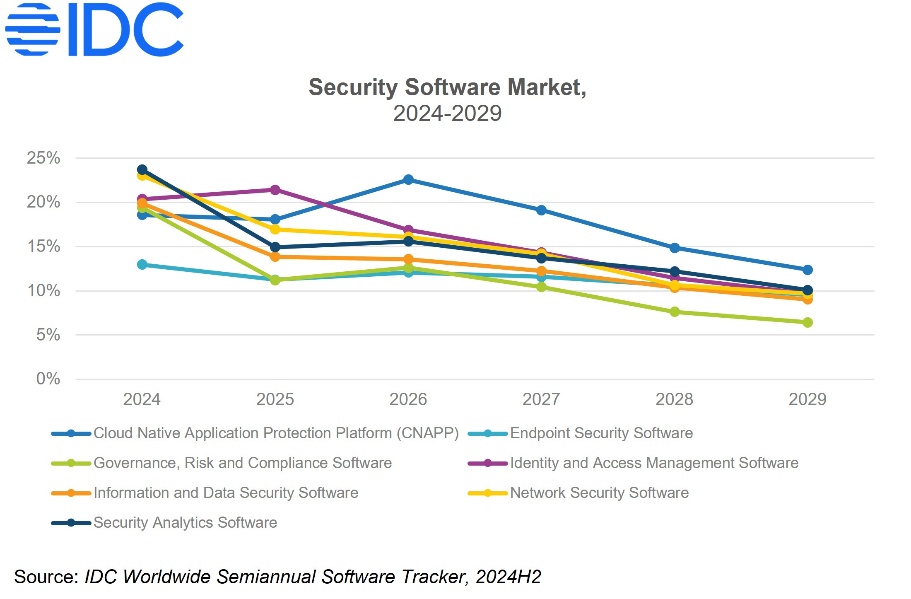
Indonesia’s security market is also evolving from basic cybersecurity measures to more strategic, scalable defenses. Early investments focused on network security, analytics, and data protection—fueled by remote work demands and regulatory readiness. These formed the backbone of first-wave modernization but are now being integrated into broader cloud and endpoint platforms, causing growth of standalone solutions in these areas to plateau.
Attention is now turning to technologies that enable security at scale. Identity and Access Management (IAM) is gaining traction as organizations manage increasingly complex access scenarios across hybrid systems and third-party platforms—driven by workforce digitalization and early Zero Trust adoption. Meanwhile, Cloud Native Application Protection Platforms (CNAPP) are rising in prominence as cloud strategies mature and enterprises seek to embed security earlier in the application lifecycle. These shifts reflect a move toward context-aware, AI-augmented platforms that reduce friction and support long-term scale.
Security adoption also varies significantly by industry. Financial services remain at the forefront, shaped by OJK (Otoritas Jasa Keuangan) regulations that require strong controls for incident response and third-party risk management. With high exposure to digital fraud and sensitive data, banks, insurers, and fintechs are adopting proactive, integrated strategies—some of which include AI-based fraud detection and real-time monitoring. Manufacturing and communications sectors are also actively investing in cybersecurity, working to secure increasingly digitized operations and protect cloud-based services. Meanwhile, education, healthcare, and local government face slower adoption, constrained by legacy infrastructure, resource limitations, and skills gaps—despite rising exposure to digital threats.
“As AI becomes more integrated into security operations, organizations are moving beyond basic automation toward intelligent systems that learn, adapt, and support analysts in real time. This shift is not just about easing workload—it enables faster response, sharper prioritization of threats, and more sustainable operations, especially for teams facing high alert volumes and limited resources,” said Sandika Putra, Associate Market Analyst di IDC Indonesia.
-Ends-
About IDC Trackers
IDC Tracker products provide accurate and timely market size, vendor share, and forecasts for hundreds of technology markets from more than 100 countries around the globe. Using proprietary tools and research processes, IDC’s Trackers are updated on a semiannual, quarterly, and monthly basis. Tracker results are delivered to clients in user-friendly excel deliverables and online query tools.
About IDC
International Data Corporation (IDC) is the premier global provider of market intelligence, advisory services, and events for the information technology, telecommunications, and consumer technology markets. With more than 1,300 analysts worldwide, IDC offers global, regional, and local expertise on technology and industry opportunities and trends in over 110 countries. IDC’s analysis and insight helps IT professionals, business executives, and the investment community to make fact-based technology decisions and to achieve their key business objectives. Founded in 1964, IDC is a wholly-owned subsidiary of International Data Group (IDG), the world’s leading tech media, data and marketing services company. To learn more about IDC, please visit www.idc.com. Follow IDC on Twitter at @IDC and LinkedIn. Subscribe to the IDC Blog for industry news and insights.