In Europe’s markets, strategic messaging must prove ROI and stay aligned across strategy, sales, analysts, and country GTM teams. 

Strategic Messaging in Europe’s Markets 

As 2026 planning accelerates, high-performing GTM teams at tech vendors across Europe know that campaigns alone won’t secure growth. They’re stress-testing positioning – not only for internal alignment, but for resonance with buyer expectations, stakeholder dynamics, and budget scrutiny. 

The fundamentals of effective messaging remain constant across regions: clear strategy, ROI proof, and alignment across functions. In Europe, however, an added layer of complexity must be addressed: messaging needs to resonate across fragmented national markets, languages, and governance models while staying consistent for buyers. 

What We’re Seeing from Top-Performing GTM Teams in EMEA 

  1. Building from buyer economics, not brand preference

The strongest value narratives in 2026 are rooted in buyer economics. For European GTM teams, that means anchoring messaging in: 

  • Business outcomes tied to line-of-business KPIs 
  • Time-to-impact metrics that satisfy budget scrutiny 
  • Proof points that link product value to spend categories and investment decisions 

IDC research shows that messaging built around use-case ROI increases renewal likelihood by 3.5x. For GTM teams competing across Europe, this ROI narrative must be credible at headquarters and adaptable in local markets. 

  1. Aligning to who the buyer really is now

Your champion may still sit in IT or product, but the buying committee has expanded. In 2026, procurement, finance, RevOps, and CFOs will shape final evaluations – and their questions go beyond features and functions: 

  • How does this investment impact budget and efficiency? 
  • Where does it fit in the broader vendor stack? 
  • Does it align with compliance and operational resilience goals? 

For European GTM teams, these dynamics don’t change, but multi-country decision-making adds friction. ROI messaging must stay consistent across borders, so what a buyer hears in Paris matches what they hear in Munich or London. 

  1. Checking internal alignment before buyers do

Too often, what strategy wants to say, what sales are saying, and what analysts are reporting don’t fully align. That slows the buyer’s journey or stops it altogether. 

In Europe, the risk of misalignment is multiplied: 

  • A message crafted centrally may not translate effectively in country execution 
  • Analyst commentary may highlight ROI drivers in one market that don’t match what buyers hear locally 
  • Country-level adaptations risk drifting unless anchored in a shared ROI-based strategic framework 

Leading European GTM teams are addressing this by creating aligned narratives validated against external signals. That way, strategy, sales, analysts, and country teams reinforce each other rather than pulling apart. 

Why It Matters for Tech Vendors in Europe

In fragmented markets, the risk isn’t messaging that’s “wrong.” It’s messaging that’s slightly off – between strategy, sales, and analysts, or between headquarters and local GTM teams.

The strongest European GTM teams in 2026 will be those that:

  • Keep strategic alignment as their foundation
  • Prove ROI under budget scrutiny
  • Adapt to country-level nuance without losing consistency

IDC’s role as the Trusted Tech Intelligence provider is to help tech vendors validate and align these narratives — ensuring that what strategy defines, what sales delivers, and what analysts echo are all part of one coherent story across Europe.

Want a deeper checkpoint?

We recently published a new guide “5 Signals Your Messaging Won’t Win in 2026”.  This guide outlines the most common and often hidden signs of misalignment we’re seeing in enterprise GTM efforts right now, along with steps you can take to course-correct using IDC data.

If you have a question about anything, please fill in this form.


Today’s marketing leaders are being asked to drive bold innovation, lead AI-powered transformation, and deliver measurable revenue gains – all on last year’s budget.

This might sound like a familiar challenge for many midmarket tech CMOs. Expectations have grown more strategic, yet financial support remains static.

Fifty-four percent of midmarket CMOs expect no increase in their marketing budgets, according to IDC’s 2025 Global Midmarket Tech CMO Priorities Study. But the pressure to demonstrate marketing’s impact on growth, acquisition, and customer experience remains.

This misalignment is more than a budgeting deadlock. It reflects a widening disconnect between executive demands and what resources marketing teams have to deliver.

In a landscape increasingly shaped by AI adoption, customer expectations, and competitive urgency, this gap is a structural barrier. And it is one that threatens marketing leaders’ ability to innovate, differentiate, and scale.

This is just one of four critical disconnects IDC has identified within marketing teams today. Left unaddressed, the misalignment between corporate visions and budgeting reality doesn’t just slow down marketing. It stalls enterprise growth.

screenshot of ebook

Budgets are buried in the pressure cascade

Today’s CMOs are navigating what IDC defines as the Pressure Cascade: a convergence of executive-level demands that place marketing at the center of enterprise transformation. Marketing leaders are now tasked with more than demand generation or pipeline contribution. They must also:

  • Drive innovation to acquire new customers and power growth.
  • Deploy AI programs to personalize and enhance the customer experience – with measurable results.
  • Deliver a coherent marketing strategy that aligns with existing data infrastructures.

These expectations reflect a clear shift in the CMO’s role in the organization. Yet the financial structure supporting this evolution remains stuck in the past. Budgets are still planned around yesterday’s definitions of marketing – not today’s enhanced, cross-functional transformation.

Why budgets aren’t budging

The data uncovered by IDC reveals the disconnect leading to the budget plateau. Thirty-two percent of marketing leaders believe the C-suite will prioritize cost optimization and ROI in the next 12-18 months.

Still, more than a third of CMOs are challenged to justify investments in brand marketing and awareness, while nearly a quarter struggle with measuring and proving the strategic value of marketing.

The difficulty of proving marketing’s worth within the organization is compounded by rising economic uncertainty, and complex executive demands limits CMOs’ ability to deliver on expectations. In an era when money is being directed towards tech modernization and AI initiatives, marketing can be left off the table.

Without budget flexibility or the data to frame marketing as a growth engine, leaders risk being constrained by outdated assumptions, even as the demands of the business move forward.

The strategic cost of standing still

Static or minimally adjusted budgets may seem manageable for now, but they create long-term strategic risk for the entire organization. When funding doesn’t keep pace with the expanding scope of marketing’s purview, critical initiatives can be delayed, scaled back, or abandoned entirely.

IDC research shows midmarket CMOs are under mounting pressure to develop areas that directly influence revenue and customer acquisition, such as AI-enhanced experiences, advanced personalization, and predictive analytics.

Without adequate resources, these high-impact opportunities are left underfunded. The result is a widening gap between organizations that execute bold strategies and those that are stuck in the past – losing revenue potential, market visibility, and the path to modernization.

When “making do” doesn’t do enough

In the absence of significant budget increases, many CMOs are doing their best to optimize what they have. IDC’s 2025 study shows the top two marketing priorities for the next 6-12 months are increasing revenue from existing customers (34%) and reducing costs or streamlining operations (31%).

While these are important goals, they take the focus away from the big-picture initiatives that drive new customer acquisition or enable advanced AI adoption. These adjustments can free up resources in the short term, but they don’t have the capacity to enable market-shaping campaigns.

Legacy systems, underfunded teams, and outdated, siloed technology make it difficult to deliver the personalization, speed, and insight modern buyers expect. Without meaningful reallocation toward initiatives that directly align with executive priorities, minor budget tweaks risk becoming an exercise in standing still – not moving forward.

What’s at stake: Agility, credibility, and the competitive edge

Failing to address the budget deadlock has consequences that go beyond marketing’s internal performance metrics. Without the resources to pivot, CMOs cannot respond quickly to market shifts or capitalize on emerging opportunities.

A lack of agility can erode marketing’s perceived value across the organization. Thirty-four percent of marketing leaders said demonstrating marketing’s strategic impact and ROI was their biggest challenge in establishing internal credibility and trust. Similarly, 26% said they faced difficulty proving marketing’s leadership role in driving business growth.

Without a larger budget to meet expanded expectations, teams are forced to spread limited resources across too many priorities. Results become harder to measure and even more difficult to defend. Over time, this fuels the perception that marketing is a cost center rather than a revenue driver.

Externally, the competitive risks are just as significant. Organizations that devote resources now to AI-enabled engagement, targeted acquisition, and data-driven personalization are setting themselves up for future success.

Those that delay investment risk falling into a reactive role – chasing market leaders instead of setting the pace. For midmarket CMOs, the ability to secure and strategically deploy a sizeable budget is tied directly to their ability to lead the competition.

Breaking the deadline: The path forward is strategic, not reactive

Flat budgets are more than just a financial plateau. Over time, they reduce marketing’s ability to deliver on executive priorities, limit the scope of innovation, and dull the organization’s competitive edge. In an environment where AI adoption, customer demands, and market shifts are accelerating, standing still is not an option.

CMOs who move beyond reactive, incremental thinking and approach budget planning as a strategic exercise are better positioned to meet heightened executive expectations. They have clear, data-backed business cases, resources aligned with company-wide priorities, and measure impact in terms of enterprise growth.

The budget deadlock is real, but so is the opportunity. With the right data, a disciplined approach to resource allocation, and a willingness to reframe budget conversations, marketing can reclaim its role as a growth engine, not a cost center.

The path forward isn’t asking for more. It’s about making every dollar work harder toward measurable, high-impact outcomes.

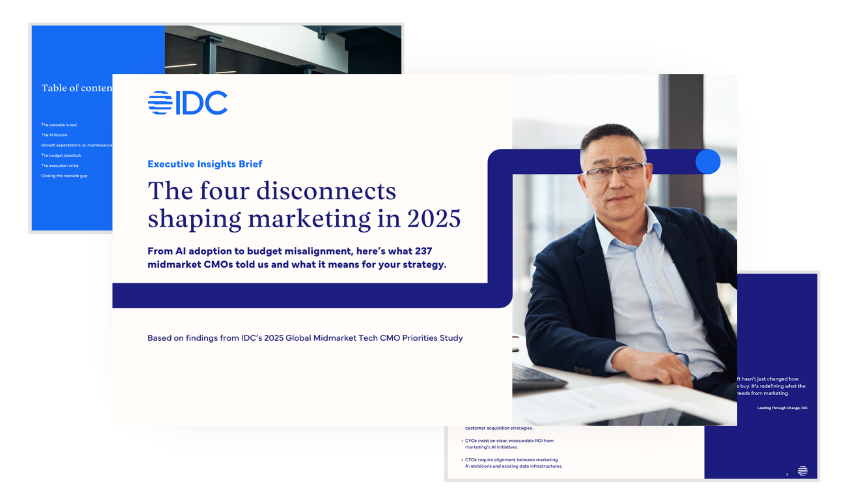
Break free from your budget deadlock. Access IDC’s Executive Insights Brief: The four disconnects shaping Marketing in 2025 for data-backed strategies to realign your marketing budget for growth – and more insights into the top challenges facing today’s CMOs.

In a world of economic uncertainty, rising rates, and AI disruption, one thing is clear: tech leaders aren’t pulling back, they’re planning smarter. 

That’s the pulse from IDC’s recent webinar on the state of tech spending and strategic planning for 2026. Whether you missed it or want the fast facts, here are five standout moments that unpack where budgets are moving, how buyers are thinking, and why IDC’s insights matter more than ever. 

1. Real growth is still there – just look through the inflation lens.

“When you adjust for inflation, you can see that real IT growth remains positive. Companies are still investing — but they’re more cautious and strategic in where the money goes.” 

 What it means: The market isn’t shrinking, it’s shifting. Decision-makers are moving from “grow at all costs” to “grow with clarity.” IDC’s inflation-adjusted forecasts reveal where that clarity lives. 

2. High rate, steady budgets: Tech is no longer discretionary.

“Even as interest rates have risen and borrowing costs go up, we’ve seen IT budgets hold steady. That’s because technology has become foundational, not discretionary.” 

What it means: Budgets aren’t breaking under pressure, they’re being reallocated with purpose. Foundational tech like cloud, data, and AI are becoming immune to cuts. 

3. Today’s breakthroughs started with the third platform.

“The Third Platform — cloud, mobile, social, and big data — was the foundation for the wave of innovation we’re seeing today. Every breakthrough you see now stands on that groundwork.” 

What it means: If you want to understand where we’re headed, start with how we got here. IDC’s long-range view helps you map innovation back to its roots and ahead to what’s next. 

4. Generative AI: Budget disruptor. Acceleration engine.

“Generative AI is already reshaping IT spending. We’re seeing budgets shift toward data platforms, model development, and governance, and it’s accelerating faster than any previous technology cycle.” 

What it means: GenAI isn’t coming; it’s here, and it’s redefining every spending curve. IDC breaks down where the money’s going, and how leaders are reallocating resources to stay competitive. 

5. The IT market just hit a trillion-dollar quarter, for the first time ever.

“For the first time ever, the IT market hit a trillion dollars in a single quarter. That’s a milestone and much of that momentum is being driven by AI investments.” 

What it means: This isn’t just hype. AI is driving the biggest IT investment cycle in history. The leaders shaping 2026 aren’t just watching the wave, they’re riding it. 

See what’s shaping 2026 before it happens.

IDC’s trusted tech intelligence helps you see the shifts before they land, so you can move first, move smart, and move with confidence. 

AI is no longer just a tool for productivity. It’s changing who makes buying decisions, how they evaluate vendors, and what they expect from every interaction. For analyst relations (AR) professionals, that means a new mandate: turning complex buyer insights into influence across executives, marketing, and sales teams.  

During IDC’s recent webinar, Turning Insights into Influence: Leveraging Buyer Behavior Research, Laurie Buczek, Group VP of Executive Insights and Thought Leadership Services at IDC, explored how AI and shifting buyer behavior are reshaping go-to-market strategies. At the end of the session, Laurie answered audience questions about the role of AI, how buying committees are changing, and what AR professionals can do to help their organizations succeed.  

How can AR professionals use AI, especially agentic AI, in their roles?

Start with secure, ring-fenced AI tools that are approved within your organization, and avoid external large language models (LLMs) that may compromise your IP. AI can help AR leaders: 

  • Synthesize analyst insights into key takeaways executives can act on. 
  • Draft executive guidance aligned to business goals. 
  • Offload repetitive tasks to agentic AI, such as generating AR plans, drafting key messages, or synthesizing analyst feedback. 

Think of AI as both an assistant (helping optimize content) and an agent (able to draft or manage elements of strategy that humans then refine and execute). 

How are buying committees using AI, and how shold vendors align with them?

Buying groups are expanding, and each persona approaches discovery differently. Increasingly, they start with AI-powered chat functions to research solutions. That means vendors must rethink how their content is created and structured. 

It’s no longer just about keywords and SEO. Content must be optimized for prompts, designed to answer the jobs-to-be-done that buyers will type into chat engines. In other words, organizations need to rebuild their content supply chain for an AI-first buyer journey. 

Many companies collect buyer insights but struggle to act on them. How can we ensure insights actually influence executives?

Too often, buyer insights live in a persona document or slide deck that gets shelved. AI can change this by: 

  • Implementing insights in real time through optimized buyer journeys and engagements. 
  • Measuring impact continuously: Using AI to track how journeys are performing and where optimizations are needed. 
  • Speaking the executive’s language: Turning insights into meaningful KPIs that demonstrate business outcomes. 

This helps AR professionals not just share insights but prove their value to leadership. 

Buyers rely on AI, but do they still trust peers and analysts?

Absolutely. AI doesn’t replace the importance of trusted experts and communities.  

Buyers are: 

  • Attending events to learn from peers. 
  • Visiting vendor websites for direct information. 
  • Turning to social communities and networks for validation. 

The takeaway: AR leaders should help their organizations influence across multiple channels: AI, digital platforms, peers, analysts, and social networks.

Learn more

The buyer journey is no longer linear. It’s omnichannel, AI-led, and persona-rich. For AR professionals, that means a new mandate: translate insights into influence across executives, marketing, sales, and peers. 

Christina Cardoza - Content Marketing Manager - IDC

Christina Cardoza is a Content Marketing Manager at IDC, where she specializes in brand content and social media strategy. With a background in journalism and editorial leadership, she has a proven ability to transform complex technology topics into clear, actionable insights.

AI is reshaping the way buyers behave. They move fluidly between digital and in-person channels, research on their own terms, and expect every interaction to feel timely and connected. Today, most buyers prefer digital-first engagement, and they notice when experiences fall short.

Even with strong teams and good intentions, it’s easy to miss the mark. Content lands out of sync. Signals slip by. Event engagement fizzles into fragmented follow-ups. The result? Stalled pipeline and missed opportunity.

That’s where orchestration comes in. To meet buyers where they are, and move at the speed and relevance they expect, sales and marketing teams need more than just campaigns. They need plays: repeatable, proven motions that turn insight into action.

Where should you start? Not every team faces the same roadblocks. Some struggle with nurture streams that stall. Others see event ROI fall flat. Some launches never hit stride. These plays are built to help you zero in on the challenges you’re facing right now and run the motion that will get you unstuck.

5 proven GTM plays to unlock growth

  1. Reignite a stalled nurture stream

When leads go quiet, it’s not the end of the story. It’s a signal. Too often, teams focus on chasing new contacts while overlooking the prospects already in their pipeline. By diagnosing drop-off points and re-personalizing the journey, marketers can convert dormant interest into qualified pipeline.

  1. Align event engagement with digital journeys

Events are high-investment moments, but without thoughtful orchestration, they fade fast. Buyers expect pre-, during-, and post-event interactions to feel connected. This play ensures event attention flows into a broader engagement journey instead of stalling out.

  1. Equip sales with signal-based content activation

Almost half of sales teams say they lack visibility into buyer intent. That leaves them pursuing leads without context. This play bridges the gap by translating signals, like demo requests or pricing page visits, into clear next-best actions. Sales gets the visibility and timing they need to act fast.

  1. Execute an orchestrated GTM launch

Great launches should feel like a single story, not a scatter of tactics. But aligning teams and channels is hard. This play brings marketing, sales, and operations together around a shared plan, message, and cadence so launches hit the market faster and with greater impact.

  1. Orchestrate the fully integrated omnichannel experience

This is where everything comes together.

Instead of relying on one-off tactics, this play builds an always-on GTM system that senses buyer signals, sequences interactions, and adapts across every channel. The result is a connected system that scales with buyers and keeps pipeline flowing

Your next move: Smarter, not bigger

Buyers aren’t waiting. They’re moving fast, guided by signals you might not even see. The good news? You don’t have to chase them. You can meet them there.

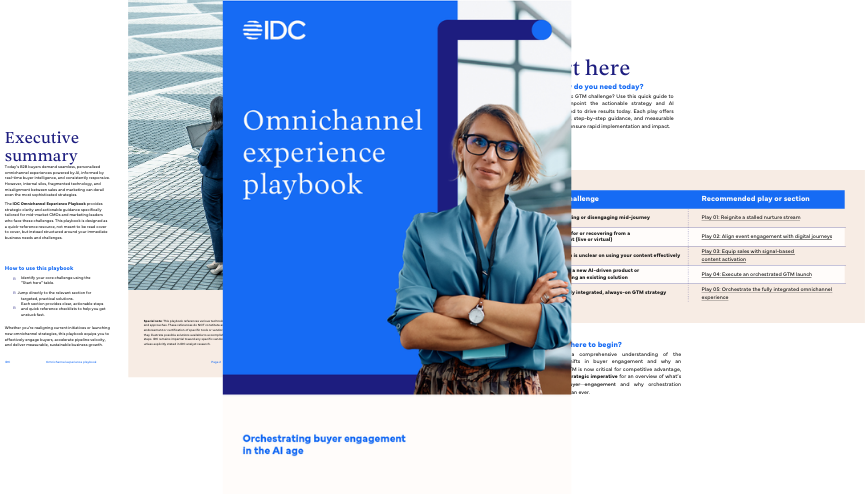
Whether you’re reigniting a stalled nurture, converting event attention into pipeline, or launching your next big solution, IDC’s Omnichannel Experience Playbook gives you the proven plays to move with forward with clarity and confidence.

And when you’re ready to accelerate, the AI Supplemental Guide shows you how to weave intelligence into every step, so your team isn’t just reacting to buyer behavior, but anticipating it, personalizing it, and orchestrating it across every channel.

Ready to move smarter? Download the full Omnichannel Experience Playbook to activate five proven GTM plays. Then explore the AI Supplemental Guide to see how intelligence, personalization, and integration can take every play further, keeping you not just in step with buyers, but one step ahead.

Christina Cardoza - Content Marketing Manager - IDC

Christina Cardoza is a Content Marketing Manager at IDC, where she specializes in brand content and social media strategy. With a background in journalism and editorial leadership, she has a proven ability to transform complex technology topics into clear, actionable insights.

Financial service providers benefit from large global fintechs as well as startups.

The role of fintechs

While the names of the vendors have changed, the impact fintechs have, both large and small, in shaping how we learn, transact and plan our financial journeys has not. 

Today’s customers are looking for many things when it comes to their financial relationships.  First and foremost is that they generally will start their process by doing their research online, whether it’s to compare rates, products, locations or reviews, they want to know the information ahead of time before taking things to the next level. 

Let’s look specifically at the banking industry. Consumers are savvy, and will be loyal if their expectations, both digitally and through employees, is being met.  That often starts right at the point of beginning a new relationship, and the importance of engaging a customer where they are, on any device, with relevant and personalized offers and messages. To do this, often times banks will look towards their core provider, an enterprise platform solution, or specialized vendors to develop solutions.  Large institutions may choose to build their own, but will often augment areas with prebuilt components in order to improve speed to market. 

IDC 2025 FinTech Rankings

IDC Financial Insights has been conducting its IDC FinTech Rankings research for over two decades. The research is a quantitative “state of the industry” measurement for financial services– and fintech-based revenue earned by the top 150 technology firms globally. The financial services industry is made up of banking, insurance, capital markets, and fintech firms that buy hardware, software, and services from third-party IT providers. Two major categories of IT companies are ranked: 

  • IDC FinTech Top 100: Solution providers that derive more than one-third of their revenue from the financial services and fintech industries and across no more than two additional key non-FSI industry verticals 
  • IDC FinTech Enterprise Top 50: Solution providers that support four or more key industries yet have sufficient revenue from the financial services and fintech industries to be ranked 

When one looks at the amount of budget earmarked for technology spend, again in hardware, software and services (not employees), IDC estimates that annually over USD 550 billion is spent by banks, capital market and insurance providers. To put that in perspective, that would make the IT spend by FSI equivalent to being one of the largest 25 in the world by nominal GDP, equivalent in size of the economy of Ireland.  

Finovate Fall themes and messages

As in year’s past, I have had the opportunity to see what the next generation of fintech providers are working on at the Finovate event in New York City. It was great to see so many exciting solutions spanning the banking and wealth management industries. While these fintechs only had a few minutes, seven to be exact, to demonstrate their solution, there were some themes that seemed to resonate with the solutions demonstrated. 

First, the importance of customer experience remains a key component of the demonstrated solutions, but glad to see that the importance of employee experiences has equaled in importance. The reality is that the industry has neglected the solutions supporting our employees, and often times they are being asked to support customers who are using modern technology with outdated interfaces and disparate platforms. Single sign in has been helpful, but there is much that needs to be done. 

Second, and to nobodies surprise is leveraging AI to automate and create efficiencies.  Our research would agree that the primary benefit of AI is to create efficiencies out of inefficient processes, but this does not always necessarily mean that it will automate a process. For example, using AI to begin a fraudulent transaction makes sense to gather as much information as possible, yet we are not ready to have AI actually execute the steps necessary to either disable a card or issue a refund. There still needs to be a human on the loop, whether it is the customer or the bank employee. 

And finally, there were solutions pitched that focused on identify management and improving security, particularly focused on money movement and maintaining compliance with existing and future regulatory requirements.  The idea, which is more refinement than innovation, is to embed fraud prevention within the solution, but ensure that the forensics are available to detect and deter actions by bad actors. 

Marc DeCastro - Research Director - Consumer Banking - IDC

Marc DeCastro is responsible for the consumer banking engagement strategy practice. Mr. DeCastro’s core research coverage includes the complete omni-experience journey for the retail customer, including branch transformation, digital product strategies, and onboarding. Based on his background covering the consumer banking space, Mr. DeCastro’s research also includes a particular emphasis on how consumer trends and habits are forming the next generation products and services that utilize current and emerging technology.

For nearly two decades, search engine optimization (SEO) dictated how brands achieved visibility online.

Ranking high on Google or Bing meant being found, considered, and chosen based on certain criteria. Marketers built entire playbooks around understanding algorithms, shaping content, and winning the top position on the results page.

That world is changing. The rise of generative AI (GenAI) has introduced a new discovery experience. It is one that doesn’t list websites, but delivers answers and tailored recommendations directly to the consumer.

Where SEO once determined rankings, large language models (LLMs) are now shaping which brands appear in conversations and product suggestions. Some models, like Perplexity.ai, make the buyer journey completely seamless from discovery to purchase.

This isn’t a technical adjustment. It’s a strategic reset.

To stay relevant, marketers must learn how to influence the systems consumers increasingly rely on. LLM optimization, a new approach to impacting search results, is quickly becoming marketing’s next imperative.

screenshot of ebook

The shift from “search” to “chat”

IDC forecasts companies will spend up to five times more on LLM optimization than traditional SEO by 2029. This significant budget reallocation signals a broader move from AI experimentation to complete AI integration.

The momentum is clear. In response to ChatGPT’s debut in late 2022, major technology companies have launched (or are developing) their own customer-facing LLMs. Investment is accelerating as well: IDC projects a 59% compound annual growth rate (CAGR) in GenAI spending between 2023 and 2028.

Consumers are moving just as quickly. Over 45% of people now use GenAI weekly, often for personal research and recommendations. The parallels to the early days of search are striking, but this time, implementation is happening in just a few years, not decades.

For CMOs, this means visibility, strategy, and budget will increasingly hinge on how well the brand is represented within LLM systems.

Why SEO alone isn’t enough

SEO was built for a search-first internet. Keywords, backlinks, and metadata drove rankings and reach. But the AI experience era is changing search in ways SEO alone cannot address.

Most major engines now feature enhanced search, where AI-generated summaries appear above traditional rankings. Even the best-optimized content is pushed further down the page. And when customers move directly to platforms like ChatGPT or Perplexity, they bypass ranked results entirely.

In this environment, the familiar metrics of SEO lose influence. A page may be perfectly optimized for keywords yet never shape how an AI model interprets or recommends a brand. Representation is increasingly determined by what the model ingests and prioritizes, not by where content appears in a list.

To remain discoverable, marketers must look beyond search engines. The question isn’t how to rank higher, it’s how to be recognized and represented in AI-powered responses.

Rewriting the rules of visibility

Generative AI has introduced a new standard for digital discoverability. LLMs don’t rank pages; they synthesize responses and recommend options. That means fewer opportunities for discovery, with higher stakes for inclusion.

This new environment is giving rise to practices like Generative Experience Optimization (GEO). GEO focuses on structuring content so it can be ingested and surfaced by generative engines. Research shows it works: brands that apply GEO practices can see up to a 40% increase in visibility within AI-generated responses.

But GEO is only the beginning. It’s a bridge to the broader discipline of LLM optimization: the ability to shape how models interpret, prioritize, and present brands across conversations, shopping experiences, and enterprise tools.

The growing consumer expectation for personalization makes this transition even more important. Customers now frame queries by values and preferences – for example, asking for sustainable brands, locally sourced products, or companies with strong ESG records.

Meeting these demands requires more than SEO tactics. It requires a full LLM optimization strategy to ensure your brand is consistently represented in the answers customers already trust.

Why this matters for marketing leaders

LLM optimization isn’t another channel shift. It’s a new foundation for reach and relevance.

Marketing leaders are under pressure to adapt to the new AI-powered paradigm:

  • Competitive urgency: Early adopters are already experimenting with how to shape generative answers. Just as first movers in SEO once dominated search results, those who adapt quickly will capture an outsized share in LLM-driven recommendations.
  • Customer experience: Generative platforms increasingly guide discovery and decision-making. If your brand is absent or misrepresented in these interactions, you won’t even be on customers’ radar.
  • Brand reputation: Because LLMs synthesize context, any inaccuracies or outdated information about your brand can quickly be amplified, displacing the identity you want to project.
  • Budget challenges: As resources are dedicated toward AI priorities, marketing leaders must demonstrate the value of investing in LLM optimization over long-established tactics.

It’s clear: waiting is not an option for marketing leaders. LLM optimization will determine which brands are consistently elevated in the channels where customers are discovering new products and solutions.

Preparing for the LLM era

As with AI adoption, implementing LLM optimization requires more than experimenting with new tactics It demands a deliberate transition in how marketing organizations approach visibility. IDC has identified three priorities for leaders preparing for this transition:

  1. Audit your brand presence in LLM systems. The way your brand appears in generative search defines the new baseline of representation. If you’re absent from LLM search results, you’ll be invisible to consumers.
  2. Create content optimized for GenAI models. Generative systems reward clarity and authority, not just keywords. The signals that once boosted a page in search rankings aren’t the same ones that will cause a brand to feature in an AI response. You must develop an integrated content strategy primed for ingestion and prioritization within LLMs.
  3. Devote training and resources to GenAI marketing. LLM optimization is not SEO by another name. Additional investment and a fresh mindset are essential to help marketing teams adapt to the new AI-driven content creation standards.

This is just the starting point. Full transformation will require cross-functional alignment, new success metrics, and a commitment to showing up where decisions begin.

The new strategic imperative

The shift from SEO to LLM optimization marks a new era of discovery where AI determines which brands are visible, trusted, and recommended. For marketing leaders, the risk of inaction is invisibility in the very channels where customers go for answers.

The opportunity is clear. Those who prioritize LLM optimization will shape how their brand is represented in an AI-first world, ensuring they have a voice in the conversations that drive decisions. The future of marketing is no longer just about rankings. It’s about investment, leadership, and earning consumers’ trust.

Dive deeper into how to prepare for the future of LLM optimization with IDC’s Four Disconnects Reshaping Marketing Today and Tomorrow. Explore the strategic frameworks, emerging roles, and high-impact actions that will define success in the LLM era.

Apple’s “Awe-Dropping” event this week delivered more than routine updates; it marked a strategic realignment of the company’s hardware portfolio and a deepening of its ecosystem strategy. The new iPhone 17 lineup, including the all-new iPhone Air (starting at $999), addresses competitive pressures, redefines market segments, and further entrenches Apple’s services into customers’ daily lives.

Driving upgrades and shortening cycles

Apple’s 2025 product strategy is simple: increase upgrade rates and shorten replacement cycles. The iPhone 17 Pro redesign and the debut of the iPhone Air introduce distinctive form factors designed to encourage users to upgrade earlier.

This approach aims to sustain iPhone market share, which currently stands at 18% of the global smartphone market and 42% of the global market value as of the first half of 2025, and will likely achieve IDC’s forecast of 4% volume growth this year.

A shift in portfolio strategy: The iPhone Air

The biggest shift revealed was Apple’s discontinuation of its “Plus” model in favor of a new, ultra-thin iPhone Air. This marks a deliberate pivot from segmenting the market by screen size to a more nuanced strategy based on design philosophy and form factor. The goal is to create a new still-premium, but non-Pro tier, fundamentally altering the portfolio’s architecture.

The newly introduced iPhone Air is an ultra-thin model designed to replace the discontinued “Plus” variant. It features a 6.5-inch display, a 48MP Fusion camera system, an A19 Pro chip, eSIM-only support, and a smaller battery that Apple says will still last all day. It weighs 165 grams with a titanium frame and is 2.31mm thinner than the iPhone 17—which also makes it thinner than its direct competitor, the Samsung S25 Edge. This device represents a bet on the market appeal of industrial design.

The strategic positioning of the iPhone Air has a direct parallel with the launch of the MacBook Air in 2008 and the iPad Air in 2013. Like those devices, the iPhone Air trades some specifications for portability and design, targeting consumers who value aesthetics, in-hand comfort, and thinness over maximum camera performance or battery capacity.

With a more durable body, an advanced chip, and most of the iPhone 17’s features, the iPhone Air offers fewer compromises than expected. This product aims to improve sales in the segment between the standard version and the Pro Max version—a segment where the former Plus models were never able to establish themselves as strong performers. Although Plus models accounted for only 5–7% of Apple’s shipments, we expect the Air to contribute well over that given the novelty. The iPhone Air offers similar specs to the standard iPhone 17 but is positioned as a different model and a more desirable kind of premium device, which will help Apple establish a new premium, non-Pro tier that can help grow the overall average selling price, which the Plus version never did.

Although there’s a question mark about how much consumers care about thinner devices, the performance of similar competing products is promising. For example, the Samsung S25 Edge sold over a million units in the first month of sales in Q2 2025 to become the sixth highest-selling smartphone globally in the high-premium ($1,000–$1,600) price segment. This suggests there’s an appetite for thinner devices—or perhaps a desire for a device that stands out from the others—making it a compelling driver for many users to upgrade.

iPhone 17 Pro and Pro Max: Performance and design redefined

For its flagship models, Apple is undertaking a significant re-engineering effort focused on performance, professional-grade imaging, and durability. A key element of this strategy is the material shift for the iPhone 17 Pro and Pro Max. The new lineup moves away from the titanium frames of the previous two generations to a new aluminum unibody.

There are two main reasons for this change: first, thermal management; and second, durability. The new A19 Pro chip with advanced AI capabilities is expected to generate significant heat. This shift from titanium to aluminum is essential for maintaining peak performance during intensive tasks, such as gaming or ProRes video recording. Durability is another important factor. While titanium is stronger, it is also more rigid. Softer aluminum is better at absorbing and dissipating impact energy.

Other factors that went into this strategic decision are design and aesthetics. By using aluminum, Apple gains flexibility in colors and finishes. For example, the new cosmic orange option would not have been possible with titanium. Providing more colors in the lineup also addresses user demands and expands Apple’s user demographics and overall user experience. Finally, switching to aluminum helps Apple scale production and control costs—factors that are increasingly important in today’s volatile economic climate where Pro devices remain in high demand.

The camera system also sees a significant improvement. For the first time, all three rear lenses—Wide, Ultra Wide, and Telephoto—will have 48MP sensors. This upgrade, particularly for the telephoto lens, will enable up to 8x optical zoom in the Pro versions—a substantial leap from the 5x zoom on the iPhone 16 Pro. The front-facing camera is also receiving an upgraded 24MP sensor, a jump from the 12MP sensor of previous generations.

Externally, the new design offers a horizontal camera bar, replacing the traditional square bump. This simple redesign of the cameras will become one of the main motivators for users to upgrade, which will accelerate Apple’s replacement cycle.

Apple increased the price of the iPhone 17 Pro by $100, as it now comes with a minimum of 256GB of storage (compared to 128GB in the iPhone 16 Pro), and maintained the price of the Pro Max model at $1,199—which is noteworthy given the current economic environment impacting the U.S. market.

iPhone 17: Solid, incremental upgrades

The standard iPhone 17 introduces only incremental changes, underscoring Apple’s decision to prioritize its higher-end models. The device retains its $799 price point and includes a 6.3-inch display with upgraded ProMotion capabilities, increased brightness, and improved durability through Ceramic Shield 2 and an anti-reflective coating. Performance gains come via the A19 chip, while the camera system now features a 48MP dual Fusion setup, a new ultra-wide lens with 4x the resolution of its predecessor, and improved front-facing capabilities.

These updates improve usability but stop short of redefining the device. In contrast, Apple has shifted more innovation toward the new iPhone Air and the iPhone 17 Pro line, where design and functionality advances are more pronounced. The result positions the standard iPhone 17 as a modest refresh—solid, but clearly secondary to the company’s premium offerings. Still, the standard iPhone 17 will benefit from a notable upgrade: base storage of 256GB. It will be available later this month.

Apple Watch: Expanding health leadership

Apple’s new smartwatch lineup underscores its push into health diagnostics, durability, and connectivity, further positioning the Watch as both a lifestyle device and an emerging health platform.

Apple Watch Series 11 debuts a thinner, more durable design, efficient 5G, and expanded health monitoring. Hypertension detection, analyzing trends over 30 days, could alert over 1 million users to undiagnosed conditions in year one, according to Apple. Combined with enhanced sleep tracking and 24-hour battery life, it deepens Apple’s stake in preventive health. At $399, it balances premium features with mainstream reach.

Apple Watch SE 3 gains an always-on display, new gestures, sleep apnea detection, and faster charging. At $249, it broadens Apple’s health ecosystem to entry-level buyers, particularly younger and cost-conscious users.

Apple Watch Ultra 3 emphasizes performance and resilience, with Apple’s largest display, new satellite connectivity, and 42-hour battery life. At $799 and built with recycled titanium, it targets outdoor and endurance segments while signaling sustainability.

Apple is advancing wearables into chronic-condition monitoring, a shift that may force rivals to adjust. Samsung must broaden its health capabilities, Google needs to strengthen credibility in clinical use, and Garmin will have to balance its fitness focus with expanding health features.

AirPod Pro 3: Beyond audio

Also announced at the event were the new AirPods Pro 3, representing a bold step toward making earbuds central to Apple’s ecosystem.

Hardware gains include an overhauled acoustic design for deeper bass and a broader soundstage, along with noise cancellation that Apple claims is twice as effective as before. Fit and durability improve with five ear tip sizes and IP57 water resistance. Battery life rises to 8 hours—a 30% increase.

The bigger story is Apple Intelligence. Live Translation is the showcase: real-time, gesture-driven translation between two people wearing AirPods, with ANC lowering background noise to prioritize voices. This could make AirPods more central to travel and cross-border communication.

Apple also expanded its role in health and fitness. A new heart-rate sensor enables tracking across more than 50 exercise types, syncing data into Fitness and third-party platforms. AI coaching arrives via Workout Buddy, indicating a push to make AirPods a more comprehensive wellness companion.

Apple kept the price at $249, with availability later this month. We expect strong holiday-quarter sales, which is a meaningful update.

Apple sets its portfolio up for growth

Apple’s 2025 fall event underscores the company’s ability to reset the narrative at a time when the smartphone market faces headwinds from tariffs, trade frictions, and consumer price sensitivity. By introducing the iPhone Air, Apple is not only filling a gap left by the underperforming Plus series but also signaling a willingness to re-architect its lineup around form factor and design philosophy rather than just screen size. This shift, combined with a substantive redesign of the Pro models and a carefully tiered portfolio, positions Apple to stimulate demand in a slowing market.

The iPhone 17 Pro and Pro Max emphasize Apple’s push into performance, durability, and advanced imaging, while the iPhone 17 delivers a solid refresh at a lower entry point, ensuring the lineup speaks to both premium buyers and more cost-conscious users. The iPhone Air, much like the MacBook Air and iPad Air before it, expands the addressable market by offering a new “premium-but-not-Pro” tier that could resonate with buyers hesitating on $1,100+ devices.

Meanwhile, the Apple Watch lineup strengthens Apple’s role in preventive health monitoring, and AirPods Pro 3 broaden functionality through Apple Intelligence, real-time translation, and fitness tracking. Together, these moves reinforce Apple’s strategy to reignite upgrade cycles and deepen ecosystem loyalty.

Tom Mainelli - Group Vice President - IDC

Tom Mainelli heads the Device & Consumer Research Group, overseeing a wide array of hardware and technology categories that cater to both home and enterprise markets. His team's research spans PCs, tablets, smartphones, wearables, smart home devices, thin clients, displays, and virtual/augmented reality headsets. He also co-manages IDC's supply-side research team, which monitors display and ODM production across various categories. IDC's consumer research, anchored by the Consumer Market Model, employs regular surveys and proprietary models to forecast numerous consumer-focused activities and spending across hardware, software, and services. As Group Vice President, Tom collaborates closely with company representatives, industry contacts, and other IDC analysts to provide comprehensive insights and analysis on a diverse range of commercial and consumer topics. A frequent speaker at public events, he travels extensively, enjoying every opportunity to engage with colleagues and clients worldwide.

Nabila Popal - Sr. Director, Data & Analytics - IDC

Nabila Popal is Senor Director with IDC's Data & Analytics team, specializing in Mobile Phones, PC Monitors and other consumer devices. Ms. Popal is responsible for the global research and quality and timely delivery for her respective technologies, coordinating with regional and worldwide research teams. She continuously engages with global vendors and key market players to discuss the latest industry trends and dynamics. Ms. Popal is also responsible for future product planning and evolution whilst managing client relationships and providing thought leadership and executing custom engagements. She also manages communications with the media and is often published in leading local and international media outlets. Ms. Popal has been with IDC since 2013, and prior to her role with the Worldwide team, she was with IDC MEA, leading the research for Middle East, Africa, and Turkey, based out of Dubai, UAE.

The IDC European Enterprise Communication and Collaboration Survey 2025 reveals increasing market segmentation in the UC space, as customers demand more choice and flexibility. This underlines the need for UC providers to evaluate their strategies and align more closely with evolving market trends. Below are the key findings from the European survey.

Businesses Demand Greater Choice and Flexibility

Most current UC offerings present binary, mutually exclusive choices that lock customers into a single platform. These options fail to address the full spectrum of business requirements, forcing organizations into trade-offs between critical capabilities such as transparency and control versus scalability and flexibility. As a result, many are unable to achieve their desired outcomes to the fullest extent.

A Resurgence of On-Premises Deployments

Cloud solutions provide scalability and eliminate upfront infrastructure costs, but some organizations are reverting to on-premises models to regain greater control and transparency over their IT environments. Regulatory constraints and geopolitical concerns — including the implications of the US Cloud Act — are driving this shift, particularly in sensitive verticals. However, this choice also involves trade-offs, with transparency and control being prioritized over flexibility. But it is not just reverting back to on-premises UCC – 60% across the board have stated that they will replace their existing solutions.

A New Era of Choice in Deployment Models

As customer demand for flexibility increases, the market is seeing greater segmentation and a shift away from traditional “either/or” approaches. Deployment models no longer need to be substitutes for one another. Instead, they can coexist, with each bringing unique, often irreplaceable value. Applications can now be decoupled from the underlying infrastructure, offering a wider range of hosting options across environments. This represents a market inflection point, where customers have more choice and flexibility to adopt solutions that best meet their needs.

Hybrid Deployments Are Becoming the Standard

Two-thirds of European businesses are already using multiple UC solutions across different deployment models to meet diverse requirements. While this hybrid approach enables organizations to capture the strengths of various models, it also introduces challenges — including higher maintenance costs, operational complexity, and integration issues. In the context of AI-driven automation, this creates opportunities for innovation to simplify hybrid environments and reduce complexity.

Strategic Implications for UC Providers

No single vendor can cover all requirements alone. A clear understanding of customer priorities, combined with close ecosystem collaboration, will be critical as the market continues to evolve. IDC’s European UCC research provides the insights needed to help providers align strategies with shifting customer needs.

If you have a question about anything, please fill in this form. 

In today’s digital world, buyers discover, evaluate, and purchase solutions in new ways. To remain competitive, organizations must understand these evolving behaviors and act on them.  

With trusted insights, marketing, sales, and executive leaders can make smarter, faster decisions and reshape their go-to-market strategies. Analyst relations (AR) professionals are uniquely positioned to bridge these insights with influence. In a recent IDC webinar, “Turning Insights into Influence: Leveraging Buyer Behavior Research,” Laurie Buczek, Group VP of Executive Insights and Thought Leadership Services at IDC, shared how AR leaders can guide their organizations through the next wave of change.

AI is reshaping the C-suite

Sixty-three percent of CEOs are already operationalizing AI initiatives.

AI is no longer experimental. It’s strategic, and the shift is starting at the top. IDC research shows AI is accelerating from ad hoc adoption to full-scale transformation:

  • 51% of organizations are in the opportunistic phase of AI adoption.
  • 47% of CEOs rank AI-driven business automation as a top investment priority.
  • 54% see AI as a lever to reinvent business models.

This shift is bigger than technology. AI is influencing how decisions are made across the entire C-suite. That makes it critical for vendors and AR teams to influence beyond IT teams, reaching across business and technical leadership.  

The buyer journey is now AI-first

Sixty-eight percent of the buyer journey is now digital.  

As AI reshapes decision-making at the executive level, it’s also transforming how buyers themselves discover, evaluate, and engage with vendors. IDC research shows: 

  • Application-based searches, like YouTube and Reddit, now surpass traditional internet search for vendor discovery. 
  • 73% of decision makers expect to rely more on AI chatbots in the future. 
  • Among IT buyers, that number rises to 85%. 

The trend is clear: buyers aren’t just digital first. They are becoming AI-first. That means your messaging, content, and influence strategy must be optimized not only for SEO, but for AI prompts, jobs-to-be-done, and discovery tools. 

Marketing’s mandate has changed

These shifting buyer expectations demand new leadership. Marketing, once focused on campaigns and channels, is now being redefined as the orchestrator of the entire journey. IDC research shows CMOs are evolving into Chief Market Officers focused on integrating cross-functional engagement and driving growth. 

This evolution is backed by changing skill demands: 

  • Marketing science and analytics are critical for decision-making. 
  • Creative storytelling remains vital to differentiate and connect. 
  • AI fluency, from prompt engineering to agentic workflows, is becoming a core requirement. 

One CMO summarized the shift well, “Sales has integrated into marketing. The CMO is now the chief commercial officer. We view sales as a channel in the customer’s journey versus a standalone function.” 

Where AR leaders come in

With CMOs stepping into broader commercial roles, AR professionals have a unique opportunity to ensure executives stay aligned with market realities and to turn insights into true influence. 

AR professionals can turn insight into influence by: 

  • Explaining how AI is reshaping customer business models and updating messaging to reflect it. 
  • Mapping the expanded buying committee to avoid missed revenue opportunities. 
  • Rebuilding the content supply chain for a digital, omnichannel, AI-first world. 
  • Helping executives understand that an AI-ready marketing organization is no longer optional. 

Bringing these threads together, the future of buyer engagement is clear: omnichannel, AI-led, and persona-rich. For AR professionals, the mandate is not just to capture insights, but to turn them into influence. 

Christina Cardoza - Content Marketing Manager - IDC

Christina Cardoza is a Content Marketing Manager at IDC, where she specializes in brand content and social media strategy. With a background in journalism and editorial leadership, she has a proven ability to transform complex technology topics into clear, actionable insights.