The market leadership imperative in the agentic economy

In the agentic economy, where autonomous AI systems increasingly act on behalf of the business, market leadership depends on an organization’s ability to orchestrate AI-driven decisions, workflows, and governance at scale. As autonomous agents increasingly shape how work gets done, leaders must shift from controlling systems to navigating interconnected, AI-enabled operations with confidence, trust, and strategic clarity.

This is the central message of IDC’s FutureScape Field Manual: C-suite Edition — The Market Leadership Imperative: Creating Advantage in the Agentic Economy. Rather than focusing on AI as a standalone capability, the ebook examines how agentic systems are reshaping decision-making, operating models, and leadership responsibility across the enterprise.

From control to navigation

For decades, leadership in technology-driven organizations was rooted in control: standardizing systems, optimizing processes, and reducing variability. In the agentic economy, that model no longer holds. AI agents introduce autonomy, interdependence, and speed at a scale that challenges traditional command-and-control approaches.

IDC frames this shift as a move from control to navigation. Leaders are no longer steering isolated systems; they are guiding dynamic networks of human and machine decision-makers. Success depends on understanding how these systems interact, where governance must evolve, and how trust is established when decisions are increasingly made by software acting on behalf of the business.

The implication is sobering: leaders can have the right strategy and still drift if they fail to account for these forces. The field manual positions leadership not as command and control, but as navigation, continuously adjusting course with insight, governance, and alignment across the C-suite.

The crosscurrents reshaping enterprise strategy

A core section of the ebook examines the major forces converging around agentic AI. Rather than treating them as separate issues, the analysis shows how they reinforce one another.

Economic volatility is forcing tighter capital discipline just as AI investments accelerate. Geopolitical realignment and digital sovereignty are reshaping where data, models, and infrastructure can live. Regulatory pressure is increasing faster than many organizations’ readiness. At the same time, the workforce is being redefined as human–AI collaboration replaces task-based automation.

The takeaway is clear: in the agentic economy, technology strategy now intersects directly with geopolitical strategy, talent strategy, and trust strategy. Leaders who address these dimensions in isolation risk fragmented adoption and rising complexity.

Four pillars of the agentic future

To help executives make sense of this environment, the field manual introduces four leadership pillars that serve as a shared compass for decision-making.

The first focuses on navigating disruption itself, recognizing that volatility is now structural, not episodic. The second addresses the shift from AI pilots to enterprise-wide orchestration, in which agents operate across systems rather than within silos. The third centers on trust, resilience, and transparency, positioning governance not as a constraint but as a source of confidence and differentiation. The fourth looks beyond productivity, exploring how agentic AI unlocks new forms of innovation, growth, and value creation.

Each pillar is framed with IDC research, executive-level implications, and reflective questions designed to spark discussion across leadership teams.

Trust as an operating discipline

One of the most distinctive elements of the ebook is its treatment of trust. Instead of positioning trust as an abstract value, the field manual treats it as an operational capability.

It introduces the idea that transparency, explainability, accountability, and governance must be embedded into daily operations as AI becomes more autonomous. Trust becomes measurable, visible, and actionable — not just a compliance requirement, but a leadership behavior that directly affects resilience, innovation, and stakeholder confidence.

A shared language for the C-suite

What sets this field manual apart is its intent. It is not written for one role or function. It is designed to create a shared language between CEOs, CIOs, CFOs, CMOs, COOs, and CHROs at a moment when decisions about AI can no longer be delegated or deferred.

The ebook connects near-term realities with longer-term consequences, helping leaders understand not only what is changing, but what they need to be discussing next. It invites dialogue rather than prescribing answers, a deliberate choice in an era where certainty is rare, but informed navigation is essential.

Why this matters now

The agentic economy is already taking shape. Organizations that move deliberately, align strategy with governance, and treat AI as a leadership issue will be positioned to turn disruption into advantage.

This field manual offers a clear-eyed view of that challenge, and a structured way for leaders to begin navigating it together.

For those ready to move from insight to impact, the full eBook provides the depth, context, and questions needed to chart a confident path forward.


Ryan Smith - Content Marketing Director - IDC

Ryan Smith is the Director of Content Marketing at IDC, where he leads brand-level content and social media strategy, aligning research insights with compelling storytelling to engage technology decision-makers. With a background in both IT and marketing, Ryan brings a unique blend of technical understanding and creative strategy to his work. He’s also a seasoned storyteller, speaker, and podcast host who believes the right message, told the right way, can drive both trust and transformation.

Work in 2026 is being rewired around human-AI teams, where people who learn to collaborate with intelligent systems are gaining a clear edge in productivity, creativity, and career growth. IDC’s latest FutureScape and Future of Work insights show that this is no longer a distant trend but the operating reality for leading organisations worldwide.

The new shape of work

According our 2026 Futurescape for the AI-enabled Future of Work around 40% of roles in the G2000 will involve direct engagement with AI agents by 2026, fundamentally reshaping how entry, mid-level, and senior jobs are designed. In Europe specifically, we expect around 70% of new positions to be directly influenced by AI, blending technical fluency with human-centred capabilities like problem solving, empathy, and domain expertise.

AI is simultaneously and subtly absorbing much of the background work. Our analysis suggests AI tools can save workers over 40% of their typical workday, with IT workers gaining up to 45% of their time back as routine tasks are automated. Instead of spending hours on status reports, basic analysis, or rote documentation, employees can focus more on designing solutions, making decisions, and collaborating with customers and colleagues.

Agents as instruments, not co-workers

One of our most important messages though is that AI agents should be treated as instruments that extend human capability, not as synthetic co-workers to be managed like people. When AI is framed as a powerful tool in a human-led process, organisations are less likely to over-automate and more likely to invest in skills, governance, and thoughtful workflow redesign.

This mindset shift is already visible in how leaders talk about AI “co-pilots” across development, operations, and knowledge work. We predict  that as agentic AI matures, organisations that focus on measuring and improving AI–human collaboration, rather than just raw productivity, will see margin gains of up to 15% by the end of the decade.

The skills crunch: $5.5 trillion on the line

The biggest drag on this transformation is no longer the technology but the skills to use it well. Our data shows that over 90% of global enterprises will face critical skills shortages by 2026, with AI-related gaps alone putting up to $5.5 trillion of economic value at risk through delays, missed revenue, and quality issues. Yet in our Global Future of Work Decision Maker only about a third of organisations say they are fully ready for AI-driven ways of working, and just a similar share of employees report receiving any AI training in the past year.

This imbalance is already reshaping labour markets. The 2025 IDC Employee Experience survey shows that that 66% of enterprises are reducing entry-level hiring as they deploy AI, and 91% report roles being changed or partially automated. Routine-heavy junior tasks are disappearing fastest, while demand grows for roles that can design, supervise, and continuously improve AI-infused workflows.

How to ride, not resist, the wave

For leaders and professionals, the 2026 question is not “Will AI take my job?” but “How quickly can my organisation and my skills adapt to human–AI collaboration?”. Our research into AI, automation, and Future of Work points to a few practical priorities that separate frontrunners from the rest.

  • Build AI literacy for everyone, not just specialists: core skills now include prompt design, interpreting AI output, and knowing when to override or escalate decisions.
  • Redesign roles around human strengths: shift job descriptions toward judgment, creativity, relationship-building, and cross-domain problem solving, with AI handling repeatable analysis and orchestration.
  • Invest in trustworthy data and governance: companies that neglect high-quality, AI-ready data will see productivity fall behind as they struggle to scale agentic solutions.
  • Measure collaboration, not just output: by 2029, organisations that track and optimise human–AI collaboration are projected to enjoy up to 15% higher margins than those that chase automation alone.

Work has been rewired, but the most valuable node in the system is still the human at the centre of an intelligent network of tools, agents, and collaborators. In 2026, the winners will be those who treat AI not as a threat or a crutch, but as a force multiplier for distinctly human ambition.

To watch our EMEA FutureScape predictions presentation, click here.

If you have any questions, please drop them in this form.

Meike Escherich - Associate Research Director, European Future of Work - IDC

Meike Escherich is an associate research director with IDC's European Future of Work practice, based in the UK. In this role, she provides coverage of key technology trends across the Future of Work, specializing in how to enable and foster teamwork in a flexible work environment. Her research looks at how technologies influence workers' skills and behaviors, organizational culture, worker experience and how the workspace itself is enabling the future enterprise.

After 38 years with IDC, I have decided that it’s the right time to step into the next chapter of my career. Beginning in January, I will transition out of my current role into supporting the company as a Special Advisor, where I will continue to champion IDC and the critical role we play in guiding the technology community forward. 

When I joined IDC as an associate research analyst, I could not have predicted the opportunities and experiences that would follow. I was drawn to IDC because of its unique vantage point on the technology industry, and I stayed because of two things: the constantly changing nature of technology and its impact on the world, and the opportunity to learn from some of the smartest people in the industry—across IDC, our customers, and the broader market. 

Throughout my career, I’ve had the privilege of working with exceptional colleagues and leaders who shaped IDC’s global research and data offerings. Together, we created, honed, and strengthened IDC’s position as the trusted source for technology intelligence used by organizations around the world. 

What’s next 

During my time here, IDC has evolved through multiple technology cycles—from client/server, to mobility and cloud, and now AI. With strong leadership, a talented global team, and a clear vision for what trusted tech intelligence looks like in the AI era, IDC is stronger than ever. 

To my colleagues: thank you for your dedication, your partnership, and the professionalism that defines IDC. 

And to our customers and partners: thank you for trusting us with your most important decisions and challenging us to continuously raise the bar. 

IDC’s future is bright and I am excited to support it.  
 

Crawford 

Crawford Del Prete - President - IDC

Crawford Del Prete was appointed President of IDC in February 2019. Prior to his current role, he served as IDC's Chief Operating Officer. Through his leadership, IDC has established a leading position as the world's most prominent and trusted technology market intelligence provider. Crawford joined IDC in 1989 as a research analyst. Throughout his IDC career, he has grown multiple IDC businesses to industry leadership positions. He was instrumental in creating IDC's high visibility research and data tracking products which are used daily in the IT industry for strategic planning. Crawford is a leading authority on the IT industry and has completed extensive research on the structure and evolution of the information technology industry. He advises technology and business leaders on how to adapt and change in a time when technology is changing the world. He is frequently quoted in publications such as The Wall Street Journal, The Financial Times, The New York Times and other leading media sources. He is a regular guest on Bloomberg Technology TV, offering insight and perspective on daily technology events. He was awarded The Patrick J. McGovern Award for Management Excellence in 2014. In 1995, he was awarded IDC's James Peacock Award for research excellence, IDC's highest research honor. He holds a B.A. from Michigan State University and in 2012, he was named a Distinguished Alumni of the University. Follow Crawford on Twitter @craw.

As the IDC Government Insights team developed this year’s IDC FutureScape: Worldwide Smart Cities and Communities 2026 Predictions, one trend became clear: cities of all sizes are rapidly adopting LLM-driven AI tools. As cities confront tighter budgets, rising public needs, and the accelerating pace of AI adoption, two predictions stand out: One prediction on Agentic AI and workflow orchestration, and the other on unlocking the value of government data through fine-tuned large language models (LLMs).

Together, these prediction signal a shift from technology-as-a-tool to technology-as-a-teammate (or as “a personal intern”)— where intelligent systems collaborate with humans to simplify complexity, bridge data silos, and elevate service delivery. For mayors, CIOs, and innovation officers, this is more than automation, it’s a reimagining of how government works.

Agentic AI Connects the Dots Across City Systems

By 2027, 65% of cities will deploy AI agents across systems and data to orchestrate end-to-end workflows and reduce workloads while addressing risks of misuse and overreach and “process debt.”

Local governments have long wrestled with what IDC has termed “process debt” — the accumulated workflow inefficiency of fragmented systems, redundant data entry, and manual workarounds. Agentic AI changes that equation. Unlike traditional AI models built for narrow tasks, AI agents can understand goals, coordinate across systems, and execute full workflows — from processing applications to reconciling budgets to automating permit approvals.

But this evolution demands groundwork. Before AI agents can drive real impact, state and local governments must map workflows, clean data, and redesign processes that currently constrain efficiency. As we often discuss, automating broken processes “rarely delivers better outcomes.” Instead, success depends on combining automation with human oversight, workforce readiness, and transparent governance.

Human + Machine Collaboration

Agentic AI will shift how public sector teams work — not by replacing people in the near-term, but by augmenting their capacity. Entry-level clerical roles may evolve, but new opportunities will emerge for “AI process managers,” ethics officers, and cross-agency data specialists. IDC emphasizes that HR must be a strategic partner in this transformation, guiding reskilling and maintaining morale during rapid change.

The payoff? Smarter workflows, faster decisions, and lower service delivery costs. When AI agents manage the repetitive, city staff can focus on what humans do best — strategic decisions, innovation and empathetic human interactions.

Unlocking the Hidden Value of Government Data

By 2026, 50% of state and local governments will invest in fine-tuning LLMs on data the models have never seen, unlocking value from decades of protected records and siloed systems.

Every city sits on a goldmine of data — from zoning and traffic to health, housing, and economic development. Yet much of it is trapped in systems that don’t talk to each other; not only that, this data is private and has not been used to train the LLMs that are serving up GenAI results.

The next wave of Smart City innovation will come from fine-tuning LLMs on this untapped data. Cities will begin training models on internal records — with strict governance — to capture local context and institutional knowledge. The result: AI systems that “speak government”, understand regulatory nuances, and generate insights and recommendations grounded in real municipal operations. This provides faster insights for planning decisions and actions that support mission outcomes.

From Locked Archives to Living Intelligence

Imagine an AI system trained on decades of urban planning documents, council minutes, and building permits. It could summarize past precedents for new zoning requests, detect policy inconsistencies, or surface patterns in infrastructure maintenance failures. Or consider a model fine-tuned on social services data — capable of predicting which households may need early intervention to prevent homelessness.

These capabilities hinge on one foundation: responsible data governance. IDC advises governments to invest in “AI-ready data” — standardizing formats, labeling metadata, and implementing data governance technologies to ensure security and trust. As models become more specialized, leaders must also modernize infrastructure, upgrading government clouds and integrating intelligent computing power to support large-scale inferencing.

Bringing It Together: The Convergence of Agentic AI and Data Intelligence

The two predictions are two sides of the same coin. Agentic AI depends on data liquidity; data intelligence depends on intelligent orchestration. Together, they form the digital nervous system of the future city.

As IDC’s broader FutureScape 2026 report underscores, the Smart City of the near future is not just connected — it’s context-aware. AI agents will move seamlessly across departments, drawing on fine-tuned LLMs to provide decisions informed by a city’s own history and conditions.

The FutureScape highlights key trends:

  • Agentic AI is the next leap in digital government, transforming automation into orchestration across workflows.
  • Fine-tuned government LLMs will unlock decades of hidden data, fueling more contextual and accurate decision-making.
  • Responsible governance is the foundation — without ethical frameworks, AI progress can erode rather than build trust.
  • The future is collaborative: Humans define intent and context; AI executes and optimizes — together delivering public value faster and smarter.

Guidance for City Leaders

Smart City success depends not just on adopting AI, but on designing for agility, responsibility, and inclusion. Based on Predictions 1 and 6, here are three critical actions:

  1. Modernize the Data Core
    Build secure, interoperable data platforms that connect siloed systems. Invest in metadata management, data lineage, and ethical AI governance frameworks that prepare your data for fine-tuning and automation.
  2. Pilot Agentic Workflows in High-Impact Areas
    Start small but strategic — automate processes where the value is measurable (e.g., licensing, fleet maintenance, or procurement). Use sandboxed environments to test AI agents safely before scaling.
  3. Center People in the Process
    Partner with HR to redefine job roles and develop AI literacy. Transparent communication and change management are essential to maintain public trust and employee confidence.
  4. Design for Accountability and Transparency
    Incorporate audit trails, explainable AI, and citizen feedback loops. The legitimacy of AI-driven decisions will determine long-term success more than the sophistication of the technology.

The FutureScape 2026 predictions make one thing clear —when agentic AI and data governance converge, cities can be better proactive orchestrators of well-being, equity, and sustainability.

Cities like Boston, Singapore, and Barcelona are already using AI-powered urban planning platforms to integrate policy, climate, and citizen feedback — showing how government-specific data can supercharge innovation responsibly. These early movers demonstrate what’s possible when leaders treat AI not as a black box but as a civic partner.

As Smart City leaders plan their 2026 strategies, now is the time to evaluate your readiness for agentic AI and data-driven transformation.

If your city is already advancing innovative, AI-enabled initiatives, consider submitting your project for the IDC 2026 Smart Cities and Communities North America Awards, now open for nominations.

Ruthbea Yesner - Program VP - IDC

Ruthbea Yesner is the Vice President of Government Insights at IDC. In this practice, Ms. Yesner manages the US Federal Government, Education, and the Worldwide Smart Cities and Communities Global practices. Ms. Yesner's research discusses the strategies and execution of relevant technologies and best practice areas, such as governance, innovation, partnerships and business models, essential for government and education transformation. Ms. Yesner's research includes analytics, artificial intelligence, Open data and data exchanges, digital twins, artificial intelligence, the Internet of Things, cloud computing, and mobile solutions in the areas of economic development and civic engagement, urban planning and administration, smart campus, transportation, and energy and infrastructure. Ms. Yesner contributes to consulting engagements to support K-12 and higher education institutions, state and local governments and IT vendors' overall Smart City market strategies.

AI will continue to shape the enterprise communications landscape in 2026, with organisations seeking practical value while navigating cost, governance, and deployment constraints. Interest in AI is high, but companies still face gaps around affordability, readiness, and real-world use cases. As a result, the market will progress through grounded, incremental steps, supported by stronger data foundations, evolving pricing models, and greater collaboration across ecosystems and service partners.

1. AI Adoption Will Remain Pragmatic and Focused on Clear ROI

AI will continue to gain momentum, but organisations will prioritise capabilities that deliver immediate, measurable value, such as summarisation, transcription, call insights, and automated follow-ups.

While interest in agentic AI grows, mainstream adoption will be limited by cost and narrow use-case readiness. Vendors will increasingly focus on making agentic capabilities more affordable, modular, and easier to deploy.

2. Data Foundations Will Become the Enabler for Context and Automation

As organisations look into value extraction, data quality and connectivity become essential. AI will need access to contextual, structured, and cross-functional data to deliver accurate outcomes and automate workflows.

To meet these needs, vendors will open their ecosystems, deepen integrations with CRM, ERP, and workflow tools, and begin supporting agent-to-agent orchestration (A2A/MCP) across front-, mid-, and back-office processes.

3. Pricing Models Will Evolve to Reflect AI Consumption Patterns

As AI features become more widely used, traditional subscription pricing will feel less aligned with the way organisations actually consume AI. Vendors will gradually introduce usage-based or metered models, allowing customers to scale AI adoption at their own pace.

To ensure reliability, AI will increasingly blend generative and deterministic approaches, supported by stronger AI observability to maintain accuracy and trust.

4. Verticalisation and Professional Services Will Help Close the Adoption Gap

AI adoption challenges vary significantly by industry. In 2026, more vendors will develop vertical-specific UC&C solutions that reflect distinct workflows in sectors such as healthcare, retail, financial services, and manufacturing.

Because the gap between vendor innovation and customer adoption persists, vendors will collaborate more closely with professional services providers who can translate innovation into practical transformation through guided deployment and workflow redesign.

5. Europe Prioritises Hybrid Deployment and Democratized AI for SMBs

In Europe, concerns around data sovereignty and transparency will continue to influence technology decisions, prompting sustained interest in private cloud and selective retention of on-premises components. Most organisations will move toward hybrid models that offer both innovation and control.

At the same time, European vendors will intensify their focus on SMBs, which represent the bulk of the region’s economy. 2026 will see continued efforts to democratise AI, offering simpler, lighter-weight solutions—such as AI receptionists—as well as modular capabilities that make AI adoption accessible to smaller businesses via partner-led delivery.

Conclusion

In 2026, enterprise communications will move forward through practical AI adoption, deeper data integration, flexible pricing, verticalised innovation, and hybrid deployment models. Markets like Europe will emphasise sovereignty and SMB accessibility, but globally, success will depend on vendors balancing innovation with pragmatism—offering AI that is trustworthy, affordable, and genuinely transformative for how people and organisations communicate and work.

For more information, drop your question in here.

For more predictions, watch IDC’s EMEA FutureScape predictions webcast here.

Oru Mohiuddin - Research Director - IDC

Oru Mohiuddin is a Research Director in the European Enterprise Communications and Collaboration team. Based in London, she is responsible for IDC’s coverage of Unified Communications and Collaboration in the region. Her work focuses on tracking the markets for premise-based and cloud solutions and new developments and trends, particularly in the light of changing work patterns impacting the traditional mode of enterprise communication. Prior to joining IDC, Oru worked for Euromonitor International, where she focused on Future of Work and technology in the SMB context. She also worked in New York and Bangladesh and speaks English and Bengali. Oru was awarded Chevening Scholarship by the British Foreign and Commonwealth Office to pursue her MSc in International Development from the University of Birmingham. In addition, Oru has a BA from Marymount Manhattan College in New York.

Graham Fruin - Senior Research Analyst, European Enterprise Communications and Collaboration - IDC

Graham Fruin is a senior research analyst in IDC's European Enterprise Communications and Collaboration team. Based in the U.K., his primary focus is on the voice and data connectivity markets. His work has a particular emphasis on the migration from legacy voice solutions to IP-based platforms and the way they are used in conjunction with unified communications. In addition, he analyzes the evolution of the internet access market, which includes the rapid proliferation of Fiber to the Premises (FttP) across Europe.

Since the arrival of ChatGPT in late 2022, the dominant AI technology narrative was that large, general-purpose “foundation models” could serve many use cases: everything from writing software code to creating marketing plans, summarizing meetings, analyzing contracts, and more.

But as we approach 2026, the tide is shifting, and it is becoming apparent that to serve targeted business use cases optimally, AI models work best when they are at least somewhat specialized. What’s more, even providers of state-of-the-art AI models are actually delivering their products and services as “mixtures of experts” (MoEs): collections of task-specialized models hidden behind a unified front-end, where each request (prompt) is routed to the specialized model that fits best.

The shift: From model selection to model orchestration

Before the rise of GenAI, choosing the best AI model architecture was a key step to success in driving an effective outcome. Even now, in GenAI implementations, many teams spend significant time trying to find the “best model” to serve a given use case. Teams scour model benchmarks, run tests, compare outputs, select a winner, and optimize around it.

However we are currently seeing an explosion of innovation and engineering advances in AI models, and what might be “best” today might very well not be best in six months (or even next month). What’s more, agentic AI systems demand flexibility. Different tasks that agents are being called on to execute are likely to require different kinds of capabilities.

Model routing enables teams to build systems that evaluate incoming requests and automatically route them to the model best suited to the job; or even combine models in sequence to produce an optimal outcome.

Why this matters: Performance, cost, and trust

The value of model routing is about more than insulation from technology entropy; it’s also about optimizing performance, cost and trust.

  • Performance: Model routing enables systems to boost accuracy and reliability by dynamically selecting the most context-appropriate model rather than forcing a generalist to handle every request. In addition, models can be selected based on where they run – at the edge, on premises, in a public cloud, for instance – due to the impact on latency as well as cost.
  • Cost control: With routing, workloads can be distributed intelligently between premium proprietary models, where needed, and efficient open-source alternatives.
  • Governance and trust: Enterprises can enforce compliance and sovereignty by ensuring certain data types are always processed by approved, region-specific, or private models.

How leaders should prepare

So what does all this mean for leaders trying to put model routing into practice? It starts with shifting mindset, strengthening oversight, and designing for flexibility from day one.

  • Adopt a multi-model mindset. Stop optimizing around a single model and start designing architectures that can host and switch between many.
  • Invest in AI governance and observability. Model routing introduces another layer of technology, and you will need monitoring systems that track system performance, quality, and cost across every route and over time.
  • Explore blends of open and proprietary models. Understand that state-of-the-art proprietary models can deliver great results, but cost and flexibility can suffer. Open models – which are massively easier to specialize, and offer deployment flexibility – may fit individual use cases very well.

IDC perspective: Routing is the road to scale

For businesses, delivering AI value at scale is about using a variety of levers to optimize results – it’s not about leveraging ever-larger models. Model routing is one of the main levers that will become increasingly important.

As businesses confront the crosscurrents of data sovereignty, compute costs, and model diversity, routing architectures provide a key tool to navigate complexity. Model routing helps organizations treat AI-powered automation as a distributed, orchestrated capability, rather than a monolith. Those who master routing will move faster, spend less, and innovate more safely. Those who don’t will watch their single-model strategies stall under the weight of their own limitations.

Download IDC FutureScape 2026: AI & Automation Predictions to explore how routing, orchestration, and agentic architectures will redefine the enterprise technology stack.

Neil Ward-Dutton - VP AI, Automation, Data & Analytics Europe - IDC

Neil Ward-Dutton is vice president, AI, Automation, Data & Analytics at IDC Europe. In this role he guides IDC’s research agendas, and helps enterprise and technology vendor clients alike make sense of the opportunities and challenges across these very fast-moving and complicated technology markets. In a 28-year career as a technology industry analyst, Neil has researched a wide range of enterprise software technologies, authored hundreds of reports and regularly appeared on TV and in print media.

AI is no longer being used as just a tool to assist people. It’s becoming agentic across every industry, moving autonomously, learning adaptively, and embedding itself into the core of how organizations operate. This shift marks one of the most profound transformations in modern enterprise: the rise of agentic AI, where systems don’t just support decision-making, they make, orchestrate, and optimize it.

A recent IDC prediction reveals that by 2027, half of enterprises will be using AI agents to redefine how humans and machines collaborate. That single forecast captures what’s at stake for 2026: the agentic era. It’s an era where workflows, strategies, and even business models are being redefined by systems that learn, reason, and act across every layer of the enterprise.

The question is no longer whether AI will reshape businesses. It’s how quickly, how deeply, and how to prepare.

IDC’s 2026 FutureScape was built to answer exactly that. Through exclusive webinars, global reports, and analyst insights, leaders can see what’s next for their industries and what to do about it now.

To help organizations navigate these accelerating crosscurrents and chart a deliberate path forward, IDC’s 2026 FutureScape brings together the latest predictions, research, and foresight on the next phase of AI’s evolution.

Charting the next AI course

FutureScape 2026 is more than a collection of forecasts. It’s a navigation system for what’s ahead, a guide for leaders to anticipate disruption, steer through uncertainty, and turn turbulence into forward momentum.

Built on 35 global prediction sets across 12 industries, this year’s FutureScape explores how agentic AI will evolve from experimentation to enterprise orchestration, and what that means for strategy, technology, workforce, and trust.

Through IDC’s lens, the agentic journey unfolds as both a challenge and an opportunity:

  • Challenge: Economic volatility, regulation, and workforce disruption can quietly pull organizations off course. Fragmented AI adoption risks wasted investment and slower progress.
  • Opportunity: With deliberate navigation that aligns strategy, workforce, and tech stack, those same forces can become momentum toward resilience and growth.

FutureScape 2026 reframes disruption as a navigable current. The organizations that will thrive in the agentic era are those that see AI not as an experiment, but as the operating logic of the enterprise.

What you’ll gain from IDC’s 2026 FutureScape

Across every report and prediction, one truth stands out: AI has become the engine of enterprise transformation. The organizations that lead will treat AI as infrastructure, embedding it across decisions, operations, and customer experiences.

FutureScape 2026 identifies four powerful currents shaping this transformation:

  1. Navigating the crosscurrents of disruption
    Leaders are confronting economic uncertainty, regulatory shifts, and geopolitical turbulence. IDC’s research shows that governed, well-aligned AI can transform these disruptive forces into forward motion to fuel agility and growth instead of fragmentation.
  1. Charting the path to enterprise-wide orchestration
    Many organizations are still stuck in pilot mode. The winners will move from isolated experiments to enterprise-scale orchestration, where agentic AI operates seamlessly across data, applications, and workflows to drive continuous improvement and innovation.
  2. Building trust, resilience, and prosperity
    As AI assumes greater autonomy, trust becomes the foundation of long-term success. Responsible AI practices, transparent governance, and human oversight will differentiate the organizations that thrive from those that stall.
  3. Unlocking innovation beyond productivity
    The true promise of AI lies not in incremental efficiency but in new value creation. FutureScape 2026 highlights how agentic AI is redefining industries from healthcare to finance to manufacturing by powering new business models, products, and experiences.

Every prediction in FutureScape 2026 is grounded in IDC’s data-driven research and designed to help leaders move from insight to action.

Why the 2026 FutureScapes matter now

The 2026 reports arrive at a pivotal moment in the AI transformation journey.

According to IDC’s AI Maturity Model Benchmark, only 1% of organizations have reached the stage of an optimized, AI-fueled enterprise while over half remain in early stages of transformation.

At the same time, global AI investment continues to surge. Agentic systems are projected to account for nearly half of all AI spending by 2029, reflecting the rapid shift from tools that assist to systems that act autonomously and intelligently.

The message is clear: the future isn’t waiting. The gap between early adopters and laggards will widen quickly. Businesses that modernize their technology stacks, reskill their workforces, and embed agentic AI into strategy today will define the next era of innovation, trust, and growth.

How to access the research

IDC’s FutureScape 2026 program brings these insights to life through:

  • Global reports: Benchmark your organization against IDC’s global predictions and see where your industry is headed next. Become a subscriber to access the full reports.
  • Webinars: Join IDC analysts and explore how to make the agentic pivot and operationalize AI strategy across your enterprise.
  • Events: Connect with peers and IDC experts at regional FutureScape sessions worldwide to translate foresight into action.
  • Analyst commentary: Access quick takes, videos, and blogs linking FutureScape predictions to real-time market shifts.

Together, these touchpoints help leaders turn IDC foresight into measurable strategy, bridging the gap between understanding and execution.

Are you ready to chart the path forward?

The crosscurrents of disruption aren’t slowing down. Economic, technological, and societal forces are converging faster than ever. But with the right navigation, they can become momentum.

IDC’s 2026 FutureScape provides that compass. It reveals not only what’s coming next but how to prepare, equipping business and technology leaders with the confidence to steer through uncertainty and harness agentic AI as a force for innovation, trust, and prosperity.

Because the future isn’t being built somewhere else. It’s being built right now.

Be part of it with IDC’s 2026 FutureScape.

ROI Is the new mandate: Events are back at the center

B2B tech marketers are navigating tighter budgets and higher expectations in 2026. With ROI under the microscope, one strategy is emerging as both high-impact and measurable: events. IDC’s latest Sponsor Survey surfaces the data behind this shift, equipping marketing leaders with clarity on how and where to focus.

Events deliver real value at critical stages

This isn’t a return to events as usual. It’s a reimagining based on measurable business outcomes.

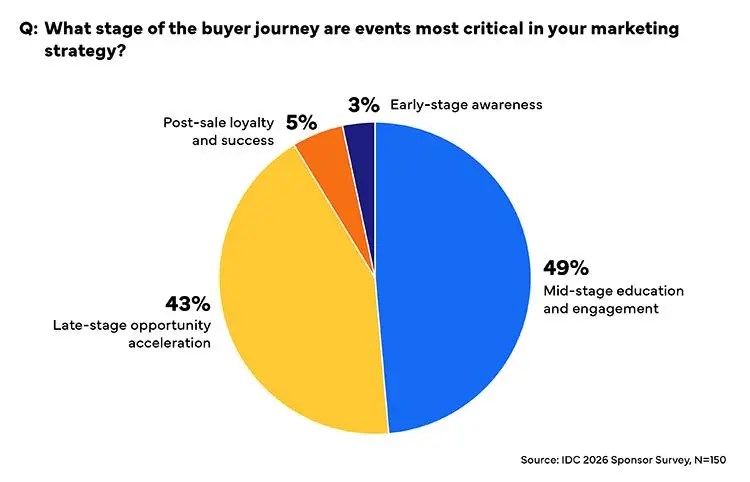
According to IDC’s 2026 Sponsor Survey of 150 senior marketers across the US, UK, Germany, and Singapore:

  • 67% rank brand awareness as a top priority
  • 53% are focused on generating qualified leads
  • 90%+ say events deliver the most value in mid-to-late funnel stages

Hybrid takes the lead and the budget

The format matters, and hybrid is winning.

When asked which formats they’ll prioritize in 2026:

  • 57% of marketers chose hybrid events as their top format
  • 58% expect their event budgets to increate next year

This reflects a push for flexible, scalable, and inclusive experiences that can drive personalized engagement at scale.

What performance looks like in 2026

To prove impact, marketers are aligning event ROI with funnel-specific metrics:

Top success metrics:

  • Cost per opportunity (67%)
  • Lead quality and conversion (60%)
  • Deal influence in key accounts (43%)

Top challenges:

  • Complex execution (52%)
  • Delivering personalized experiences (42%)

Marketers aren’t just seeking impact, they need proof they can show upstream.

What marketers value most in event partnerships

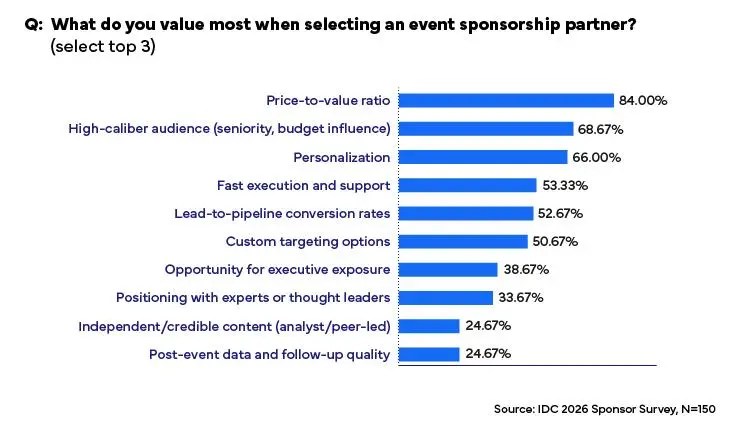
Marketers aren’t just choosing events; they’re choosing strategic ecosystems. The IDC survey reveals a strong alignment between what drives investment and what defines a valuable partner.

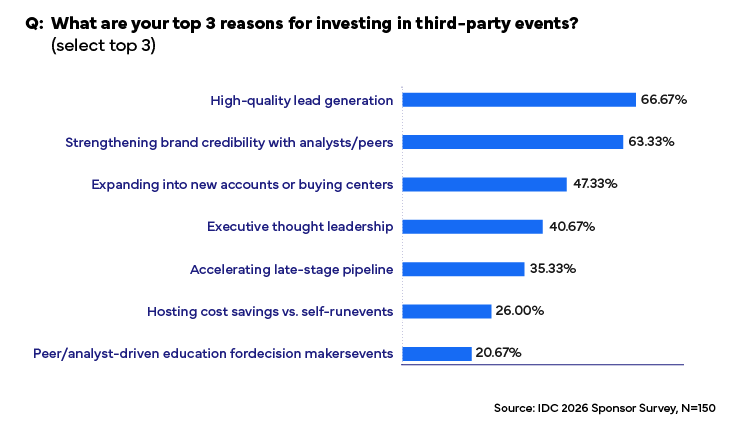
What drives investment in third-party events:

  • High-quality lead generation (67%)
  • Credibility through association with analysts or peers (63%)
  • Expansion into new accounts or buying centers (47%)

These motivators point to one thing: marketers want more than visibility; they want validation and velocity. Events must open doors, fast-track trust, and spark meaningful conversations.

What defines the right partner:

  • Price-to-value ratio (84%)
  • High-caliber audience (seniority, budget influence) (69%)
  • Personalization (66%)
  • Fast execution and support (54%)
  • Lead-to-pipeline conversion performance (53%)
  • Custom targeting options (51%)

Insight-led content is the difference maker

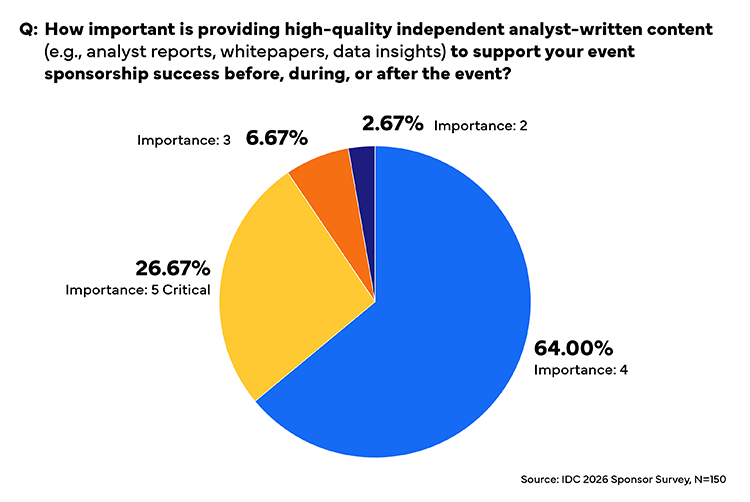
The success of an event hinges on relevance. That’s why marketers are doubling down on partners who bring audience precision and analyst-backed content.

  • 91% say independent, analyst-led content is critical to event success
  • Trusted insight builds trust across every stage of engagement before, during, and after the event

Key takeaway: Price-to-value, audience quality, and credible content are top criteria when selecting event partners.

Navigate your 2026 strategy with confidence

Events are no longer standalone experiences, they’re central pillars in a broader B2B growth strategy. When backed by trusted tech intelligence, the right formats, and analyst-led content, events can help your team hit every metric that matters.

Whether you’re optimizing your event calendar or rethinking your demand strategy, IDC’s insights are here to guide your next move.

🗓️ Explore the IDC 2026 Events Calendar
Discover the best opportunities to connect with your audience with data, formats, and partnerships that work.

Jyoti Lalchandani - Group Vice President & Regional Managing Director (META) - IDC

Jyoti Lalchandani is a seasoned business executive with more than 25 years of experience in emerging markets across Europe, the Middle East, and Africa (EMEA). In his role as IDC's Group Vice President and Regional Managing Director for the Middle East, Turkey, and Africa (META), he has been instrumental in establishing IDC’s presence in the region – first, through the initial expansion of the Dubai headquarters and then by spearheading the development of IDC offices in Johannesburg, Istanbul, Riyadh, Casablanca, Lagos, Nairobi, and Cairo.

In today’s crowded tech market, features don’t sell. Value does. And yet, far too many sales teams are still stuck pushing product specs while their competitors walk away with the contracts. 

The truth? If your team can’t lead with business value, you’re already behind. 

High-performance sales teams are not created by chance. It’s not about having the loudest pitch or the biggest pipeline. It’s about building teams that can step into the boardroom as trusted advisors. Teams who can link your technology to measurable outcomes that your clients can’t ignore. 

And here’s the catch: most organisations think they’re doing this. Almost none are. 

What Does “Business Value” Really Mean in Sales? 

So, what does it really take to transform a standard sales team into a high-performing one? One that consistently sells business value as an outcome? 

In today’s technology landscape, having an innovative product is just the starting point. What truly sets successful tech vendors apart is their ability to demonstrate clear, measurable business value and return on investment (ROI) to their customers. 

To get there, marketing, sales, and sales enablement leadership must work together to build strong messaging, market insights, and client success stories that can be leveraged in customer interactions. Leading the discussion on what the company can do for the customer and then quantifying the value of that partnership, builds trust and sets a high-performance benchmark. 

How to Equip Sales Teams to Lead with Value 

Not all enterprises can align every salesperson to a consistent value message for each product or service. Salespeople bring a range of individual styles into their relationships, but what unites them is the focus on building trust and instilling confidence in their solutions.  

Despite this need, many organisations lack the experience to develop value-based messaging, collateral, and enablement programs that bring this confidence to life. Creating alignment across teams requires structure, expertise, and the right insights. 

How IDC Helps Sales Teams Sell on Business Value 

At IDC, we work with technology vendors worldwide to strengthen their ability to sell based on business value and tangible outcomes. Our analysts and consultants deliver market insights, benchmarks, and customer validation that empower marketing, sales, and enablement leaders to align around proven value delivery. 

Through tailored sales enablement workshops, value-based messaging frameworks, and analyst-led collateral, IDC equips teams to engage customers with confidence and demonstrate measurable ROI. Get in touch to learn more. 


Nathan Budd - Senior Director, Custom Solutions - IDC

Nathan Budd is a consulting director, working across strategic, market intelligence and go-to-market solutions. With experience across a spectrum of ICT projects and clients, he delivers a breadth of knowledge and insight to the IDC European consulting team. Over the years, Nathan has worked with CEOs, industry forums, executives and sales teams, to define market strategy, positioning and sources of revenue growth. He is an experienced speaker, project lead and facilitator, bringing energy and perspective, while maintaining the connect between strategic-level thinking and grass-roots action.

A market that demands its own perspective

IDC today published the European Contact Center-as-a-Service (CCaaS) MarketScape, recognizing that Europe’s contact center landscape is shaped by unique regional dynamics, stringent regulatory frameworks, and a more measured approach to adopting new technologies. These characteristics make it essential to evaluate Europe as a distinct market rather than as an extension of global models. Success in this region depends on understanding trust, compliance, and local engagement at a much deeper level.

A market defined by diversity and regulation

The European CCaaS market is expanding rapidly, projected to grow from US$1.5 billion in 2024 to US$3.7 billion by 2029. Yet, it remains highly diverse and fragmented. Differences in regulation, business culture, and language shape how contact centers operate and adopt technology. For example, priorities such as pricing, professional services, and data residency vary widely across key markets, underscoring the importance of regional insight and tailored strategies over a one-size-fits-all approach.

Why a European MarketScape matters

The IDC European CCaaS MarketScape provides an in-depth assessment of how vendors address this diversity. It evaluates how effectively they align their strategies and offerings with Europe’s regulatory, cultural, and operational realities.

It also considers how vendors demonstrate thought leadership — not by simply leading with innovation, but by helping contact centers modernize responsibly. This includes educating customers on the value of digital transformation, offering support to overcome adoption barriers, and using partnerships to bridge linguistic and cultural gaps while building trust.

By capturing these nuances, the IDC European CCaaS MarketScape delivers a region-specific perspective that reflects the complexity, diversity, and maturity of Europe’s contact center ecosystem — and highlights the industry’s steady evolution toward AI-driven, compliant, and customer-centric operations.

IDC MarketScape: European Contact Center-as-a-Service Applications Software 2025 Vendor Assessment is available now.

If you have a question about anything, please fill in this form.

Oru Mohiuddin - Research Director - IDC

Oru Mohiuddin is a Research Director in the European Enterprise Communications and Collaboration team. Based in London, she is responsible for IDC’s coverage of Unified Communications and Collaboration in the region. Her work focuses on tracking the markets for premise-based and cloud solutions and new developments and trends, particularly in the light of changing work patterns impacting the traditional mode of enterprise communication. Prior to joining IDC, Oru worked for Euromonitor International, where she focused on Future of Work and technology in the SMB context. She also worked in New York and Bangladesh and speaks English and Bengali. Oru was awarded Chevening Scholarship by the British Foreign and Commonwealth Office to pursue her MSc in International Development from the University of Birmingham. In addition, Oru has a BA from Marymount Manhattan College in New York.